


A new principle could make battery management systems in electric cars or home storage more cost-effective and safer in the future. German researchers have developed a talking battery that is supposed to transmit its state from within.
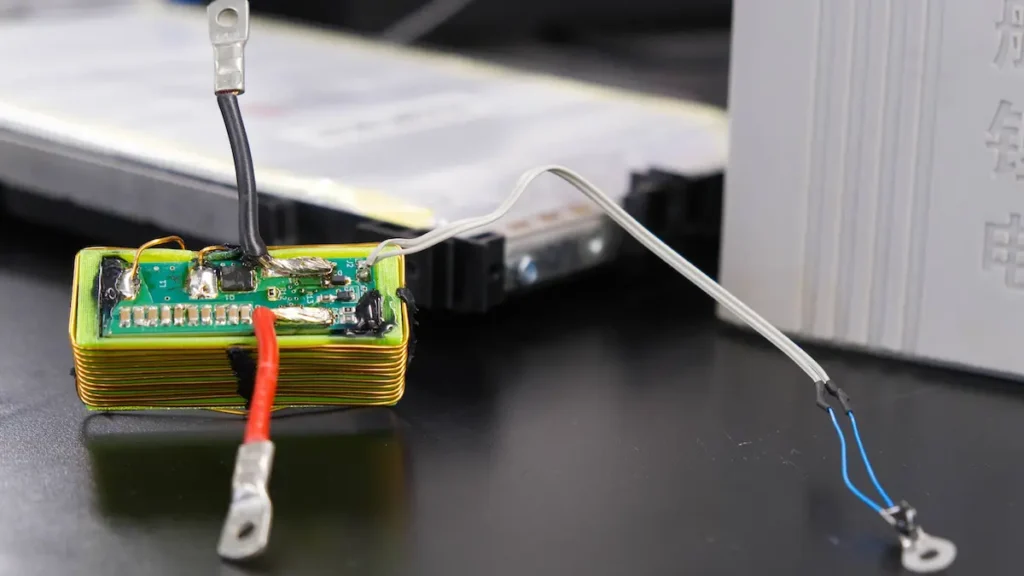
To date, sensors have usually only measured the temperature of battery cells on the outside, although heat often first arises on the inside. However, a research team at the Christian Albrechts University in Kiel at the Chair of Power Electronics recently presented a new development. First author Johannes Diers and Doctor Hamzeh Beiranvand used existing power connections to send digital signals directly from inside the cell to the outside.
To date, manufacturers have primarily only measured the temperature of batteries on the outer shell. However, dangerous heat often first arises inside a battery and initially goes unnoticed there. In the new process, a tiny electronic circuit converts the measured values and uses the regular charging lines as a communication channel. This means that the system does not require any additional data cables and saves valuable space.
How talking batteries save costs and installation space
The dual use of existing components could help make the communication system more cost-effective than traditional sensor solutions. According to an initial cost estimate, the Kiel team speaks of a saving of around 35 percent.
Theoretically, the principle works not only with temperature sensors, but also with pressure, gas or other sensors. These could transmit information in the same way. Hamzeh Beiranvand classifies the development as follows:
Our work is a first step towards smart batteries that continuously monitor and report their condition. This would make battery systems safer and more economical.
Potential benefits and long-term benefits of the technology
Since the sensors directly record processes inside the cell, the process could help make battery systems safer in the long term. At the same time, the approach could help reduce the costs of such systems in applications such as electric cars or home storage.
The team believes that the circuit could be made even smaller in the future or even integrated directly into new battery materials. It should be possible to use it in electric cars, wind and solar energy and even home storage systems.
Also interesting: