


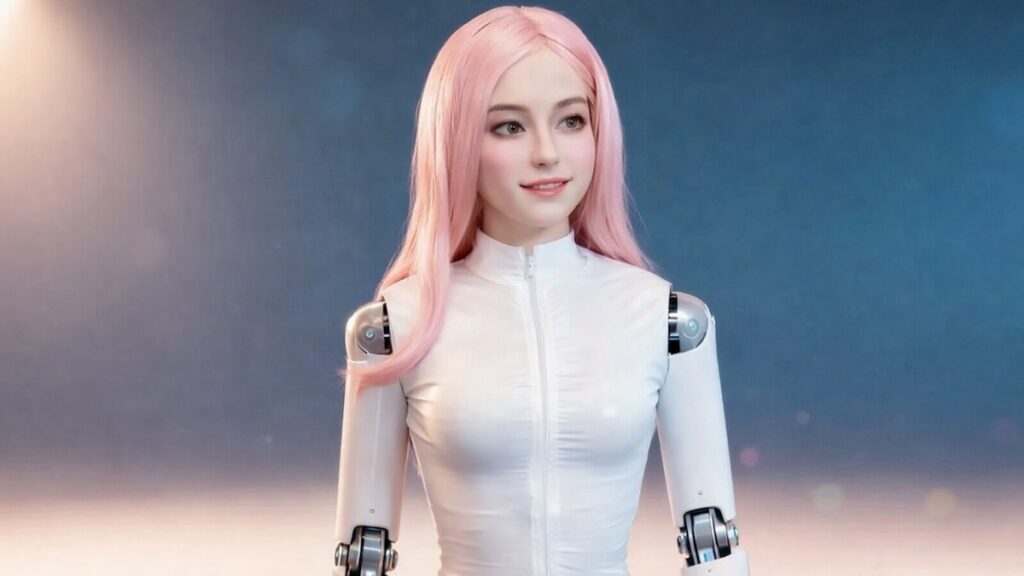
The Chinese company DroidUp has developed a humanoid robot designed for human-like interaction in the care sector. Moya is intended to further blur the boundaries between humans and machines with realistic movements, silicone skin and an artificial body temperature. A commentary analysis.
Care robot Moya in detail
- Moya was developed by the Chinese company DroidUp in Shanghai. The humanoid robot is 165 centimeters tall and weighs around 31 kilograms. In contrast to other care robots, Moya is not intended to lift loads, but rather to have conversations with those in need of care.
- According to DroidUp, Moya mimics human warmth by creating a Silicone skin constantly tempered at 32 to 36 degrees Celsius becomes. There are layers of cushioning under the skin that are intended to mimic tissue. The humanoid robot has feminine features such as an imitation ribcage and even a rib structure.
- The care robot has various features Customization options. Care facilities can, for example, swap out parts to give it either a male or female appearance. According to DroidUp, Moya’s movements are 92 percent human-like. A camera allows the robot to scan its surroundings. The market launch is planned for the end of 2026. The expected price: $173,000.
When innovation fails due to reality
DroidUp’s promises are as warm yet as thin as Moya’s silicone skin. However, beneath the surface there is a classic Tech dilemma. Because with a starting price of around 145,000 euros, the humanoid is not a nursing assistant, but a luxury object.
Specifically, this means: Even if Moya could prove an actual benefit in practice, the humanoid robot would hardly be affordable for care facilities where it could actually be used. In short: The technical innovation fails due to economic reality.
But the technology itself also gives rise to skepticism. Because: The advertised 92 percent human-like movements turn out to be classic upon closer inspection Marketing nonsense. Videos reveal stiff and cautious motor skills that are far from natural body language.
But Embodied AI requires a finely tuned interaction between mechanics, sensors and software. This is exactly where Moya still seems unfinished. In addition, DroidUp sells bionics as a solution to a social problem. But Technology cannot replace human carebut at most supplement it. Because: Care requires trust, not just temperature.
Voices
- DroidUp founder Li Qingdu in an interview: “Most robots on the market today have a hard shell and feel cold and mechanical. A robot that truly serves humans should be warm and have a temperature almost like that of a living thing that humans can connect with.”
- Nurse, educational scientist and author Björn Kiehne to the AOK: “Patients react well to being addressed by care robots. I see a great opportunity in the development of human-like care robots. What is the difference between the resonance that an animal or nature triggers in us and that generated by a machine? We are always in conversation with the inanimate and non-human world.”
- It’s in a nursing forum on Reddit general tenor among nursing staff relatively clear. One user said: “All I want is support for lifting, my back hurts. Give me a robot with a face and AI function. I just don’t want to put patients who weigh twice as much as me from a wheelchair to bed alone.”
Basic acceptance of care robots
If Moya hits the market at the end of 2026, it will probably end up where Bbudgets are greater than the actual care needs. The target group is likely to be primarily private clinics and research centers. The robot will only play a minor role in everyday care.
If you want to relieve the burden on care, you have to think about costs and scaling – and not just fill a showroom. Meanwhile, DroidUp is relying on a strategy that aims at acceptance through humanity. However, initial reactions show that the initial fascination quickly fades tip over into discomfort can.
The almost human body of Moya polarizes namely stronger than cold machine arms. However, the question is not what is technically possible, but what is really needed in everyday life. Moya could still be a harbinger of affordable social robots.
A current study from Japan reveals at least a basic level of acceptance among nursing staff and those in need of care – provided the robots are safe. Whether this requires a warm silicone handshake is extremely questionable.
Also interesting:


🤝 25 euros for free!
Open yours now free NIBC daily money and receive up to 2.75 percent interest on your money! And on top of that there is even more 25 euros free!
Secure interest now
Requirements apply, advertisement