


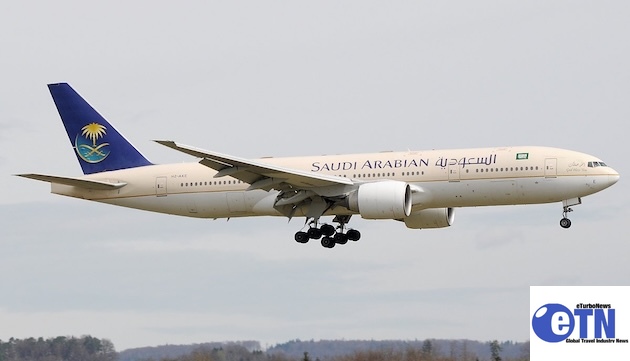
Ex-Saudia Boeing 777s reportedly entering Iran highlight how Gulf détente, US sanctions, and shifting Middle East priorities are reshaping aviation politics.
Iran’s reported acquisition of at least five retired Boeing 777-200ER aircraft formerly operated by Saudi Arabian Airlines is more than an aviation story. It is a test case for how sanctions, secondary markets and shifting Middle East priorities now intersect.
Aviation-tracking reports say several ex-Saudia Boeing 777s have moved into Iran or are in the delivery pipeline, with at least two reportedly at Tehran’s Mehrabad Airport for renovation. The reported Iranian operator is Mahan Air, a carrier under US sanctions since 2011. Available reporting does not prove a direct Saudi-Iranian government or airline-to-airline sale; instead, it points to indirect transfers through intermediaries and secondary-market channels.
The symbolism is striking. Saudi Arabia and Iran restored diplomatic relations in 2023 after a China-brokered agreement, ending years of formal rupture that had formed conflicts from Yemen to Syria. (Reuters) The arrival of former Saudi widebody jets in Iran now lands in a region where US influence, Chinese mediation and Gulf risk-management are all being recalibrated.
For Tehran, the aircraft offer badly needed long-haul capacity after decades of restricted access to Western aircraft and spare parts. Iran briefly reopened the door to Western manufacturers after the 2015 nuclear deal: IranAir ordered 100 Airbus aircraft and 80 Boeing jets, but the US withdrawal from the JCPOA and the reimposition of sanctions in 2018 effectively collapsed those plans.
For Washington, the episode highlights the limits of aviation sanctions. US Treasury designated Mahan Air in 2011 for alleged support to the IRGC-Qods Force, and OFAC has warned the aviation industry that Iranian procurement networks use deceptive schemes and third-party intermediaries to obtain aircraft, parts and services.

Iran Reopens Tehran Airport: Is Middle East Aviation Returning to Normal?
Iran resumes commercial flights from Tehran amid a fragile ceasefire, while Tel Aviv, Dubai, Abu Dhabi, and Doha maintain varied aviation stability. Is this a sign of normalization in regional airspace?
The aircraft transfer also complicates the political narrative. If framed as a Saudi-Iran commercial breakthrough, the story overstates the evidence. But if viewed as a sanctions-era aviation maneuver made possible by looser regional channels and Gulf détente, it becomes a revealing signal: Middle Eastern actors are increasingly managing relations with Iran through hedging, not isolation.
Saudi Arabia, meanwhile, is investing heavily in aviation expansion of its own. In 2023, Saudia and Riyadh Air ordered up to 121 Boeing 787s, a deal promoted as part of the kingdom’s plan to become a global aviation hub.
Retiring older 777s fits that modernization strategy. Their reported onward movement to Iran shows how retired assets can acquire new geopolitical significance once they enter opaque resale networks.
The deal’s biggest consequence may be reputational rather than operational. Five older 777s will not transform Iran’s aviation sector overnight. But their in Iran demonstrates that embargoes can slow access, raise costs and increase risk—without fully stopping acquisition. In today’s Middle East, where Saudi Arabia, Iran, China and the United States are all adjusting their priorities, even second-hand aircraft can become strategic signals.