


AI has everyone buzzing. And if the energy at Connect:AI proved anything, it’s that the AI era is moving faster than a New York minute.
Every hyperscaler, frontier model, data lake, and app has transformed into an AI platform. And the momentum isn’t going to stop. But cracks are starting to form for some teams, and we need better answers before the system grinds to a halt. But before you can manage it, you need to see it.
That’s where the MuleSoft vision comes in: giving you total enterprise visibility over what’s actually out there so you can secure your perimeter, monitor AI token spend management, and keep teams innovating.
The sessions, demos, and real-world customer use cases at Connect:AI laid out a definitive blueprint for navigating this transition, proving that the integration tools organizations already trust can be seamlessly evolved into an enterprise agent control plane.
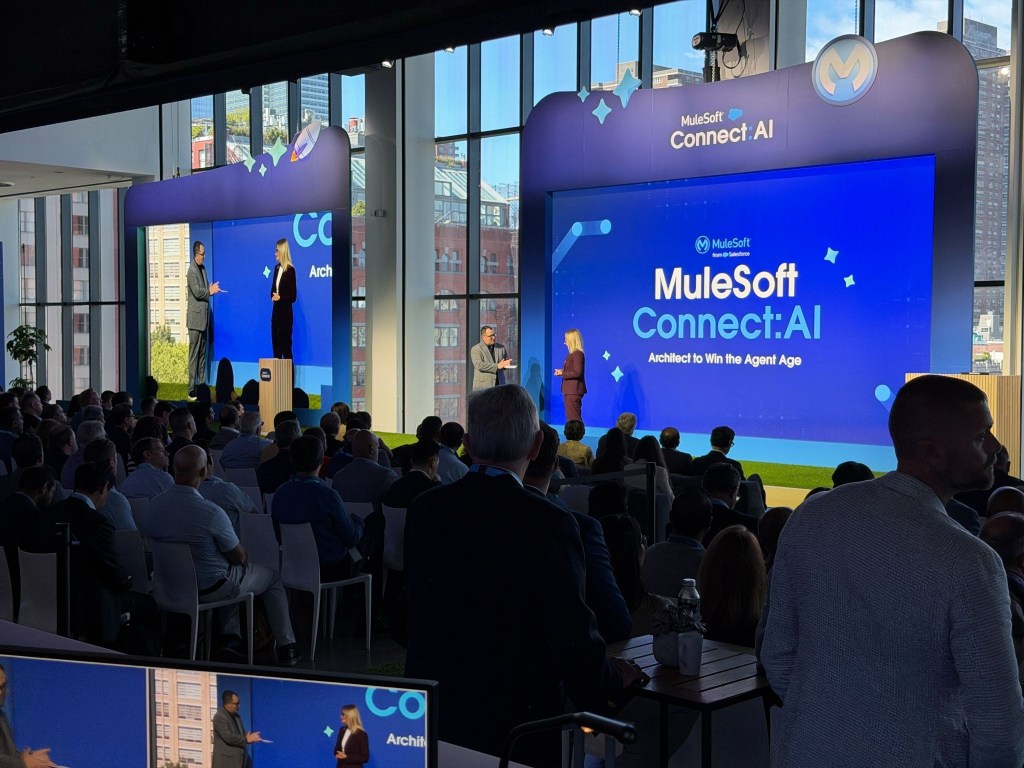
Architect to win the agent age: How to deploy, cost-control, and govern AI at scale
Organizations have aggressively moved past experimental pilots and are actively racing AI agents into production. However, as this deployment accelerates, a critical realization has emerged: Agents aren’t just another piece of traditional software.
- Software follows orders; agents make decisions
- Software fails predictably; agents can repeat a task flawlessly 99 times and pivot entirely on the 100th
- Software scales through replication; agents scale through learning
This inherent autonomy means agents demand immaculate data, deeper context, and custom guardrails. Without them, organizations quickly run into massive operational friction: fragmented architectural complexity, skyrocketing token expenses, and legacy governance that simply can’t match developer velocity.
Agent Fabric solves for this as the enterprise agent management platform engineered to act as the centralized registry, cost control center, and safety roll bar for the agentic era.


Accelerating AI experiences via seamless connectivity and coordination
Building a standalone agent is no longer the primary hurdle. The friction now lies in the shadow plumbing – the extensive connectivity work required to anchor an agent into complex enterprise ecosystems. When agents fail in production, the model itself is rarely to blame; the culprit is usually architectural design. A single agent attempting to manage end-to-end business processes inevitably degrades at scale. To combat this, MuleSoft introduced two core architectural advancements within the enhanced Agent Fabric UI: instant connectivity with MCP Bridge, and guarded orchestration via Agent Broker and Agent Script.
1. Instant connectivity with MCP Bridge
Agents fundamentally prefer the Model Context Protocol (MCP) to interact with data sources. Instead of forcing engineering teams to waste weeks rebuilding existing integrations, the new MCP Bridge converts traditional API endpoints into agent-ready MCP servers with just a few clicks. This allows organizations to leverage their established API portfolios instantly. Furthermore, the upcoming A2A (Agent-to-Agent) Bridge will extend this philosophy to click-not-code agent interoperability protocol.
2. Guarded orchestration via Agent Broker and Agent Script
To manage complex workflow, such as an IT Help Desk triaging low-severity password resets versus high-severity unauthorized access alerts, organizations require intelligent dispatching. Agent Broker acts as this centralized dispatcher, routing incoming natural language requests to specialized sub-agents. By leveraging Agent Script (Salesforce’s open-source scripting language), developers can inject built-in determinism into workflows. This ensures that critical compliance or security paths are executed with zero room for model deviation, combining rigid business logic with flexible agentic reasoning.
Optimizing and controlling runaway AI costs
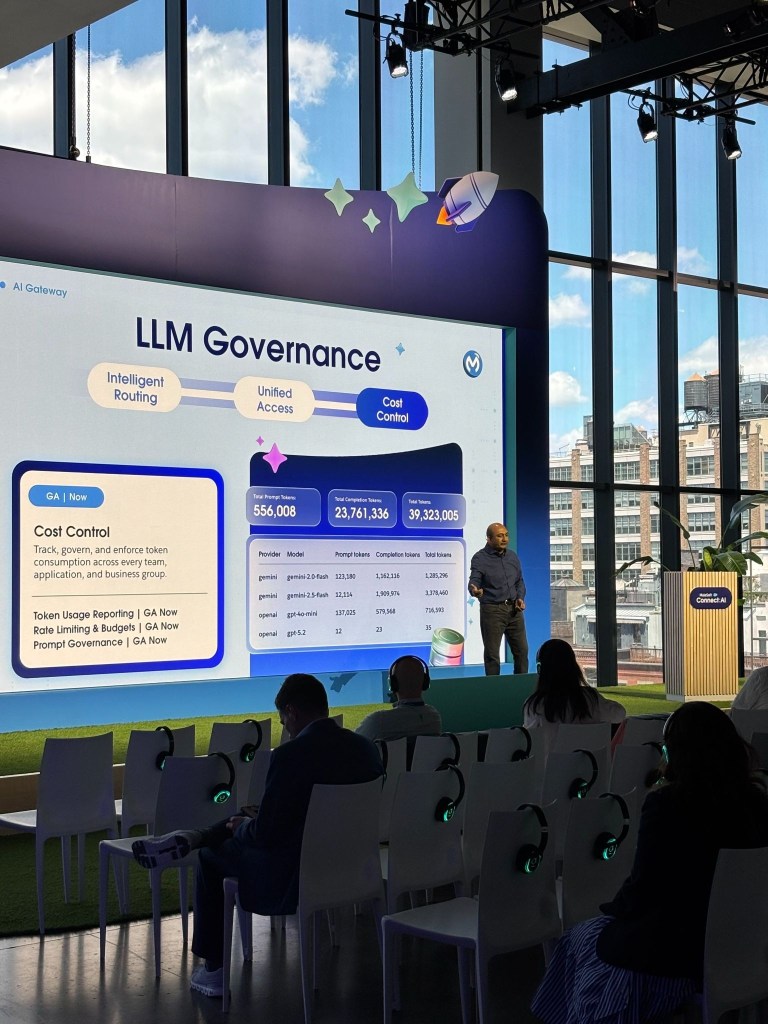
As agent usage spikes, FinOps and IT leaders are experiencing severe cloud cost déjà vu. Token consumption can scale exponentially overnight, throwing off monthly budgets and impacting profit margins. Through Omni Gateway, the evolved governance layer of Flex Gateway that supports APIs, agents, MCP servers, and LLMs, enterprises now have a dedicated FinOps toolkit to maintain predictability.
| Cost Optimization feature | Operational function |
|---|---|
| Client Keys | Functions like a prepaid debit card for LLMs, enforcing hard caps and spending limits for specific teams, applications, or user roles |
| Semantic Routing | Acts as an intelligent traffic cop, evaluating prompt severity to route routine requests to cheaper, lightweight models (e.g. Gemini Lite) while reserving premium models (e.g. OpenAI) for complex edge cases |
| MCP Optimization policies | Automatically analyzes and rewrites verbose vendor tool descriptions and payloads into concise formats, driving immediate reductions (often up to 30%) in token overhead |
Through unified Cost Management dashboards, financial and technical leads gain a bird’s-eye view of precise token usage across the entire infrastructure, stopping billing surprises before invoices arrive.
Universal governance: Identity, federation, and the Agent Kill Switch
True scale is impossible without security. In the past, compliance validated how human developers built, upgraded, and patched software. Now that operations are agentic, human fallibility has been introduced directly to computer reasoning via hallucinations and data access risks. MuleSoft’s approach to holistic AI governance centers on three pillars:
- Trusted Agent Identity: Agents must operate on behalf of a specific user. An agent responding to an intern must inherently inherit different data boundaries and system access rights than an agent executing tasks for the CFO
- Gateway Federation and Universal Policy: Modern enterprise architectures are highly fragmented, with services running across multiple third-party environments like Kong, AWS, or Azure. Gateway Federation provides a single plane of glass to discover and manage these assets without moving them, applying Universal Policies (such as PII detection or access control lists) uniformly across the entire hybrid infrastructure
- Agent Kill Switch: Giving agents autonomy makes them valuable, but retaining the centralized authority to instantly shut down a malfunctioning or looping agent makes them safe

Real use cases: Customer panel and spotlight on Capita
Getting a preview of what’s to come is great, but being able to get real world use cases from customers really brings it all to life.
We had an opportunity to hear from Tiina Stephens, Director of AI Engineering at Capita, who shared how the UK-based Business Process Outsourcing (BPO) enterprise tackled their fragmented integration environment challenges. In trying to scale their agentic adoption, they faced issues with governing and reusing all of the AI in use across the business. With Agent Fabric, Capita can now manage over 400 agents as a single governance layer, across Agentforce, Azure, and AWS – eliminating shadow AI.
“We wanted one unified view of every AI agent across the organization, and we wanted every employee to be able to build. MuleSoft gave us the governance framework to do both, enabling us to scale AI adoption across every layer of the business without compromising control or innovation.”
– Tiina Stephens, Director of AI Engineering, Capita
We also heard from more customers, bringing the MuleSoft roadmap and vision into concrete enterprise execution with our slate of distinguished IT leaders. Joining the panel were Jeff Gautney, SVP, CIO at Rush University System for Health, Awinash Sinha, CDIO at Zoom, and Filippo Cassano, Head of Digital Enterprise Architecture, Infrastructure & Operations at Ferrari.
As industry leaders, Rush University Health System, Zoom, and Ferrari are proving that successful agentic AI adoption requires fundamentally reimagining business architecture rather than just deploying new tools. By prioritizing scalable infrastructure, these organizations are balancing rapid innovation with long-term stability and ROI.
Jeff Gautney from Rush noted that embracing modern development methods is critical: “Vibe coding with MuleSoft has really enabled us to move AI from the back to the front.” Filippo Casanova from Ferrari emphasized the importance of a reusable foundation: “We are building an integration layer where we are using reusable assets, reusable capabilities, reusable data, and we are trying to use them as building blocks of a new architecture.”
This strategic focus is already yielding significant results at Zoom, where their “super agent” has revolutionized customer support with a 32% savings in the department. By focusing on these standardized foundations and measurable outcomes, these industry leaders are successfully turning the promise of AI into tangible operational value.
With a total of 12 customers represented across our sessions and showcases, including brands like Adecco Group, Royal Bank of Canada, and Oxford Global Resources, it’s clear that MuleSoft is the best partner to drive agentic transformation.
Breakout highlights: Omni Gateway, Cost Management, and Headless MuleSoft
The afternoon sessions drilled deep into the runtime mechanics of AI governance, including the newly expanded MuleSoft Omni Gateway (the next evolution of Flex Gateway) and diving deeper into cost management with new tools like Custom Keys.
The conversations didn’t stop in the breakout rooms. Throughout the day, our Broadcast Studio brought together customers and partners to share how they’re putting enterprise AI into practice.
Leaders from Deloitte Digital, Ferrari, Oxford Global Resources, Capita, and Rush University discussed what it takes to move from AI pilots to production, from building agent-ready architectures and governing AI at scale to preparing organizations for the people and process changes that come with AI transformation.
While every organization is on a different journey, one theme remains consistent: lasting AI success starts with connected systems, trusted data, and governance built for scale.
Hands-on demos and 1:1 guided sessions
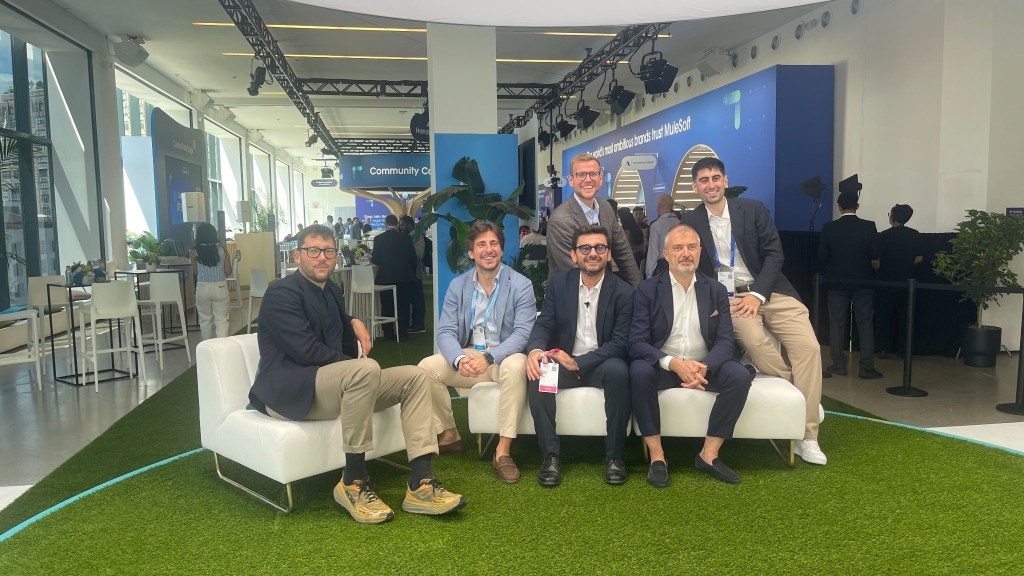
One of the highlights of Connect:AI is the benefit of multiple demos of our newest innovations. From Omni Gateway to Agent Fabric, four demo stations gave customers the chance to see our products in action, discussing their specific use case with our product and solutions team members.
In the case of Agent Fabric, attendees had the opportunity to book a guided session to test drive it, covering three scenarios: managing agent sprawl, bridging the gap between existing infrastructure and AI agents, and extending the control plane to manage your entire agent catalog.
Semantic Routing and Custom Keys
Omni Gateway is now the key to bringing absolute predictability to AI budgets. The gateway introduces Custom Keys, which function like prepaid credit cards for LLM usage. By assigning distinct, impassable spending limits to specific business teams or applications, we have granted leaders a means of enabling innovation without busting the budget. This logic perfectly mirrors our security system. Implementing these access controls establishes non-negotiable thresholds for computational expenses, giving control over what’s being spent.
Eradicating MCP Servers’ hidden tax
Because vendor-provided MCP servers often feature overly wordy tool descriptions and bloated payloads, they quietly burn through massive blocks of text before an agent even executes an action. Built to handle LLMs, agents, and MCP servers alongside traditional APIs, Omni Gateway directly answers the industry’s growing anxieties around runaway token costs and security vulnerabilities.
Applying Omni Gateway’s Tool Mapping Policy enables the system to automatically analyze and rewrite vendor tool definitions into the most concise format an agent can interpret, leading to an immediate 40% reduction in token consumption.
Headless MuleSoft: Bringing governance into the IDE
Modern developers and business units spend their time inside tools like Claude, Slack, Microsoft Teams, and IDEs like Cursor or Windsurf, and MuleSoft is actively tearing down the walls around where its control plane lives. Through natural language, administrators can manage enterprise infrastructure headlessly inside an AI workspace like Claude. In a live workflow demonstration, an IT Governance Lead prompted Claude to evaluate risks within an active support queue.
Behind the scenes, Claude checked credentials, scanned the Agent Registry, flagged a specific authentication error on a newly built help desk broker, and recommended applying a JWT Validation policy alongside a PII Detector to prevent sensitive data leakage – all executed and secured via a single conversational interface.
Industry expert panel: Governing a multi-agent enterprise
We listened to an exceptional thought leadership panel pulling together perspectives from industry leaders from Deloitte, The Futurum Group, and MuleSoft customer, Capita. They discussed contextualizing the market reality, noting that autonomous agent deployments are currently outpacing standard corporate governance structures.
Mitch Ashley, The Futurum Group, noted that MuleSoft is uniquely positioned to lead this transition because its AI control plane builds directly upon a battle-tested, existing API management footprint. He emphasized that, for current customers, inheriting these advanced AI gateway and orchestration capabilities on top of their current investments provides an immediate consolidation advantage over deploying risky, standalone AI infrastructure.
A common theme Kurt Anderson from Deloitte sees when working with clients is feeling intimidated by growing their AI footprint. “It’s important to identify opportunities for quick wins and grow from there. You don’t have to go it alone.”
Tiina Stephens, Director of AI Engineering from Capita, then shifted the conversation from industry theory to practical execution. She shared how they utilize MuleSoft to bridge legacy business systems with autonomous workflows, proving repurposing APIs and other tools organizations already own can be gracefully evolved for the agentic era. As a result, Capita is successfully leveraging over 400 agents successfully to drive innovation and efficiency.
The day closed with our annual Partner Awards, highlighting the important work they do as strategic advisors to enable organizations globally with MuleSoft to become agentic enterprises. Congratulations to the winners:
- Global Partner of the Year: Deloitte Digital
- Innovation Excellence: Caelius Consulting
- Above and Beyond: Capgemini
We are so grateful for them as true partners, bringing their deep industry expertise to help our customers deploy complex, large-scale agentic transformations with MuleSoft.
Scale smarter, not harder
Accelerating your growth doesn’t mean tearing down what works – it means building the right guardrails. Organizations that scale the most efficiently are those that prioritize their underlying control plane.
Now, with MuleSoft’s industry-leading integration foundation, organizations are able to seamlessly bridge existing technology with the future of AI. Every API, every system, and every integration you’ve already deployed instantly becomes the bedrock of your agent infrastructure. You don’t need to rebuild from scratch – you simply unlock the true potential of the investments you’ve already made.
Whether you’re just beginning to explore autonomous agents or are already managing an extensive network of them, the path forward comes down to a trusted foundation – purposefully evolved for the future of AI. To learn more, join us on Tuesday, July 21, 2026 at 8 a.m. PT to watch our LinkedIn Live and uncover all the insights from Connect:AI.