“Everything is possible”: How two friends used AI to build a delivery startup in a short time

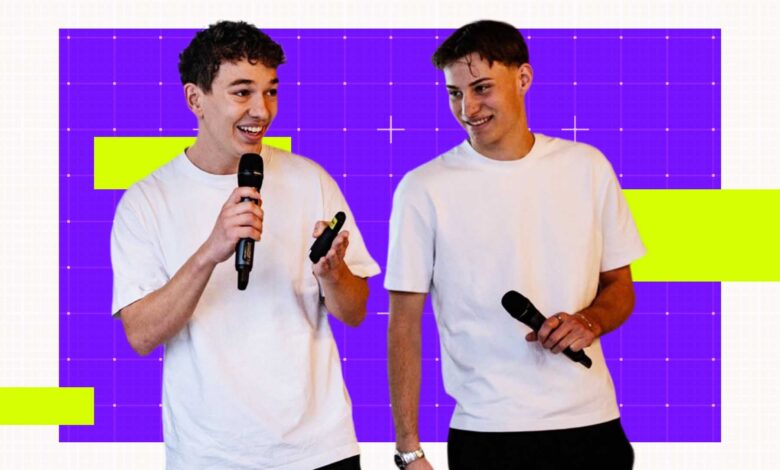
From selling eggs to owning your own software startup: two founders show how an agritech company emerges from a school challenge.

It all started with an unusual challenge during school, report the founders Jonas Nolte and Lenn Hoffmann. They regularly set small tasks for each other to challenge each other.
So Hoffmann should go out of his comfort zone and sell the eggs from his neighbors’ chicken garden in the area. At the same time, Nolte was given the challenge of teaching himself to program. “He got rid of all the eggs. And from this week onwards there hasn’t been a week in which we didn’t sell any eggs,” says Nolte in an interview. These tasks later became the basis for the two friends’ first joint venture.
Read too

This school project gradually developed into a regional delivery service. Under the name “Bauer-lieferant” the two began delivering food from local farms directly to customers. Over time, they expanded their system and developed their own software to organize orders, routes and warehouse processes.
Today they are also working on software for the digitalization of agricultural businesses. The goal is to automate processes and give farmers more time to do their actual work, they say.
The first contact with “Vibe Coding”
At the same time, the founders have started working with a new development approach that is increasingly being discussed in the tech scene: we are talking about “Vibe Coding”. This refers to an approach in which software is no longer exclusively programmed line by line in the traditional way, but rather is created more through trial and error, feedback and quick adjustments with AI support.
Read too

Nolte describes that he originally learned programming without these options, but only through YouTube tutorials. Getting started was correspondingly difficult. “I didn’t have anyone to explain it to me. I really just had YouTube tutorials,” he says. Even later, the learning process was very time-consuming. “It took me a week just to get the development environment up and running.” And mistakes also took a long time: “It sometimes took me three months to figure out any bugs.”
Nevertheless, he continued and learned “that every bug and every feature can be solved if you just stick with it.” The turning point was later a hackathon. There he used AI-supported development for the first time. “That was my first aha moment,” he says. “I then coded all night long. And had my first wow-vibe coding effect.”
Build faster, think differently
The use of AI has primarily changed the speed of development. According to Nolte, many software tasks can now be implemented much more quickly than before: “You can develop software incredibly quickly.” The way of thinking has also shifted. Instead of severely limiting individual features, today it is more about designing ideal systems and testing them quickly. “In the past, you had to carefully consider which feature was really necessary. Today you can think more about: What would the perfect system look like?”
Nolte says he first develops a version and then shows it to his co-founder. “It’s often the case that I just create something and then show it to Lenn. He then often criticizes it and we rebuild it until it fits.” According to the founder, user feedback also plays a central role: “We try to take all the feedback we can get.”
Read too

For development, the founders used several AI tools, including “Claude Code, Superpowers, Antigravity, CMUX and Wispr Flow.” Structured prompting is important when working with AI. They used frameworks such as GSD or Superpowers to formulate clearly structured tasks. In principle, however, a problem itself must first be understood before it is automated. AI is primarily used to generate Claude Code.
Limitations of Vibe Coding
Nolte currently sees one of the biggest challenges in the testing process. AI can create software, but it is not yet good enough at creating complex systems to be fully tested and secured. This means there is a risk that errors will enter the entire system unnoticed.
“Everything is possible these days”
For Nolte, one thing above all has changed through Vibe Coding, and that is the assessment of what is possible. “Everything is possible these days,” he says. His advice is correspondingly pragmatic: “I would really recommend that everyone just give it a try and build their own website. If you sit down for two hours and implement a crazy idea, you’ll get a really good feel for what’s possible.”