


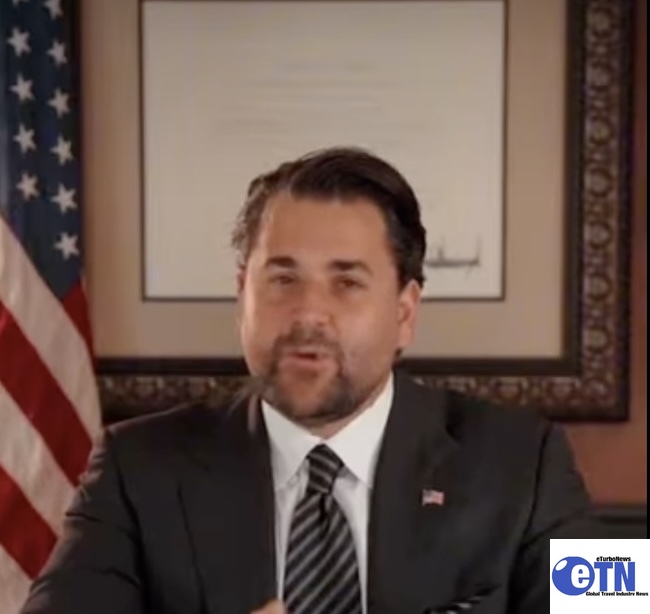
As international arrivals from Europe continue to decline, the United States faces growing economic and reputational challenges. The Trump administration’s appointment of MAGA commentator Nick Adams to promote America abroad raises questions about whether a polarizing political figure can help restore confidence among international travelers.
The United States is facing a troubling paradox. While global tourism is booming and international travel spending continues to rise worldwide, America is moving in the opposite direction.
International arrivals to the United States fell approximately 6% in 2025, with visitors from Europe among the most significant declines. Industry analysts report that bookings from Europe to the United States fell sharply, while travel spending by foreign visitors also weakened. The trend has continued into 2026, raising concerns throughout the hospitality, airline, convention, and retail sectors.


Nick Adams – United States Department of State
Nick Adams is a political and policy author, thought leader and educator. In 2020, President Trump appointed him to the Board of Trustees of the Woodrow Wilson Center in the Smithsonian Institution for a six-year term. Mr. Adams is currently Executive Director of the Texas and Florida-based Foundation for Liberty and American Greatness (FLAG), a […]
Against this backdrop, the Trump administration has made an unconventional choice: appointing Nick Adams, an outspoken MAGA commentator, self-described “alpha male,” and men’s rights advocate, as a special ambassador tasked with helping restore America’s image and attract foreign visitors.
The appointment has generated immediate controversy.
Adams is celebrated by many within the Trump movement for his unapologetic embrace of conservative values and his vocal defense of “American exceptionalism.” Critics, however, argue that he embodies precisely the cultural and political image that is discouraging many international travelers from choosing the United States in the first place.
The stakes are high.
Tourism is not simply a leisure industry. International visitors are among America’s most valuable export customers. The US Travel Association estimates that every 1% decline in international visitor spending translates into roughly $1.8 billion in lost export revenue. A sustained downturn threatens jobs across hotels, restaurants, attractions, airlines, convention centers, and small businesses that depend on overseas visitors.
Industry leaders increasingly warn that America is losing market share not because travelers have stopped traveling, but because they are choosing other destinations. While Europe, Asia, and parts of Africa continue to benefit from growing international demand, the United States is struggling with perceptions of higher costs, visa hurdles, stricter border controls, and a less welcoming environment.
The damage extends beyond economics.
Tourism has long been one of America’s most effective forms of soft power. Millions of visitors return home carrying impressions of the country’s culture, openness, innovation, and people. When fewer visitors come, those opportunities diminish. At a time when geopolitical competition is intensifying, international perception matters more than ever.
Recent surveys and industry reports suggest that political polarization, immigration crackdowns, tougher entry procedures, and negative media coverage have all contributed to a decline in America’s attractiveness as a destination. Some travel executives report that travelers increasingly view Canada, Europe, Asia, and Africa as more welcoming alternatives.
This raises a fundamental question about the administration’s strategy.
Can someone whose public persona is built around partisan politics successfully market the United States to skeptical international audiences?
Supporters argue that Adams is exactly the kind of unapologetic patriot needed to defend America’s reputation and promote major upcoming events such as the FIFA World Cup and the 2028 Olympic Games. They contend that confidence, not apology, is the path to restoring international interest.
Critics see the opposite. They argue that rebuilding tourism requires reducing friction at the border, improving visa processing, lowering costs, and projecting an image of openness. In their view, appointing a highly polarizing political figure risks reinforcing the very perceptions that are contributing to the decline.
The challenge confronting Adams is therefore much larger than marketing.
He is being asked to reverse an economic trend, repair international perceptions, and persuade millions of Europeans and other foreign travelers that America remains welcoming and accessible. Whether a prominent MAGA personality can achieve that goal—or whether his appointment becomes another symbol of America’s growing political divide—may help determine not only the future of US tourism, but also the country’s standing in the eyes of the world.
For now, the numbers suggest that winning back international travelers will require more than slogans.