


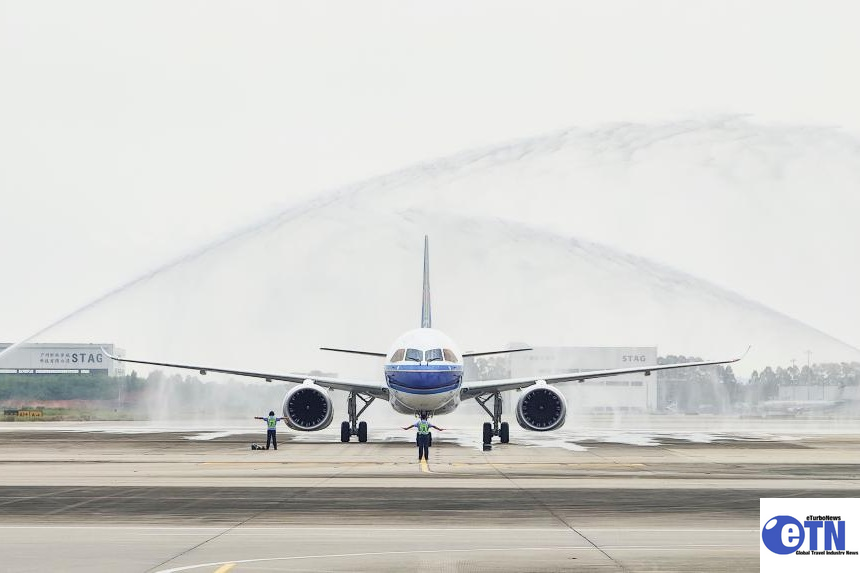
European airlines are rapidly restoring China routes despite longer and more expensive flight paths caused by Russian airspace closures. Strong travel demand, China’s visa policies and competitive pressure from Chinese carriers are driving the recovery, while North American airlines remain cautious amid weaker demand and continuing geopolitical tensions.
Beijing- European airlines are expanding flights to China this summer even as they remain locked out of Russian airspace, a restriction that has sharply increased flight times and operating costs since the Ukraine war began. The move reflects a surprising rebound in demand between China and Europe and a rapidly changing geopolitical aviation market.
According to aviation data firm OAG, direct China-Europe flight frequencies are expected to rise from about 3,011 flights in May to more than 4,150 in August 2026, significantly above last summer’s levels. European carriers, including Air France-KLM, British Airways, Lufthansa, Finnair, and Turkish Airlines, are all adding capacity despite the operational disadvantages.
Why airlines are adding China flights anyway
Several forces are driving the rebound.
1. China’s tourism demand is surging again
China has aggressively expanded visa-free entry policies for many European countries since 2023, helping restore both leisure and business travel demand. European travelers are returning to Chinese cities, while Chinese outbound tourism to Europe is also rebounding strongly.
Air France-KLM executives recently said demand from Chinese travelers to Paris and other European destinations remains robust despite broader economic tensions.
2. The Middle East conflict has disrupted Southeast Asia routes
The worsening security situation around Iran and parts of the Middle East has made some Europe–Southeast Asia corridors more difficult and costly to operate. Analysts say airlines are redirecting aircraft toward China routes, which remain commercially attractive even with Russian detours.
3. European airlines fear losing the China market permanently
Chinese carriers have gained a major structural advantage because they can still fly over Russia. This allows airlines like Air China, China Eastern Airlines and China Southern Airlines to operate shorter, cheaper and faster routes into Europe.
Industry estimates suggest Chinese airlines now control more than 80 percent of Europe-China capacity outside Russia-related traffic flows, up sharply from pre-pandemic levels.
European airlines appear increasingly willing to accept thinner profit margins simply to maintain market presence, airport slots, and corporate relationships in China.
The economics are painful
European airlines still face substantial disadvantages:
- Longer routes around Russian airspace
- Higher fuel burn
- Increased crew costs
- Reduced aircraft utilization
- Higher ticket prices
Jet fuel prices have also surged due to Middle East instability, worsening the cost burden.
For some carriers, flights to China can now take several hours longer than equivalent Chinese-operated services on the same routes.
Finnair has been among the hardest hit because its historic Asia strategy relied heavily on short polar routes across Russia. The airline has spent the past several years rebuilding its network model around India, Southeast Asia and North Atlantic traffic.
Does the same apply to North America?
Partly – but not to the same extent.
North American airlines face similar Russian airspace restrictions on China routes, but the commercial dynamics are different.
Similarities
Like European airlines, US and Canadian carriers cannot use Russian airspace for many Asia flights. Chinese airlines therefore enjoy shorter and cheaper routings on some China–North America services.
This has triggered complaints from US airlines, which argue the situation creates unfair competition. In 2025, US regulators even proposed restricting Chinese carriers that fly over Russia on US-China routes.
Key differences
However, North America-China aviation has not rebounded as strongly as Europe-China traffic.
Several reasons explain this:
- US-China political tensions remain much higher
- Corporate travel between the US and China is weaker than pre-pandemic levels
- US-China flight rights remain tightly controlled
- American carriers have shifted focus toward Japan, South Korea, India and Southeast Asia
- Tourism recovery between China and North America has lagged Europe significantly
As a result, North American airlines are generally not adding China capacity as aggressively as European carriers.
For example, major US airlines such as United Airlines, Delta Air Lines and American Airlines continue operating reduced China schedules compared with pre-2020 levels.
Meanwhile, Chinese airlines continue expanding internationally where permitted, leveraging Russian overflight access as a competitive advantage.
A reshaped global aviation map
The Russia airspace divide is increasingly reshaping global aviation competition.
Chinese carriers now enjoy:
- Lower operating costs on Eurasian routes
- Faster flight times
- Better aircraft utilization
- More scheduling flexibility
Western airlines, meanwhile, are adapting through:
- Network diversification
- New intermediate stop strategies
- More fuel-efficient aircraft
- Greater focus on premium demand
Yet despite the disadvantages, Europe’s airlines are signaling that China remains too important to abandon.
The North American market, however, appears far less committed — at least for now.