


AI agents can’t execute business processes on prompts alone, regardless of how intelligent or context aware the underlying large language model (LLM) is. To process a refund or check warehouse stock, they need secure, governed access to your enterprise systems.
Model Context Protocol (MCP) provides the standard for agent-to-tool communication, but the real question isn’t whether to adopt MCP. It’s how to implement it without creating a mountain of technical debt or exposing critical systems to AI.
MuleSoft has focused on API-led connectivity for years. Now, we’re applying those same principles to agentic AI to bridge the gap between intelligence and action.
The roadblock to an enterprise-ready MCP architecture
Your existing APIs and applications were built to support digital transformation, not agentic AI. This gap creates a familiar tension: your business-critical systems remain essential, yet they struggle to integrate with the latest technology. This creates several critical challenges:
- No meaningful context: Essential business data remains locked in systems that agents can’t access. The lack of meaningful natural language (semantic) context that the agent needs to understand when and how to use the tool prevents them from making informed, real-time decisions.
- The gap in value creation: Agents that can’t safely interact with systems of record don’t deliver measurable value. They remain interactive search engines rather than productive digital workers.
- Repeating point-to-point integrations: Manually building custom connections for every agent workflow creates brittle integrations or adds to it if you already have an API sprawl.
- Governance blind spots: Direct agent access to backend systems creates an environment where unauthorized access or actions become difficult to prevent or track.
Moving from AI experimentation to production at the enterprise level requires treating MCP as a governed interface layer, not just a technical protocol. This means that you need more than just a security measure. You need a strategy that acts as an insurance policy for the future to ensure that your AI investments remain resilient even as models and implementations evolve.
Understanding MCP components
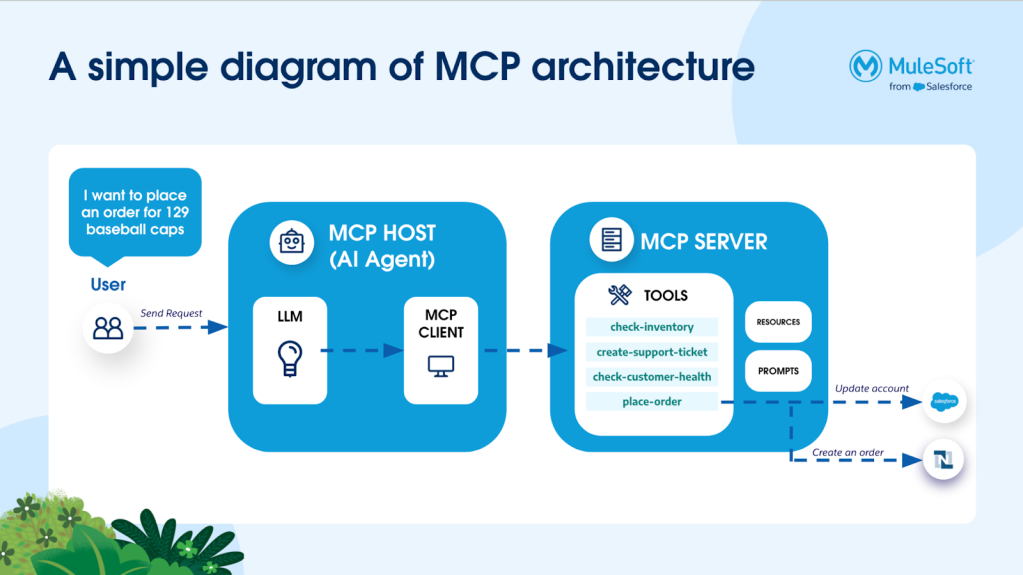
Before we discuss the strategies for a successful MCP for enterprise architecture, let’s first discuss some of the terms that will be used throughout this article. Here are the four key components of MCP architecture:
| Component | Role | Examples |
|---|---|---|
| MCP host | The environment where your AI agent operates. | Claude Desktop, custom agent platforms (ie Agentforce), integrated development environments |
| MCP client | The component within the host that implements the MCP protocol. Discovers and executes tools on behalf of the agent. | Built into AI applications to communicate with MCP servers |
| MCP servers | A service that exposes various capabilities to agents such as executable actions (tools), data or file sources (resources), or suggested prompt templates (prompts) | Your custom server exposing business APIs or third-party integrations |
| MCP tool | A well-defined capability that agents can discover and execute. | check_inventory, create_support_ticket, place_order |
This is what they look like visually:

Types of MCP implementations
Once you understand the mechanics of MCP servers, you need to then understand the two types of implementations.
- A local MCP implementation focuses on getting agents or AI applications to successfully call MCP tools and receive expected responses within the local network. This works well for individual developers building personal productivity tools or prototypes within their personal workspaces.
- A remote MCP implementation is where you often containerize the server and deploy it to cloud platforms such as AWS, Azure, GCP, or more. This allows developers and agents to access the server over the internet.
Often, you might start out with a local deployment for development and debugging and move to the remote implementation when you are ready to roll out the MCP server to the rest of the organization.
What is an enterprise MCP strategy?
An MCP for enterprise strategy extends beyond the MCP standard with considerations for governance, security, and operational requirements needed for deployment at scale.
While the protocol itself defines how agents can use and interact with the tools, it doesn’t prescribe how to secure that communication, manage access across teams, or ensure consistent policies across hundreds of agent workflows. An enterprise MCP strategy addresses these gaps.
Key characteristics of a successful enterprise MCP strategy:
So what makes for a strong enterprise MCP strategy? At MuleSoft, we break it down to the four following characteristics:
- Centralized governance: MCP servers are managed on a single platform with defined ownership, versioning, and lifecycle management. They’re published to a central registry where they can be discovered, reused, and governed centrally.
- Gateway-based security: MCP traffic flows through a gateway infrastructure where authentication, authorization, rate limiting, and threat detection are enforced centrally. This ensures that MCP servers, regardless of where they are developed or deployed, face the same security controls throughout the enterprise.
- Enterprise level operations: Production MCP deployments require monitoring, alerting, SLAs, disaster recovery, and audit logging. An enterprise MCP strategy treats these as requirements, not afterthoughts.
- Multi-team collaboration: MCP servers are inevitably built and maintained by different groups within the enterprise. A structured strategy involving a central registry ensures that these servers are visible and reusable rather than creating silos.
The goal isn’t just to make MCP work; it’s to make it work sustainably within the constraints and requirements of a real enterprise environment.
MCP as an interfacing layer
The first step to implementing the enterprise MCP strategy is to reframe your thinking around MCP. Instead of just seeing it as a tool, treat it as an interfacing layer over your existing APIs. This means you don’t rewrite backend logic or create new integration points. Instead, you expose existing, stable REST APIs with the semantic metadata agents need to understand what tools do and when to use them.
MCP servers should aggregate and simplify, not just act as a wrapper for APIs. Why? Agents perform better when there are fewer, easy-to-understand options.
By treating MCP as an interfacing layer for existing APIs, you gain several strategic advantages:
- Preservation of existing investments: Backend teams continue to operate systems the way they always have. Your API infrastructure, security policies, and integration patterns remain intact.
- Deliberate AI adoption: You can experiment with agent use cases, learn what works, and expand incrementally. You’re not forced to commit to complete platform changes before understanding how agents will behave in your existing environment.
- Coexistence of approaches: Some systems may eventually provide native MCP support. Others will still be accessed through REST APIs. Both approaches work together under a single governance model without requiring migration or coordination.
An enterprise MCP strategy with MuleSoft
The Model Context Protocol provides a standard for agent-to-system communication, but the protocol itself is just the foundation. At MuleSoft, our enterprise approach to MCP is grounded in a simple idea: developers should innovate and quickly, while IT maintains the enterprise control needed to scale safely. This is about enabling speed and governance without having to choose between them.
Developers and individual teams can build and deploy MCP servers wherever it makes sense for their workflow. If the developers are familiar with MuleSoft, they can use MuleSoft Code Builder to build MCP servers. They can experiment with new agent capabilities, iterate rapidly on tools, and respond to business needs without waiting for central approval on every decision.
At the same time, IT and security teams maintain the visibility and control they need through MuleSoft Agent Fabric. Through centralized registries, gateway-based policies, and unified observability, they ensure that regardless of where MCP servers are deployed or who built them, the same security standards apply, the same compliance requirements are met, and the same governance practices are enforced.
This balance is what makes an enterprise MCP strategy with MuleSoft sustainable. Innovation doesn’t slow down waiting for governance. Governance doesn’t become a bottleneck to progress. Teams work autonomously within a framework that protects the enterprise.
Gearing up for more MCP learnings ahead
To recap, we discussed basic MCP architecture, what an enterprise MCP strategy is, and how MuleSoft is your partner to implement the strategy. Be on the lookout for a further deep dive into the considerations you need to account for to create the strategy that fits your enterprise.
Ready to get started on building an MCP server? Learn how to make your existing APIs agent-ready with a ui-based MCP Creator and a code-based Anypoint Code Builder with this Step-by-Step Guide or follow along with an interactive demo.