


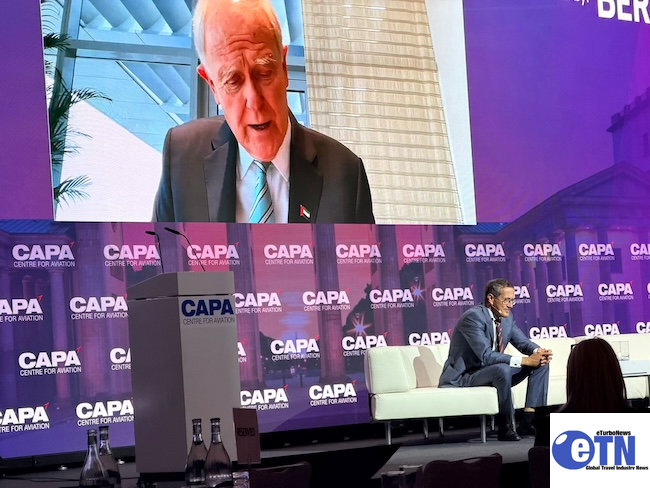
The live video interview by CNN anchor Richard Quest with the Emirates president, Sir Tim Clark, shared how Emirates rebuilt operations in just four days after the closure of the airspace, highlighting leadership, innovation, and Dubai’s global appeal while outlining bold plans for cabin upgrades and AI-driven personalization. The interview happened at the recently concluded CAPA Airline Leader Summit in Berlin.
At the CAPA Airline Leader Summit – Airlines in Transition, one of the most compelling sessions featured a candid and far-reaching conversation between Sir Tim Clark, President of Emirates, and CNN anchor Richard Quest.
In a wide-ranging dialogue, Sir Tim offered a rare, unfiltered look into how one of the world’s most successful airlines navigates disruption, drives innovation, and sustains profitability in a volatile global environment.
A Model of Rapid Recovery and Operational Strength
Few airlines demonstrated resilience as decisively as Emirates. Operating a fleet of 270 wide-body aircraft, the airline typically runs between 150 and 160 daily flights, transporting approximately 200,000 passengers from 110 nationalities.
When disruption struck due to the US and Israel’s war against Iran, civil aviation operations came to a near standstill in the United Arab Emirates, Qatar, Israel, Iran, and other Gulf countries. Yet within just four days, Emirates restored services to 87% of its original destinations—an achievement that underscores decades of operational discipline and investment in systems.
Sir Tim emphasizes that such recovery is not accidental but engineered:
“Four days later we were up and flying again… that is the core and the systems and technology we have in place now to support the operation.”
Despite setbacks in March, Emirates maintained strong financial performance, reinforcing its position as one of the most profitable airlines globally.
Leadership in Crisis: Visibility and Confidence


Leadership team | Our people | About us | Emirates
Our leadership team and their individual contributions to the growth of the global aviation industry.
For Sir Tim Clark, crisis management begins with leadership presence. With over 100,000 employees across the Emirates Group, visibility is not optional—it is essential.
“Leaders have got to be seen… making the right decisions, being there for the staff and not showing any signs of concern.”
His remarks highlight a core philosophy: stability at the top translates into confidence throughout the organization. This leadership ethos has been central to Emirates’ ability to navigate repeated global shocks.
Dubai’s Integrated Advantage
A key differentiator in Emirates’ success is the vertically integrated aviation ecosystem in Dubai. Coordination between civil aviation authorities, airport operators, and even military entities enables swift, unified responses during crises.
“We’re very vertically integrated in Dubai… the military has come into play and they are part of this.”
This level of coordination provides a structural advantage few global aviation hubs can match.
Driving Global Value Beyond the Gulf
Sir Tim also addressed the broader economic impact of Gulf carriers, particularly in Europe. Emirates’ extensive aircraft orders from Airbus and partnerships with propulsion and aerospace firms have supported thousands of jobs and reshaped production scale.
“One of the biggest leaders… that redefined the way airlines and airplanes should be built… was Emirates.”
He argued that such contributions should be considered in regulatory debates surrounding market access for Gulf airlines.
Innovation Without Losing the Human Touch
While Emirates continues to invest heavily in AI-driven personalization and modern airline retailing, Sir Tim stressed that technology will never replace the human element.
Serving passengers from over 110 nationalities daily requires empathy, cultural awareness, and human-centric design.
“The one common factor is the human—and the human is never going to go away.”
Product Evolution: From First Class to Economy
Innovation remains a constant priority across all cabin classes:
- First class: Emirates is exploring en-suite bathrooms within private suites, pushing the boundaries of luxury air travel.
- Economy class: A major overhaul is underway, with new features expected within one to two years despite supply chain challenges.
- Continuous refinement: Sir Tim warned against complacency, noting that even successful products can quickly become outdated.
“If you leave it, it’ll get stale… so we’re constantly on product refinement.”
Dubai: The Engine Behind Demand
Emirates’ recovery is closely tied to Dubai’s global appeal. The city’s strong economic model, investment in infrastructure, and thriving hospitality sector continue to attract travelers worldwide.
Passenger demand is surging, flights are full, and the destination remains a powerful anchor for the airline’s hub strategy.
The Role of FlyDubai and Strategic Integration
The conversation also highlighted the complementary role of FlyDubai within the UAE aviation ecosystem. Together, Emirates and FlyDubai create a layered network that enhances connectivity and market reach.
This integrated approach strengthens Dubai’s position as a global aviation hub.
A Competitive Landscape Shaped by Strategy
Sir Tim did not shy away from criticizing European carriers, suggesting that strategic missteps—particularly an overemphasis on North Atlantic markets—led them to miss broader global opportunities.
Meanwhile, Emirates built a multi-market hub model connecting underserved regions, establishing a competitive advantage that continues to pay dividends.
Brand Strength and the Power of Reputation
Ultimately, Sir Tim believes that strong brands recover quickly from crises. Emirates’ premium product, global connectivity, and association with Dubai’s appeal create a resilience that goes beyond operational metrics.
“If your product and your brand is as strong as ours… people will forget.”
Conclusion: Leadership Anchored in Resilience
The session at the CAPA Summit reaffirmed Emirates’ position not just as a leading airline, but as a benchmark for resilience, innovation, and strategic clarity.
Sir Tim Clark’s leadership—marked by confidence, adaptability, and relentless focus on improvement—continues to guide the airline through uncertainty while shaping the future of global aviation.
As the industry navigates ongoing disruption, Emirates offers a compelling case study: recovery is not just about bouncing back—it’s about emerging stronger, smarter, and more connected than before.