


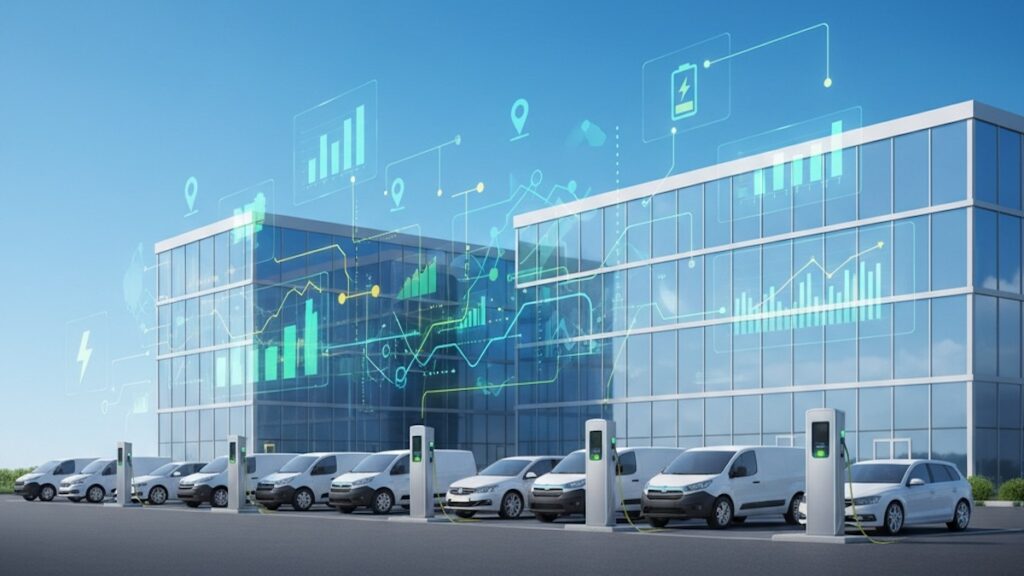
Many companies want to electrify their fleet – but fail due to uncertainty, a lack of transparency and the question: Where do I start? With data-based fleet management and partners such as the collaboration with Geotab, a complex project becomes a predictable, economical step.
Why now is the right time for the e-fleet
According to analyzes by Geotab, more than half of companies in Germany plan to electrify their fleet by 2028. This makes it clear: Anyone who acts now will gain a head start: in terms of image, costs and CO₂ targets.
Another number is exciting: In practice, 20 to 30 percent of a vehicle fleet is now often suitable for immediate electrification, and the trend is rising to up to 50 percent. In other words: Many fleets have long had vehicles that can be economically replaced by electric vehicles without having to completely restructure processes or application profiles.
At the same time, companies are under increasing pressure: CO₂ reporting requirements, ESG requirements, rising fuel prices and environmental zones make the electrification of car and commercial vehicle fleets a strategic issue, not a side project.
The biggest hurdles: range, charging infrastructure, economics
Anyone who wants to electrify their fleet will quickly come across recurring questions: Is the range really enough for all trips? Where and when can vehicles be charged? Is the change financially worth it? And which models actually fit the operational profile of the fleet?
This is exactly where the difference between gut feeling and data-driven planning becomes apparent. Telematics solutions such as the Geotab platform record real driving profiles, idle times, routes, speeds and consumption and evaluate them automatically. On this basis, it can be reliably determined which vehicles are suitable for the switch – and which ones should wait.
Geotab uses, among other things, the Electric Vehicle Suitability Assessment (EVSA), a tool that uses historical driving data to make concrete suggestions as to which combustion engines can be replaced by electric vehicles in an economically viable manner and which electric models best suit the usage profile. This turns the perceived uncertainty into a clearly understandable business case.
It doesn’t work without data: telematics as the foundation of the e-fleet
Once the decision to switch has been made, the actual day-to-day work of fleet electrification begins. This is where professional, telematics-based fleet management pays off. In addition to classic key data such as position, speed, engine status and fuel consumption, Geotab telematics devices also record specific information for electric vehicles in real time – such as charging status, charging locations, charging time and battery status.
This data can be evaluated centrally via the MyGeotab platform: Which vehicles are sufficiently charged? Where does unnecessary downtime occur? How can routes be adapted to charging stops without impacting driver productivity? For commercial vehicle fleets, for example in the delivery or service business, this transparency offers a decisive competitive advantage.
Another point: Geotab claims to support over 300 different electric vehicle models, which enables seamless integration into existing mixed fleets of combustion engines, hybrids and fully electric vehicles. This means that fleet management remains clear even in the transition phase, instead of breaking down into isolated solutions.
4 steps to an electrified fleet
Anyone who wants to electrify their fleet benefits from a structured approach. A possible timetable that has proven itself in practice:
- 1. Create a database: First, driving profiles, routes, idle times and consumption are recorded via telematics. This creates an objective picture of fleet usage.
- 2. Identify potential: Tools such as EVSA from Geotab are used to evaluate which vehicles are immediately suitable for switching and where the greatest savings potential lies.
- 3. Define charging and deployment concept: Based on the data, charging windows can be planned, suitable charging infrastructure can be dimensioned and routes optimized for electric vehicles.
- 4. Monitor and optimize operations: After the changeover, continuous monitoring helps to improve charging cycles, protect batteries, document emissions and keep an eye on costs.
Important: Fleet electrification is not a one-time project, but an ongoing optimization process. Vehicles that are not suitable today can become economically attractive in a few years – for example if ranges increase or new models with better TCO values come onto the market. With a flexible, data-driven approach, fleets remain able to act.
Sustainability, compliance and costs under control
In addition to operational advantages, sustainability and compliance are playing an increasingly important role. TÜV-certified emissions reports and data-driven sustainability solutions, such as those available in conjunction with Geotab, help companies demonstrate CO₂ reduction targets, prepare reporting for stakeholders and meet regulatory requirements, all based on real fleet data.
At the same time, operating costs can be reduced: optimized routes, lower energy consumption, fewer unplanned downtimes and better vehicle utilization have a direct impact on the TCO. Especially with electric vehicles, whose acquisition costs can be higher than those of classic combustion engines, the ongoing cost profile determines the actual cost-effectiveness.
Anyone who consistently uses this transparency can gradually expand their e-fleet. Without risk, but with clear economic arguments towards management, controlling and employees.
Conclusion: With transparency to a successful e-fleet
Switching to electric vehicles in the fleet is not a leap into the unknown, but rather a strategic decision that can be precisely planned and controlled with the right data. Telematics and intelligent fleet management form the basis for answering range questions, charging planning and economic efficiency no longer based on feeling, but on the basis of reliable facts.
Companies that rely on data-based solutions at an early stage and think holistically about the electrification of their fleet not only secure ecological advantages, but also measurable economic effects. Working with Geotab can help make the entire journey – from suitability assessment through implementation to ongoing operations – efficient.