


Most teams are managing a mix of REST, GraphQL, gRPC, AI agents, and MCP servers across multiple gateways, and your developer portal should reflect that.
Multi-Protocol Portals, Federated Asset Publishing, and Public Platform APIs
This release covers a lot of ground: out of the box support for new asset types; services cataloged from external providers now publishable alongside your Anypoint APIs; a scalability update raising the portal asset limit; and API Experience Hub’s (AEH) own Management and Consumer APIs now formally published to dev-portal.mulesoft.com, backed by a set of Skills that make portal workflows callable from MCP-compatible clients and AI orchestration layers.

New asset types
AEH now supports publishing five new asset types: GraphQL, gRPC, agents, LLMs, and MCP Servers.

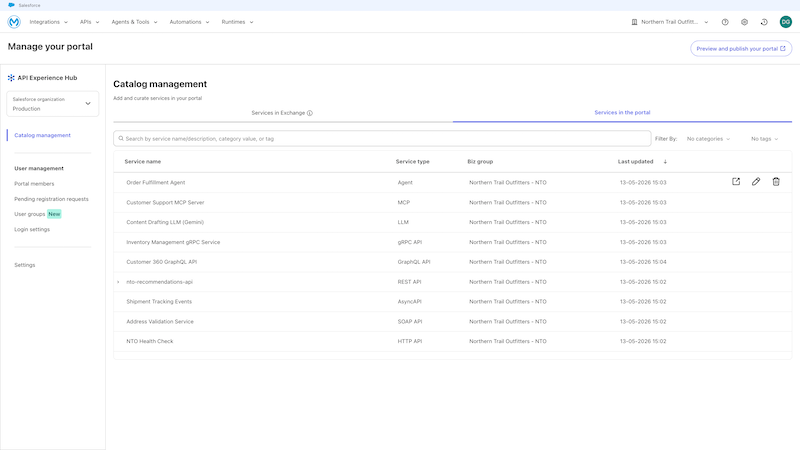
GraphQL
A query language for APIs that lets consumers request exactly the data they need from a single endpoint. These APIs are now publishable with full documentation and an interactive console. Consumers can explore the schema, write and execute queries, and request access through the same workflow they use for REST APIs.
gRPC
A high-performance remote procedure call framework that uses Protocol Buffers to define strongly-typed service contracts. These services are surfaced with full schema visibility (services, methods, and message types) and are discoverable in the same portal as the rest of your API catalog.
agents
Autonomous software components that can reason, plan, and take actions on behalf of users or other systems. Agents published to Exchange include a machine-readable A2A agent card covering capabilities, input/output schemas, and security configuration, consumable by both human developers and downstream orchestration systems. The console surfaces agent metadata and capabilities.
LLMs
Large language model endpoints that expose AI inference capabilities as a callable service. LLM endpoints are published with the same documentation and access controls as any other asset, giving teams a consistent way to discover and request access to internal or partner LLM infrastructure.
MCP Servers
Servers that expose tools, resources, and prompts to AI clients using the Model Context Protocol. MCP servers are published as structured assets in Exchange, including tools, resources, prompts, and security configuration. Developers can pull MCP tool definitions directly from the portal to configure their MCP clients.
To support the expanded asset types and broader catalog coverage, we’re rolling out a scalability update to all customers that increases the supported portal asset limit from 300 to 7,000.
Publishing assets from external gateways
AEH now supports publishing assets (APIs, MCPs, and agents) scanned and cataloged from external gateways, including the recently added API scanners for AWS API Gateway, Azure API Management, Google Apigee, and Kong, alongside your native Anypoint APIs.
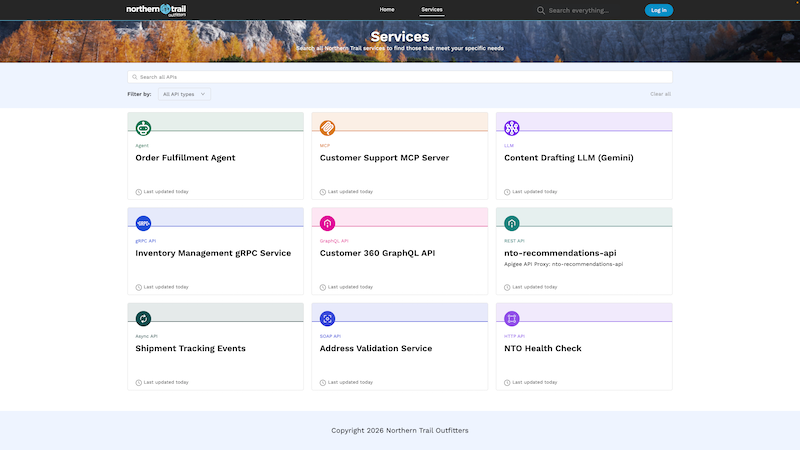
Rather than maintaining separate portals for different providers or living with a portal that only reflects part of your services portfolio, your organization can expose its full catalog from a single place. Developers can discover and explore everything in one portal, regardless of where it runs. Platform teams get a single place to curate and surface their complete API portfolio to internal and external consumers.
Public platform APIs for programmatically managing AEH
MuleSoft publishes platform APIs for the core capabilities of Anypoint Platform at dev-portal.mulesoft.com. Exchange, API Manager, Runtime Manager, and others all expose documented, versioned public interfaces that platform engineers use to automate operations and build internal tooling on top of the platform. With this release, AEH joins that catalog.
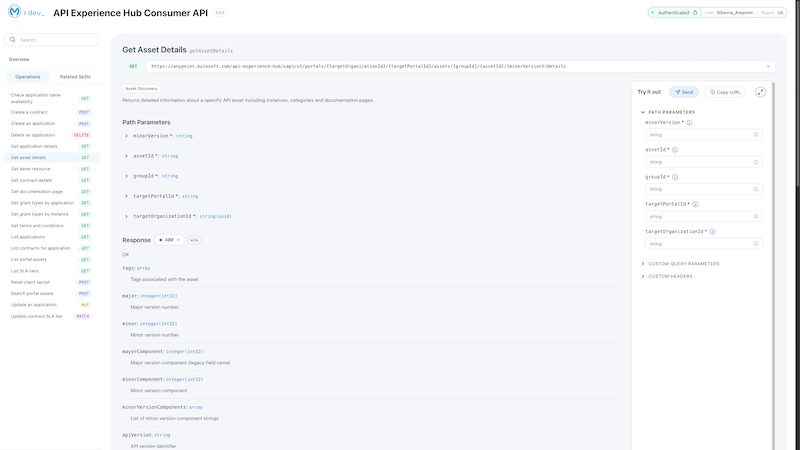
Every operation available in the AEH admin UI is now available programmatically, using the same authentication and versioning patterns you are already using elsewhere on the platform. There are two functional groups.
The Management API covers the full admin surface: connections, portal discovery, user lifecycle including prospect approval and enable/disable, user group management, IdP group mappings, and asset curation. The asset curation endpoints are what you would use to automate service publishing as part of a CI/CD pipeline, syncing assets from Exchange to the portal as part of the same workflow that promotes them through your organization’s governance process.
The Consumer API covers the portal consumer surface: asset discovery and detail retrieval, application lifecycle including create, update, delete, and credential management, and the full access request and SLA tier workflow. This is also the surface an agent can call on a developer’s behalf for programmatic API access management. Both sets of APIs are available across US, EU, CA, and JP regions.
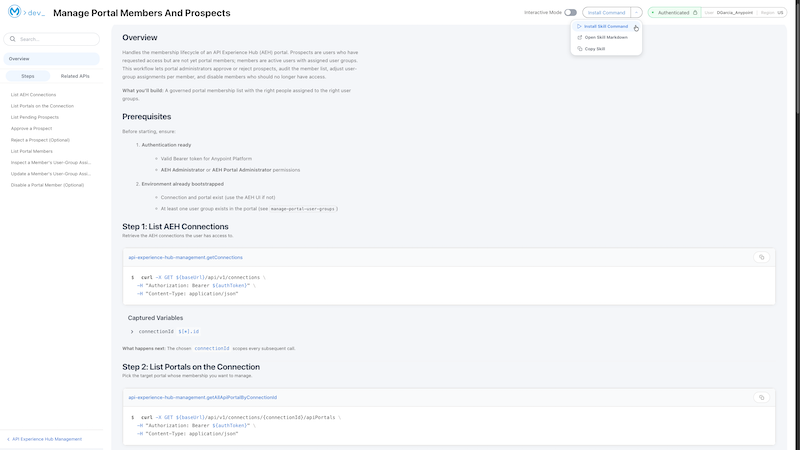
Alongside the APIs, we’re publishing six Skills: structured workflow definitions that map to the jobs portal admins and consumers actually perform. Three Admin Skills cover portal curation, member and prospect management, and user group management. Three Consumer Skills cover API discovery, application management, and access requests. Skills are callable from MCP-compatible clients and AI orchestration layers, which means portal administration and API access workflows can participate in agentic pipelines, not just manual UI interactions.
Getting started
- New asset types: If your assets are in Exchange with valid specs, they will automatically appear as publishable assets in the Catalog Management page, ready to add to your portal
- External provider assets: Requires configuring Scanners in Exchange for your external providers. Once assets appear in Exchange, they are eligible to publish through the standard curation workflow
- Platform APIs and Skills: Full specs and skill definitions are available at dev-portal.mulesoft.com
- See it in action: Watch the full walkthrough of AEH’s new asset types and platform APIs in our demo video