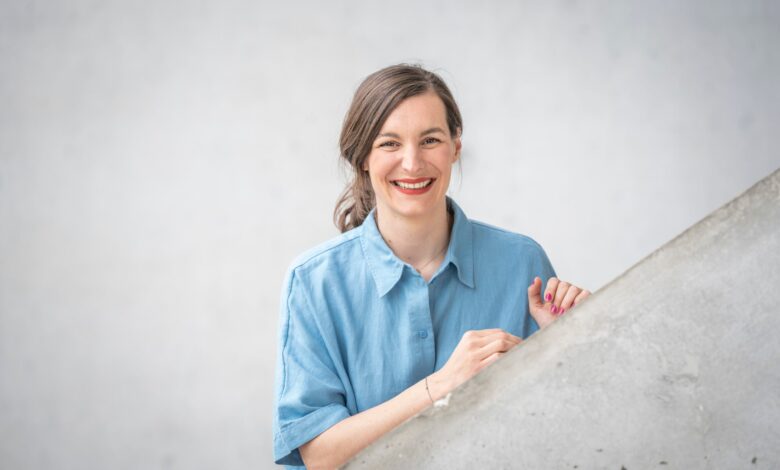
Kristina Schreiner is a VC and founder. She talks about how her background shaped her career path between family business, private equity and founding her own startup – and how she approaches the succession to the family business.

Founder and VC Kristina Schreiner grew up in an entrepreneurial family in southern Germany. For as long as she can remember, conversations at the family dinner table have not only revolved around how the day was, but also about topics such as organizational structure, risk and growth, she says in an interview with Gründerszene. How she manages the balancing act of taking responsibility, continuing a family legacy in a feminist way and at the same time building something of her own – a protocol.
My father took over our family business from his father and eventually sold it. That’s easy to say in one sentence, but behind it are years of work, decisions and uncertainty. He left it up to us to decide whether my sister or I would join the company. There was no family pressure, but rather freedom of choice.
Entrepreneurship at the dinner table
During my business studies, I repeatedly worked in this company and asked myself whether the topic (in the broadest sense, materials science) excited me enough to be able and willing to fully commit to it. The honest answer was: No, that doesn’t fit. As a family, we finally decided to sell – and I was free to choose which path I took. When I was 26, I decided to pursue a corporate career at Siemens: I worked in product management, consulting and sales for almost ten years.
Read too

More than just “the daughter of”
With the capital from the sale of the company, my father began investing in medium-sized companies. So at our Christmas family conferences we no longer talked about our own company, but rather about the portfolio companies. I found that very exciting. I wanted to go deeper and was lucky that my father opened that door for me. I wanted to sit at the table, actively shape things and have a say in where we invest. Women rarely sit at tables like this, and I knew back then that I had access that others would never have. This awareness was paralyzing at first because for me this privilege comes with great responsibility.
Despite this and precisely because of this, I gave up my corporate job in 2022 and joined our family office. Previously we had only invested in medium-sized companies. But I noticed that it is incredibly difficult to really change the culture in established companies. With startups, the leverage is much more direct: you can set the right course right from the start. So I took up the topic of startup investments. I didn’t just want to be “the daughter of” but I wanted to take on responsibility myself. Since then I have been active as a venture capitalist and business angel.
Two roles, one advantage
But investing alone wasn’t enough for me. I was missing the operational side. So I founded Chewsome, a frozen finger food startup for babies. Today I combine both: I invest in startups and at the same time build my own. That complements each other.
As a founder, I know what a pitch deck should feel like on the other side, and as an investor, I recognize more quickly what really has substance. Both roles also complement each other very advantageously at networking events.
Read too

When I describe working with my father, I can say: We are sparring partners on equal terms. He brings in his experience from medium-sized businesses, but consciously holds back when it comes to startup topics. I make the decisions alone.
Why capital is political – and what I want to achieve with it
From my point of view, it is a privilege to make investments and therefore also to act politically. Equality is not an issue that has been ticked off. This also applies where capital decisions are made.
I therefore make my investment decisions very consciously and in a feminist way. For me, it’s not just possible financial success that’s crucial: I also pay attention to the social impact and ecological impact of starting a business. If I have the choice between an all-male startup team and a diverse founding team with a similar vision, I’m more likely to choose the startup that lives diversity.
What feminist succession means to me
Where there is money, there is also a certain degree of power. We live in a time in which a lot of wealth is inherited. In Europe, around 50 to 60 percent of private wealth is passed on through inheritance and gifts. An enormous part of the distribution of wealth depends directly on birth and family, not on performance. Through my family, I have access to distribute capital differently and to specifically support women. Capital has so far only flowed to a very limited extent into various founding teams: 53 million euros flowed to startups in Germany in 2025 with exclusively female founding teams. This corresponds to only around one percent of the total risk capital of 7.8 billion euros (according to the EY Startup Barometer 2026).
For me, feminist succession means: seeing, enduring and consciously using your own privilege. Not (always) perfect, but consistent step by step. Capital will only become more feminine when we stop talking about returns and start talking about responsibility.
Read too