


We previously explored why scaling AI agents across the enterprise requires an AI control plane and introduced Agent Fabric as the foundation for governed, cross-domain orchestration. The next challenge is equally critical. How do you consistently decide where and how AI agents should be built, governed, and orchestrated?
Without a structured approach, organizations risk agent sprawl, duplication, inconsistent governance, and increasing complexity. Without this, enterprise AI risks becoming a collection of disconnected agents rather than a coherent, scalable agentic enterprise. This is where an enterprise AI agent decision framework becomes essential.
Why you need an enterprise decision framework
As agent platforms proliferate across enterprise domains with more and more choices becoming available, solution teams face increasing ambiguity:
- Does an agent already exist that I can reuse?
- Where should new agents be built?
- Does it require cross-domain coordination?
- Should it interact with external AI platforms?
- How should governance and policy be applied?
This challenge is not unique and reflects a broader shift as organizations move from isolated experimentation toward scaled, enterprise-wide adoption of AI agents. This progression is explored in the Agentic Enterprise Maturity Model, where enterprises evolve from proof-of-concepts to fully governed, orchestrated agent ecosystems.
This is where an enterprise decision tree framework is needed to provide clear architectural guidance to:
- Guide platform selection based on the scope of the use case(s)
- Promote consistent architectural patterns
- Support enterprise governance and design assurance
- Encourage reuse of existing agents and capabilities
- Reduce technology sprawl and duplication
Key principles for enterprise AI agents
Before defining an effective decision tree, it’s useful for it to be underpinned by a discrete set of core principles, namely:
- Reuse before create: Discover and reuse existing agents, tools, and capabilities
- Buy before build: Leverage approved enterprise platforms where data and processes reside
- Enterprise-governed interaction: Cross-domain and cross-platform interactions must be governed through an enterprise agent fabric
- Leverage common services: Use platform-native services locally, and enterprise services for cross-domain consistency, governance and orchestration.
These principles enforce discipline, reuse, and scalability which are essential for enterprise adoption.
The enterprise agent decision tree framework
At the core of the approach is a structured decision tree model as outlined in the figure below.

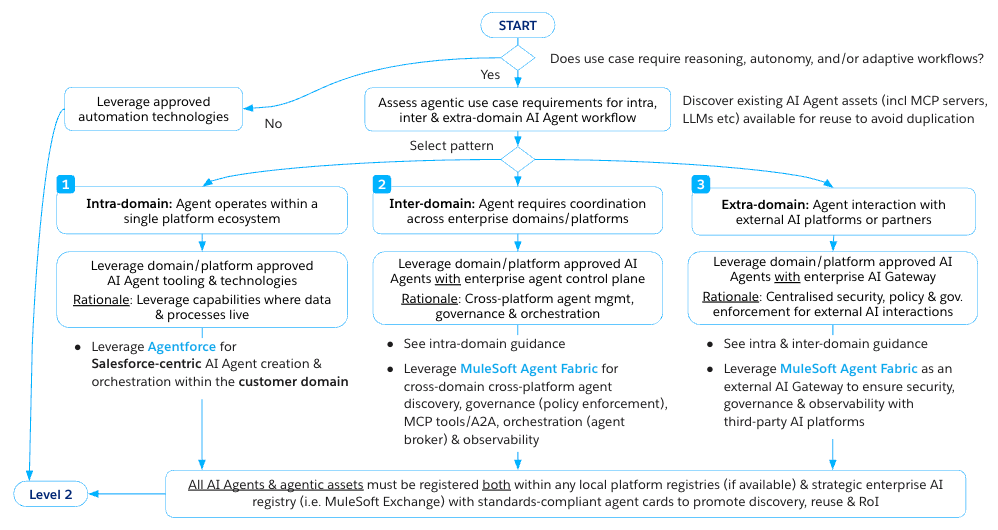
Let’s look at the flow of the decision tree:
| Does the use case require an agent? | Not all use cases require agents especially if there’s no need for reasoning, autonomy and adaptive workflows, This is where traditional automation remains the right approach |
| Determine the domain scope | Intra domain: Agent operates within a single platform ecosystem where domain-native platforms should be used (eg Agentforce within the customer domain) |
| Inter domain: Agent requires coordination across multiple enterprise domains. This is where an enterprise capability (ie Agent Fabric) is needed for cross-domain cross-platform orchestration, governance, routing and observability | |
| Extra domain: Agent interacts with external third-party or partner agents. This is where an enterprise AI gateway is needed to enforce strong security, policy and governance | |
| Enforce discovery and reuse | Before building anything new, it’s key to discover existing agents, tools, and capabilities to prevent agent sprawl, duplication, increased costs and technical debt. It’s critical to ensure all agents are registered in an enterprise AI registry (as well as local registries where available) for discoverability, reuse, and to provide an ROI |
Platform vs. enterprise common services
Once a platform is selected, another key decision emerges: Should capabilities be provided by the platform or by enterprise services? Let’s explore this as part of the next level of the decision tree framework as outlined in the figure below.

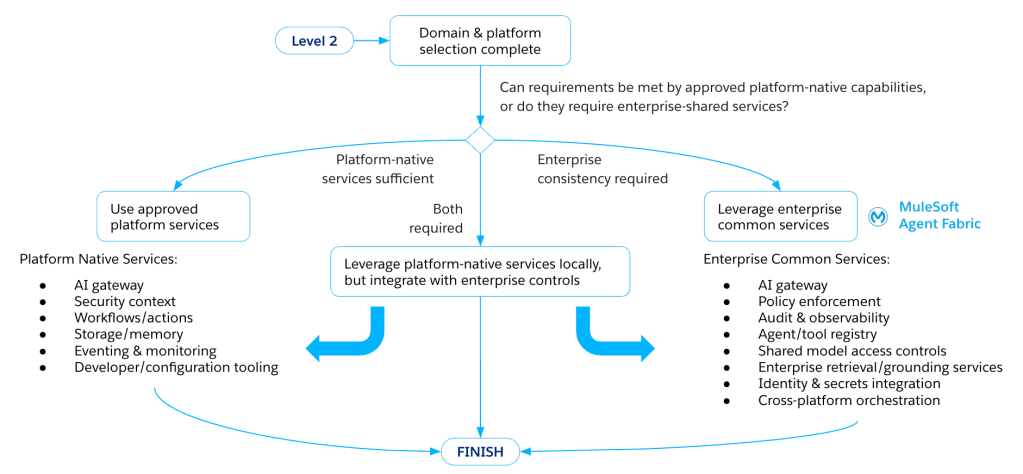
This decision tree requires the assessment of whether the use case requirements can be met by approved platform-native capabilities or whether enterprise-level services are needed. Let’s expand on the services below:
| Platform native services | AI gateway: Provides platform-managed access to approved or customer-supplied LLMs within the domain, aligned to local runtime, security and configuration needs |
| Security context: Leverages the platform’s native identity, roles, and permissions to ensure agents operate within the correct domain-specific access boundaries | |
| Workflows and actions: Provides built-in capabilities to execute domain-specific processes, tasks, and automations close to the underlying business logic | |
| Storage and memory: Supports persistence of state, session context, and short-term memory required for agent interactions within the platform | |
| Eventing and monitoring: Enables real-time event handling and platform-level monitoring to track agent activity and trigger actions based on domain events | |
| Developer/configuration tooling: Platform-native tools for building, configuring, and managing agents using declarative or code-based approaches |
| Enterprise common services (via Agent Fabric) | AI gateway: Provides a centralized access layer to external and internal AI services, enforcing security, policy, and compliance for all AI interactions |
| Policy enforcement: Applies consistent enterprise-wide guardrails (eg PII detection, content filtering, compliance rules) across all agent interactions | |
| Audit and observability: Provides end-to-end visibility into agent behavior, decision flows, and interactions across domains for monitoring, debugging, and compliance | |
| Agent/tool registry: Acts as a central catalog of agents and tools, enabling discovery, reuse, and lifecycle management of agentic assets | |
| Shared model access controls: Governs how foundation models and AI services are accessed, ensuring approved usage, cost control, and compliance with enterprise standards | |
| Enterprise retrieval/grounding services: Provides shared capabilities for accessing trusted enterprise data sources and knowledge bases to ground agent responses consistently | |
| Identity and secrets integration: Centralizes authentication, authorization, and secure credential management across platforms and agent interactions | |
| Cross-platform orchestration: Coordinates interactions between agents and tools across domains, enabling end-to-end workflows and enterprise-wide agent collaboration |
In practice, most solutions adopt a hybrid model but the key point is that enterprise services, delivered through Agent Fabric, provide the enterprise consistency and control required for agent adoption at scale.
Bringing it all together
The enterprise AI agent decision framework ultimately provides a structured way to answer three critical questions:
- Where should the agent be built?
- How should it be governed?
- How should it be implemented?
By applying this framework, enterprises can scale AI agent adoption with confidence, maintain architectural consistency, avoid duplication and fragmentation, align AI initiatives with business domains, and strengthen governance and control.
When combined with an enterprise control plane such as Agent Fabric, organizations can move from fragmented experimentation to scalable, governed, and reusable agent ecosystems. The future of AI agents is not about individual platforms, but about how they are orchestrated, governed, and aligned to enterprise architecture principles.
Without a clear decision framework, enterprises risk building more agents. With it, they build a scalable, governed, and truly agentic enterprise.
Final thoughts
AI agents represent a fundamental shift in enterprise architecture. Without the right control plane, they risk becoming fragmented, isolated, ungoverned and ultimately unsustainable. The future is not about choosing a single agent platform but is about designing an enterprise agent ecosystem that is domain-aligned, reusable, governed, orchestrated, and observable.
At the heart of that ecosystem, Agent Fabric acts as the enterprise agent control plane enabling organizations to move from isolated agents to a connected, governed, and intelligent agentic enterprise. By partnering with MuleSoft, you can ensure your transformation journey to an Agentic Enterprise is well-guided, grounded in architecture best practice and delivers measurable business outcomes.