


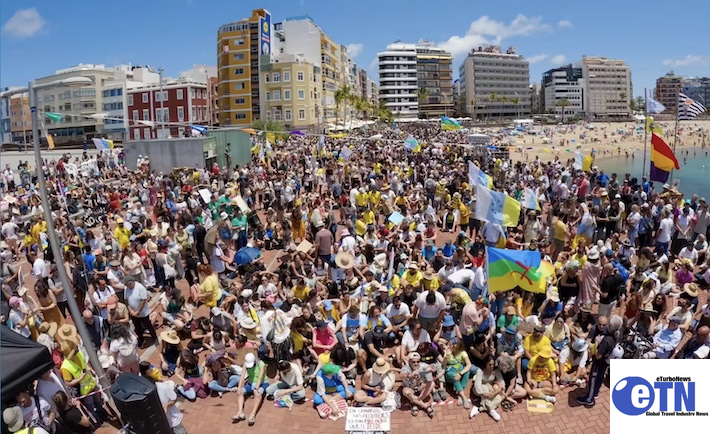
Carnival’s weather-delayed arrival turned Playa del Inglés on the Canarian Islands into a sudden crush of glitter, traffic and celebration. Visitors expecting calm found gridlock and nonstop revelry instead—where overcrowding meets freedom, the Yumbo Center pulses with life, and even the Maspalomas Dunes offer fleeting escape.
A Festival That Arrived Unannounced in Gran Canaria
For many travelers arriving in Playa del Inglés yesterday, the confusion began before the celebration.
Carnival, a fixture of the island’s cultural calendar, had been postponed by a week after bouts of extreme weather—high winds, dust-laden skies, and unsettled conditions that disrupted preparations across Gran Canaria. When the festival finally resumed, it did so not gradually, but all at once.
Visitors who had booked quiet beach holidays based on the original dates found themselves stepping into the middle of one of Europe’s most exuberant—and overwhelming—street parties.
“It wasn’t on our radar,” said a Dutch tourist, wheeling a suitcase past a line of stalled taxis. “We thought the season was over. Apparently, it was just getting started.”
Paradise, Amplified


By day, Playa del Inglés offers the familiar promise of winter sun: wide beaches, steady warmth, and the cinematic sweep of the Maspalomas Dunes, where golden sand drifts towards the Atlantic.
By night, particularly during carnival, that promise is transformed into something louder, denser and less predictable.
At the Yumbo Centre, music pulses through open-air corridors as crowds gather shoulder to shoulder. Costumes—feathered, sequined, illuminated—move through the complex like a living parade. The boundary between performer and spectator dissolves.
The delayed start only intensified the effect. With visitors, performers and locals converging in a compressed timeframe, the result was a sudden surge—an entire festival’s worth of energy released at once.
A Global LGBTQ Sanctuary

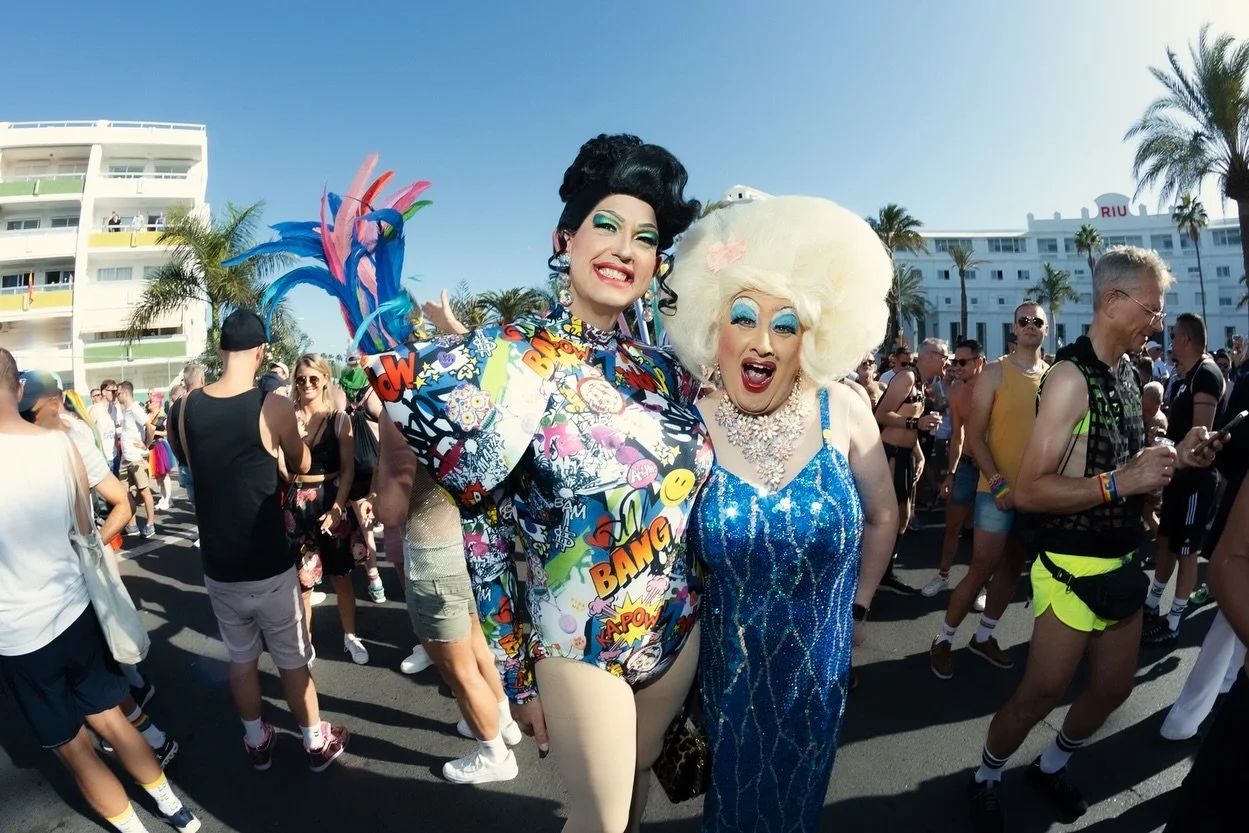
Long before carnival, Playa del Inglés had established itself as one of Europe’s most important LGBTQ destinations. The Yumbo Centre, in particular, functions as both social hub and cultural landmark—a place where identity is not only accepted but celebrated.
During carnival, that identity expands into spectacle.
Drag performances spill into the streets. Costumes challenge, parody and reinvent gender norms. Visitors arrive from across Europe and beyond, drawn by the promise of freedom—social, personal, and aesthetic.
“It’s not just tolerance,” said a visitor from Stockholm. “It’s participation. You’re expected to join in.”
The Dunes: Quiet, and Not So Quiet, Liberation

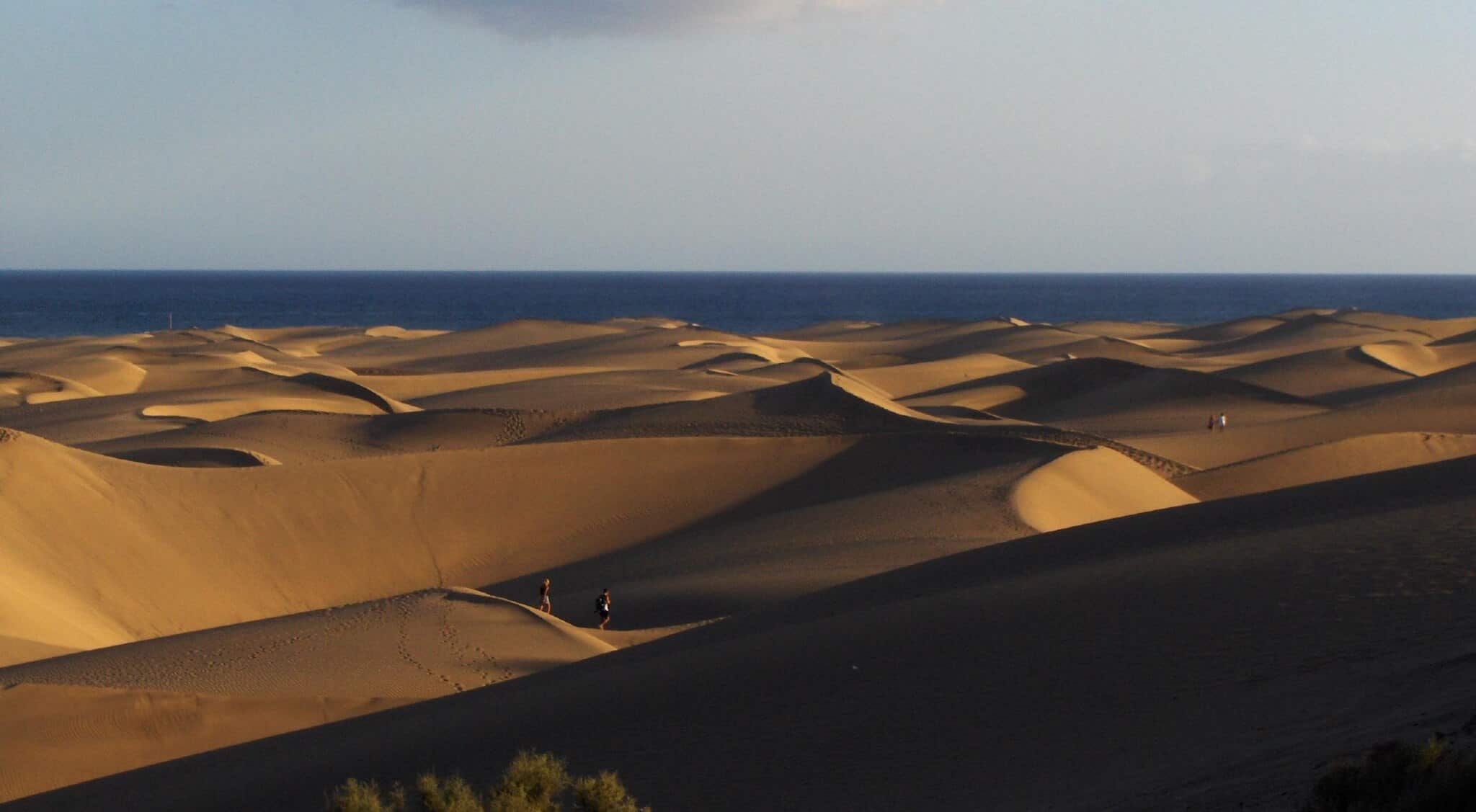
A short walk from the noise, the Maspalomas dunes offer a contrasting reality.
Here, among the protected sands, long-established naturist zones attract visitors seeking a different kind of escape. Sunbathers lay undisturbed. Others wander, unencumbered by convention or clothing.
Yet even this space has not been entirely immune to the pressures of mass tourism. During peak periods, the sense of seclusion can give way to a quieter, but still noticeable, crowding—an echo of the density found along the promenade and in the nightlife districts.
The Mechanics of Overcrowding

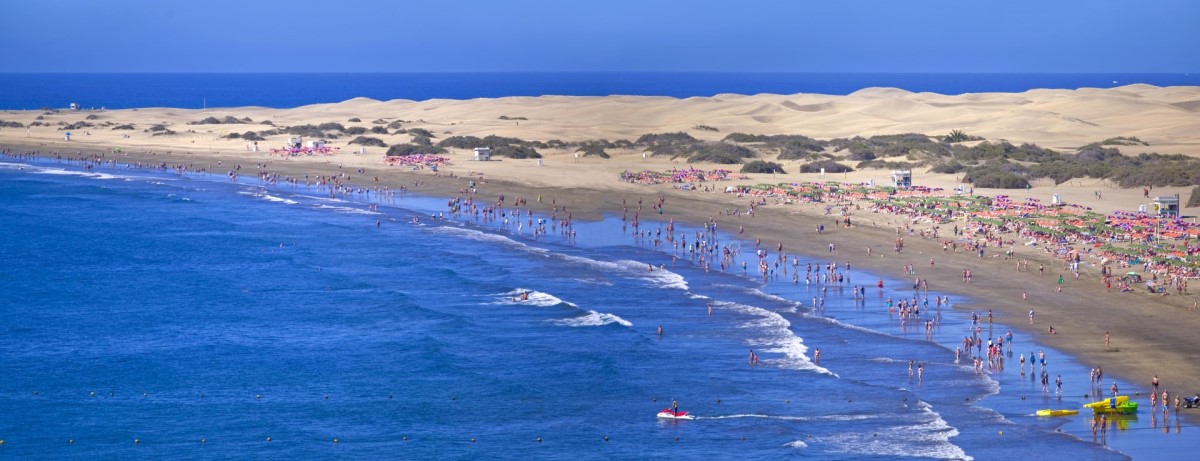
Playa del Inglés – The Official Gran Canaria Tourist Website
The delayed carnival did more than surprise visitors—it exposed the fragile balance of a destination already operating near capacity.
- Transport networks foldedwith blocked roads and limited alternatives
- Taxi shortages intensifiedleaving arrivals stranded or walking long distances
- Public spaces reached saturationturning movement into negotiation
- Noise and activity became continuouserasing distinctions between day and night
The experience of overcrowding here is not merely visual; it is physical. It is the slow progress of a crowd through narrow streets. The impossibility of finding a quiet table. The constant proximity of strangers, music, and movement.
“It feels like the entire island decided to be in the same place at the same time,” said one visitor.
The Economics of Excess
Despite the strain, carnival remains essential to the local economy.
Hotels report full occupancy. Bars and restaurants operate at capacity. Temporary employment surges. The delayed schedule, if anything, intensified spending, compressing demand into fewer days.
But the challenges are increasingly difficult to ignore:
- Infrastructure stretched beyond design limits
- Environmental pressure on fragile dune ecosystems
- Rising tensions between residents and the tourism economy
Local authorities have begun exploring ways to manage flows more effectively, but the fundamental question persists: can a destination built for leisure sustain the scale of its own success?
Why They Still Come
And still, they come.
For the sun, yes. For the beaches. For the dunes. But also for something less tangible: a sense of permission.
In Playa del Inglés, particularly during carnival, normal expectations loosen. People dress differently, behave differently, move differently through space. The boundaries of everyday life—social, cultural, even logistical—are suspended.
The delayed carnival only sharpened that effect. What might have been a gradual unfolding became a sudden immersion.
For some, it was inconvenient. For others, overwhelming.
For many, it was unforgettable.
A Destination at Its Limits—and Beyond
As the festival continues, the streets remain full. Music carries into the early hours. The dunes glow under a soft evening light, even as crowds linger at their edges.
The weather that delayed carnival has passed. The crowds it concentrates have not.
Playa del Inglés stands, as it often does, at a crossroads between paradise and pressure—between the freedom it promises and the limits it increasingly tests.
And somewhere, in the slow-moving traffic or the packed dance floors, a visitor pauses, looks around, and realizes:
This is not the holiday they planned. But it may be the one they remember.