


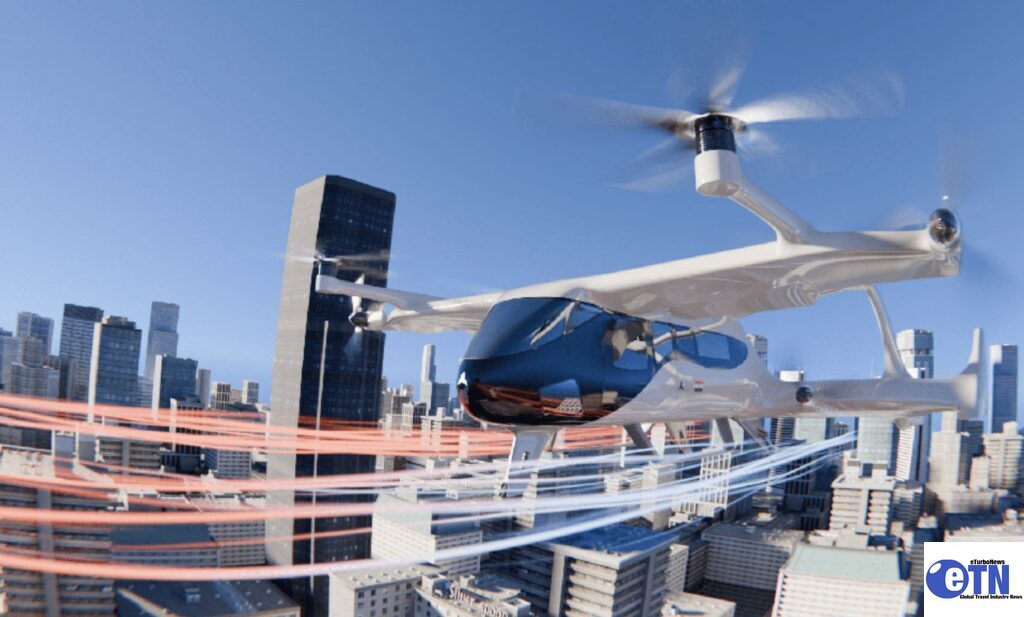
CHENNAI, India — An electric aircraft developed at the Indian Institute of Technology Madras is entering the increasingly crowded global air-taxi race with an unusual selling point: it has been designed to fit into a space not much larger than an existing city helipad.
The ePlane Company has unveiled the full-scale prototype of its e200X, a 2.2-ton electric vertical takeoff and landing aircraft, or eVTOL, intended to carry a pilot and two passengers—or approximately 200 kilograms of cargo—on journeys of up to 110 kilometers.
According to the company, the aircraft measures just eight meters by 11 meters, giving it what ePlane describes as the smallest dimensional footprint of any full-scale winged passenger eVTOL. The compact envelope is central to its pitch: instead of requiring cities to construct large new vertiports, the aircraft could eventually use some existing helipads, open lots and suitably engineered rooftops.
That does not, however, make the e200X an entirely new category of aircraft.
A distinctive Indian design, not an entirely unique concept
More than a hundred electric vertical-flight projects have appeared internationally, using designs ranging from multicopters and tiltrotors to fixed-wing “lift-and-cruise” aircraft.
Joby Aviation and Archer Aviation in the United States are developing piloted aircraft carrying four passengers. Archer’s Midnight uses a 12-propeller configuration in which six propellers tilt between vertical and forward flight. It is designed primarily for repeated journeys of approximately 20 to 50 miles.


Home | The ePlane Company
Introducing an all-electric, zero-emission air taxi, designed as one of the most compact eVTOL aircraft. This solution targets mid-mile urban air mobility, addressing congestion and pollution in cities, with potential across the $1+ trillion global UAM market.
Britain’s Vertical Aerospace is developing Valo, a larger aircraft designed for up to six people, a claimed range of as much as 100 miles, and a cruise speed of about 150 mph.
BETA Technologies has taken another approach with its ALIA VTOL. Like the e200X, ALIA uses separate vertical-lift and forward-flight propulsion rather than relying on each rotor to tilt. BETA is targeting passenger, cargo, medical and defense operations and says its electric aircraft family has already accumulated extensive real-world flight testing.
The basic idea of avoiding mechanically complex tiltrotors is therefore not unique to ePlane. Dedicated lift propellers combined with a separate cruise propeller are already an established branch of eVTOL design.
What may distinguish the Indian aircraft is how tightly ePlane says it has packaged that architecture.
The e200X has eight fixed vertical-lift propellers and separate cruise propulsion integrated with a patented wing concept called “Synergistic Lift.” None of the propulsion units need to rotate during the transition from hovering to wing-supported flight. According to the company, this reduces mechanical complexity and permits a shorter wing than would normally be required for efficient low-speed flight.
The invention is therefore better described as a Proprietary aerodynamic and packaging solution inside an existing class of aircraftrather than the invention of the eVTOL or lift-and-cruise concept itself.
Independent flight testing will be needed to establish whether the architecture achieves its promised combination of compactness, safety, range, noise reduction and energy efficiency at full scale.
Why the small footprint matters
Most air-taxi projects are not constrained only by batteries or aviation certification. They also face a real estate problem.
Large wings and rotor spans require substantial separation from buildings, people and other aircraft. Purpose-built vertiports can be expensive, politically difficult and slow to approve. In a dense city such as Mumbai, Delhi, Bengaluru, Chennai or Hyderabad, finding enough strategically located land could become one of the greatest barriers to commercial operations.
An aircraft that genuinely fits within the operating area of existing urban helipads could reduce that burden.
Even so, the phrase “rooftop capable” should not be interpreted as meaning that the e200X will be able to land on any ordinary building. Rooftop operations would still require structural assessments, fire protection, protected approach and departure paths, passenger access, charging equipment, aviation security and regulatory approval. Battery-fire planning and emergency access would be particularly important.
The aircraft’s dimensions may make rooftop operations more practical, but they do not eliminate the need for certified landing infrastructure.
What could the e200X be used for in India?
The most credible early Indian application may not be a mass-market flying taxi. It may be emergency medical transport.
Indian cities routinely experience severe road congestion, while many hospitals already possess—or are located near—helipads. A small electric aircraft could move doctors, organs, blood supplies, diagnostic samples or stable patients between hospitals and airports without depending on road travel.
The e200X’s proposed 200-kilogram payload would be sufficient for limited medical logistics or a patient-support configuration, although a true air-ambulance installation would have to accommodate a stretcher, medical equipment and trained personnel. That could prove challenging in an aircraft currently described as having only two passenger seats.
Research on advanced air mobility has identified emergency response and aeromedical transport as promising early applications because their public value is easier to demonstrate than premium commuter flights. The same studies warned that range, charging time, dispatch reliability and weather limitations could make battery-electric aircraft less flexible than helicopters in some medical missions.
Other potential Indian uses include:
Airport connections: Flights between city business districts and airports could avoid journeys that sometimes take several hours by road. The limited cabin capacity, however, would make the e200X more suitable for premium travelers than for high-volume airport transportation.
Inter-hospital logistics: Blood, organs, medicines and laboratory samples could be carried rapidly across metropolitan areas.
Industrial transport: The aircraft could connect factories, ports, technology campuses and logistics centers on predictable routes.
Regional access: A 110-kilometer range could support short links between cities and nearby industrial or tourism destinations, subject to adequate reserves and charging facilities.
Disaster response: Electric aircraft could carry small emergency loads after floods, earthquakes or road disruptions, although operations would depend on available electricity and safe landing areas.
Government and security missions: Surveillance equipment, specialist personnel or urgent supplies could be moved quietly over relatively short distances. Globally, eVTOL manufacturers are increasingly examining defense and dual-use opportunities as civilian air-taxi certification takes longer than originally expected.
Where could it fit globally?
Internationally, the e200X would enter a market already populated by better-funded competitors, many of which offer four or more passenger seats and longer advertised ranges.
That makes it unlikely to compete head-on with Joby, Archer or Vertical Aerospace as a high-capacity airport shuttle. Its stronger position may be in cities where landing-space availability matters more than cabin size.
Potential markets include congested Asian megacities, island communities, hospital networks, resort destinations and metropolitan areas where helicopter operations are restricted by noise or cost.
European regulators describe urban air mobility as a future transport system for passengers and cargo in densely populated areas, while noting that present activity remains concentrated in trials, demonstrators and limited cargo or medical operations.
Dubai is among the most advanced prospective markets. Joby has tested its aircraft there and plans routes linking Dubai International Airport, Palm Jumeirah, Downtown Dubai and Dubai Marina. The Dubai model demonstrates both the opportunity and the challenge: early air-taxi networks are likely to use designated vertiports and initially serve customers able to pay premium fares.
For ePlane, export opportunities could emerge where operators need a smaller aircraft for lower-volume routes. But international sales would require validation or certification from authorities such as the European Union Aviation Safety Agency, the US Federal Aviation Administration or their national equivalents. Indian approval alone would not automatically permit passenger operations abroad.
The economics remain uncertain
A two-passenger aircraft has advantages in size and energy consumption, but its economics may be difficult.
A commercial operator must spread the cost of the pilot, maintenance, battery replacement, insurance, landing fees and aircraft financing across only two paying passengers. Larger eVTOLs can divide many of those costs among four to six customers.
The e200X could partly overcome this disadvantage if its smaller footprint leads to substantially lower infrastructure costs, or if it serves missions where speed has a high value—such as medical transport, urgent industrial travel or premium airport transfers.