


On a June morning, catnip stands in the bed as if someone had turned up the volume: bees and butterflies crowd the violet-blue panicles. No matter how beautifully the Nepeta x faassenii blooms on its own, its appearance alone remains a beautiful motif with no dissenting voice. The easy-care, bee-friendly perennial only develops its full effect when you combine catnip: with roses, tall perennials, grasses or onion flowers, depending on the role that the partner should play in the bed. This is exactly where its strength lies – it closes gaps, blooms for weeks and tolerates drought, and all of this really comes into its own in good company.
In short
- Roses – the classic: purple catnip as a low base under yellow or pink roses, behind them delphiniums and gypsophila for height.
- Structural Perennials – Peony, foxglove and panicle hydrangea provide backbone, catnip fills the gaps in between.
- Grasses & ground cover – Miscanthus, riding grass and cranesbill bring movement and share the sunny, dry location.
- Planting distance – 30 to 40 cm from the neighbors; Pruning after the first flowering in June produces a second flower.
- Avoid – Shade and moisture plants such as hostas or marsh marigolds do not suit the location.
Combining catnip with roses: the classic
Hardly any other neighborhood is as proven as catnip with roses. The violet-blue flower veil forms a low base from which the roses rise – a color that goes particularly well with yellow noble roses and delicate pink tones. Standard roses look good along a sunny path, planted under catnip to hide the bare bases of the trunk. Both share the same requirements: lots of sun and well-drained soil.
In front of a wall, it’s worth playing with height. Place the catnip at the front, behind it airy gypsophila (Gypsophila paniculata) and as a back wall tall larkspur (Delphinium elatum) in blue – this creates a gradation that makes the bed appear deeper. For early summer, ornamental garlic (Allium aflatunense ‘Purple Sensation’) underplants a rose bush to bring purple balls into the picture, long before the catnip reaches its peak.


Structure and height: these perennials provide backbone
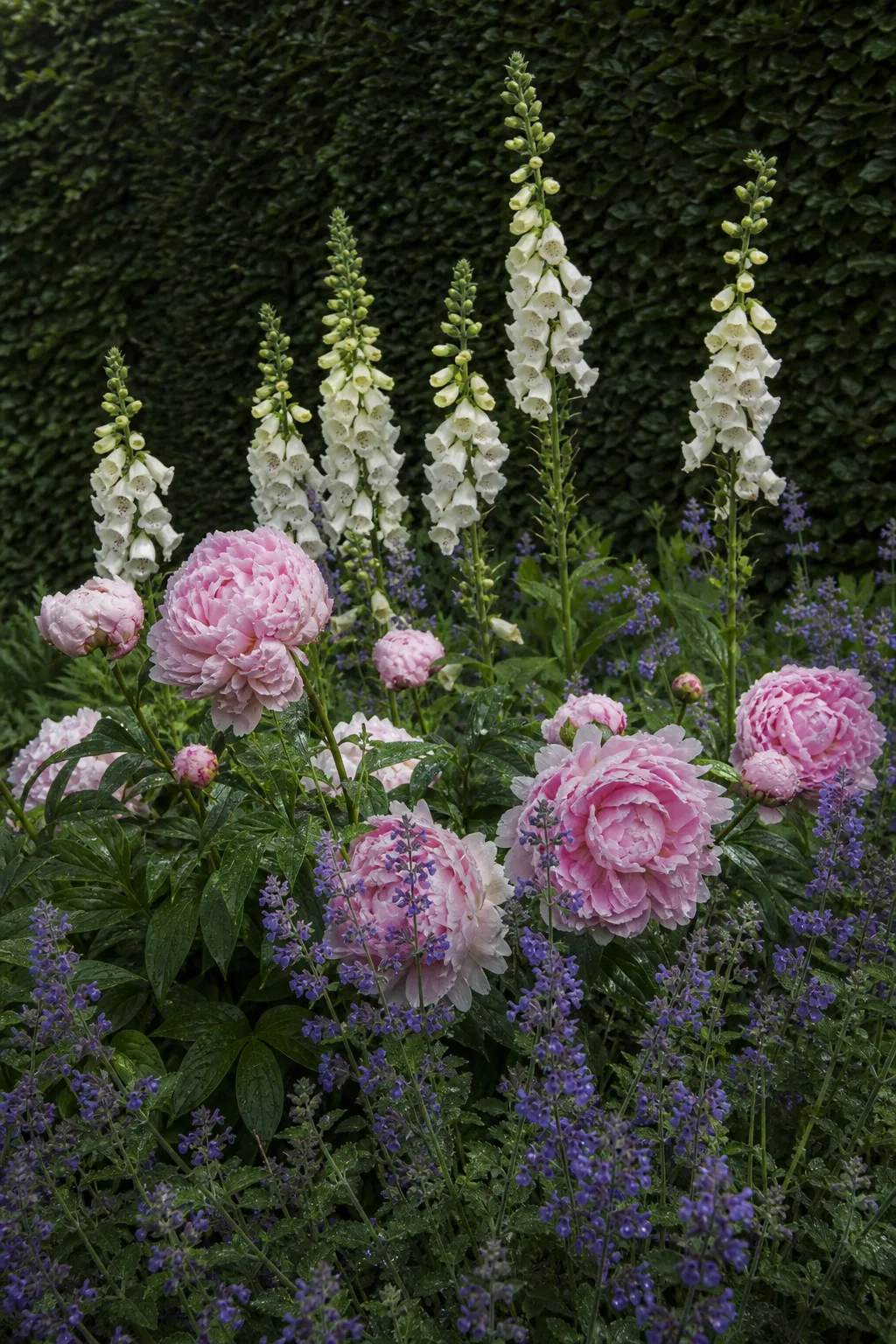
Rosen are not the only partners with stature. If you want to give the bed a backbone, place towering neighbors next to the low perennial. In country house style, panicle hydrangea (Hydrangea paniculata), sedum (Hylotelephium telephium) and lilies (Lilium hybrids) harmonize with the catnip that fills the ground between them. The lush flower balls of a peony (Paeonia lactiflora) are particularly effective in front of a dark hedge.
For the cottage garden, the mixture of foxglove (Digitalis purpurea) and poppies – such as the dark variety Papaver orientale ‘Patty’s Plum’ – is a long-time favorite. The loose, filling growth habit of catnip closes the gaps between the tall stems so that no bare spots remain. Similar to other bed combinations – such as the appropriate companion plants for lilacs – the effect comes from the alternation of height and flat undergrowth.

Grasses and ground cover bring movement to the bed
Grasses bring something to the bed that flowers alone cannot do: movement. Next to a garden bench, the feathery stalks of Hakonechloa macra and the evergreen clumps of the Japanese sedge (Carex morrowii) together with purple steppe sage (Salvia nemorosa) and catnip act like a soft cushion. Miscanthus ‘Morning Light’ (Miscanthus) sets a silvery accent in the modern front garden, complemented by white and purple petunias.
Riding grass (Calamagrostis) is ideal for dry city beds because it can withstand heat and drought just as easily as catnip itself. The Pyrenean cranesbill (Geranium endressii) with its delicate pink flowers is recommended as a gap filler on the ground. If you would like to think further about the interaction between flowering perennials and stalks, our guide on how to combine hydrangeas and ornamental grasses will also help with catnip.

Bulb flowers for the start of early summer
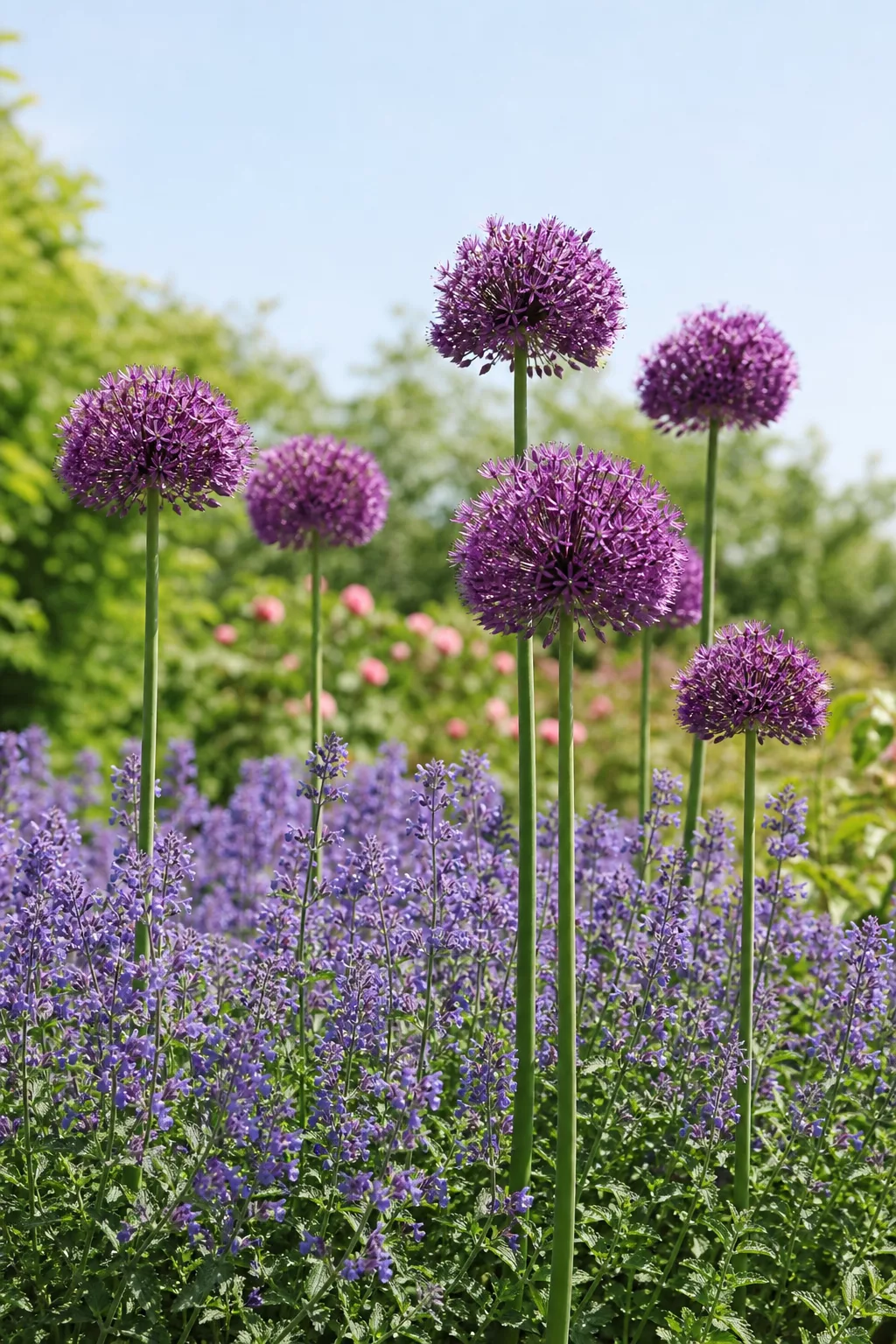
So that the bed shows color before the main season, it’s worth taking a look down – at the onions. Large ornamental allium varieties such as Allium giganteum or ‘Globemaster’ place purple balls on slender stems in front of a hedge that seem to float above the still low catnip. Smaller but just as effective is Allium aflatunense ‘Purple Sensation’ directly on the rose bush.
The trick is in the timing: The bulbs go into the ground in autumn and bloom in spring to early summer – exactly in the phase before the catnip reaches its main bloom. So the ornamental onion makes the first appearance, and when its balls fade, the violet-blue perennial is already there to fill the stage.
Which planting partners are better to avoid?
As much as catnip likes to combine, not every neighborhood is good for it. The reason is always the same location: it needs full sun and well-drained, rather dry soil. Plants with conflicting requirements quickly find themselves in trouble.
Danger For very shade perennials such as hostas (Hosta): They need cool, moist soil and should be kept in a sunny, dry place. Plants that are permanently wet, such as the marsh marigold or the Siberian iris (Iris sibirica), which are at home at the edge of the pond, are also not suitable. And overgrown neighbors such as bamboo overgrow the loose catnip over time and deprive it of light and root space. If you exclude these three groups – shade, wetness and aggressive foothills – from the outset, you will save yourself the most disappointments.

What’s Hot


Garden and plants
8 companion plants for lilacs – and 3 that don’t fit
Plant catnip correctly: planting distance, location and pruning
So that the catnip can develop freely, keep a distance of 30 to 40 centimeters from the neighboring plant. At this distance it grows together into a closed cushion in the second year without crowding the roots of its partners. It’s up to you whether you use the perennial as a continuous bed border along a path or as a flat filler in the middle of the bed – both work.
Pro tips
- 30 to 40 cm distance plan – then the gap will be filled in the second year without the roots being intruded too early.
- First pruning directly after the June bloom, about a hand’s breadth above the ground – this drives a second, often more lush burst until late summer.
- Spring pruning As an alternative: when budding begins in February or March, shorten the old stems by a hand instead of clearing them in autumn.
- As a border Plant in a continuous row, or as filler in loose groups of three or five – this way the area appears natural instead of gridded.
The second pile is the real bonus – hardly any other perennial rewards a short cut so reliably with a fresh round of flowers. Whether you grab the scissors immediately after the June bloom or leave the withered stalks standing over the winter depends on the bed: If the stems remain standing until spring, they provide shelter for insects and protect the root ball in the event of frost.

Frequently asked questions
Is catnip the same as lavender?
Can catnip tolerate partial shade?
Conditional. The robust perennial can withstand a few hours of shade a day, but in full sun it blooms significantly more profusely and more compactly. In partial shade, the growth becomes looser, the abundance of flowers decreases and the plant tends to fall apart. For a dense flower cushion, full sun is clearly the better choice.
Is catnip non-toxic to domestic cats?
Yes, catnip is non-toxic to cats. It deserves its name: the fragrances it contains have an attractive and euphoric effect on many cats, which is why they like to roll around in them. The animal is not harmed. If you want to protect the freshly planted perennial, plant it a little closer or initially surround young specimens with a low twig trellis.