


A new study analyzing 842 tourism-related aid projects worth $13.13 billion found only 89 explicitly address climate change. Researchers say tourism’s potential to drive climate-resilient development remains largely untapped, with most projects focusing on incremental adaptation rather than transformational change needed to support sustainable and low-carbon development.
Researchers find just 89 climate-focused projects among 842 tourism development initiatives worth $13.13 billion
As posted by Susanne Becken, Research, an analytics- and policy-relevant science from Christchurch, Canterbury, New Zealand, climate change increasingly threatens tourism destinations worldwide. A new study suggests that international development funding is still falling far short of leveraging tourism as a tool for climate resilience and sustainable transformation.
Published in the journal Climate and Developmentthe study examined 842 tourism-related aid projects recorded in the global d-portal development database between 1972 and 2031. Together, these projects represent more than US$13.13 billion in development assistance. Yet researchers found that only 89 projects explicitly addressed climate change.
The findings raise important questions about whether tourism—a sector deeply vulnerable to climate impacts and widely promoted as a driver of economic development—is being fully utilized to support climate-resilient futures.
“The urgency of meaningful climate action demands transformational change that integrates adaptation, mitigation, and inclusive development,” the researchers note. While development aid plays a critical role in enabling such change, tourism’s contribution remains largely underexplored.
Adaptation Dominates Climate Investments
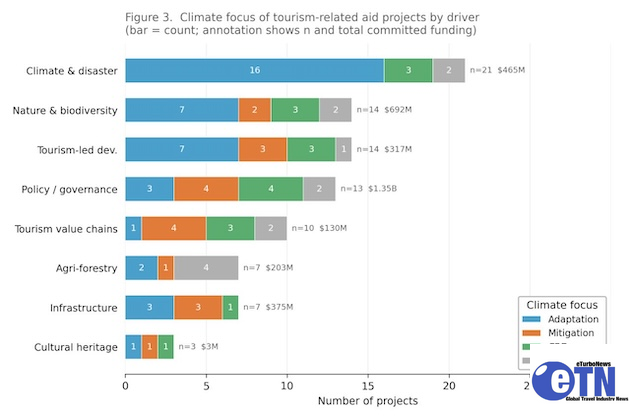
Among the 89 climate-related projects identified, adaptation emerged as the primary focus.
Most initiatives concentrated on helping destinations and communities build resilience against climate-related disasters, including extreme weather events, flooding, and other environmental shocks. Disaster risk reduction and adaptation measures represented the largest share of climate-focused tourism aid.
Nature conservation also featured prominently, particularly in larger projects where tourism was one component within broader environmental and development programs.
By contrast, climate mitigation received far less attention. Where mitigation was included, it was primarily linked to forest conservation and carbon-sink projects rather than to efforts to decarbonize tourism operations, transportation systems, or destination infrastructure.
The researchers found limited evidence of investments specifically designed to reduce tourism’s carbon footprint.
Tourism’s Transformational Potential Remains Untapped
A central question of the study was whether tourism aid is helping drive what experts call Climate Resilient Development (CRD)—an integrated approach that combines climate adaptation, emissions reduction, and inclusive social and economic development.
To answer this, researchers developed a transformation index measuring three key factors:
- Cross-sector complexity
- Inclusiveness
- Deliberate transformational design
The results were sobering.
Most projects were found to be incremental rather than transformational. While many delivered valuable development outcomes, few challenged existing development models or fundamentally reimagined tourism’s role in addressing climate change.
The study concludes that truly transformational approaches remain the exception rather than the norm.
Surprising Divide Between Small and Large Projects
One of the study’s most notable findings was a structural divide between different types of development assistance.
Researchers discovered that smaller bilateral projects—direct country-to-country interventions—often demonstrated greater transformational potential than larger multilateral programs.
According to the analysis, transformational approaches were more likely to emerge in smaller, targeted initiatives where local priorities and innovation could be integrated into project design.
In contrast, larger programs frequently reinforce existing institutional structures and development practices rather than challenging them.
This finding may prompt development agencies and international financial institutions to reconsider how tourism-related climate investments are designed and implemented.
The Missing Piece: Human Behavior and Values
Perhaps the most significant conclusion concerns what researchers describe as the “personal sphere of transformation.”
While many projects addressed infrastructure, ecosystems, governance systems, and economic development, few engaged with the social and behavioral changes needed to achieve lasting transformation.
The study argues that changing attitudes, values, decision-making processes, and consumption patterns remain a largely overlooked component of climate-resilient tourism development.
Without addressing this human dimension, researchers warn, even well-funded projects may struggle to deliver long-term transformational outcomes.
A Wake-Up Call for Tourism Development
The research arrives at a critical moment for the global tourism sector.
From small island developing states and coastal destinations to mountain communities and biodiversity hotspots, many tourism-dependent economies face growing climate risks. At the same time, tourism continues to be promoted by governments and international organizations as a powerful engine for economic growth, poverty reduction, and conservation funding.
The study suggests that these objectives need not compete.
Instead, tourism development programs can potentially become vehicles for climate-resilient, low-carbon, and socially just development—but only if climate considerations are intentionally integrated into project design from the outset.
Looking Ahead
The analysis provides one of the first comprehensive global assessments of how tourism aid intersects with climate action.
Its message is clear: tourism possesses significant untapped potential as a catalyst for climate-resilient development, but current funding patterns remain heavily weighted toward incremental adaptation measures rather than transformational change.
With only 89 climate-related projects identified among 842 tourism aid initiatives worldwide, researchers argue that deliberate policy choices, innovative funding mechanisms, and stronger integration of climate objectives will be necessary if tourism is to play a meaningful role in achieving global climate and development goals.
As governments, development banks, and international agencies search for practical pathways toward sustainable development, the study serves as both a benchmark and a challenge: move beyond business as usual and harness tourism as a force for transformational climate action.