

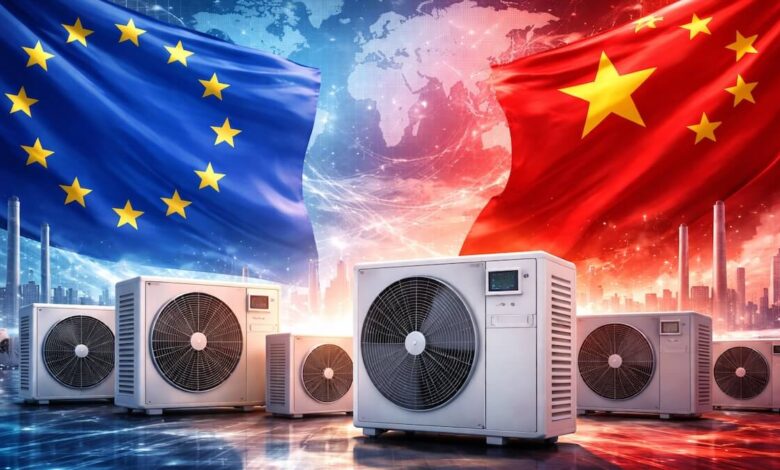
China is focusing on the heat pump market and wants to massively expand its capacities with an ambitious action plan. This means that competitive pressure is growing for European providers – and there is concern about déjà vu like in the solar industry.
Heat pumps are considered a central technology in the energy transition in the building sector because they can replace fossil heating systems and drastically reduce the CO2 emissions of buildings. Since they primarily use electricity, which increasingly comes from renewable sources, they are an important building block for achieving climate goals and increasing independence from gas and oil.
According to the Federal Heat Pump Association (BWP), around 299,000 new heat pumps were installed in Germany in 2025 alone. An increase of around 55 percent compared to the previous year 2024, in which only around 193,000 heat pumps were added.
However, the growing market is also attracting international manufacturers to the scene. This is particularly clear in the example of China, which wants to specifically promote the massive expansion of the heat pump sector with a state-controlled “action plan to promote high-quality development in the heat pump industry”.
The Federal Heat Pump Association has published and evaluated this action paper. The BWP assumes that “increasing competitive pressure can be expected for the European heat pump industry” as a result.
Will all heat pumps soon be “Made in China”?
The action plan shows that China sees heat pumps as a key technology for energy sovereignty and the achievement of climate goals and CO2 reduction. The plan sets concrete goals by 2030. Among other things, China wants to increase the efficiency of heat pumps by more than 20 percent.
In addition, the manufacturing and R&D capacities for heat pumps are to be continuously improved. During this period, breakthroughs in core technologies such as high-performance, high-temperature heat pumps, highly efficient compressors and new types of refrigerants will be developed.
But China doesn’t just want to make progress in the area of heat pumps in research and development and expansion in its own country. An “expanded international competitive advantage” is also specifically listed as a goal in the strategy paper by 2030.
The Federal Heat Pump Association reads from this that “China wants to promote a broad and politically supported increase in demand”. The plan not only covers the building sector, but also targets industry, agriculture and transport. China can already cover a broad domestic market – not just individual niche products.
What does this mean for the heat pump industry in Europe?
But is the European heat pump industry now facing a scenario that many in the solar industry know all too well? Within a few years, Chinese manufacturers had displaced large parts of local production there with massive government support, high volumes and low prices.
The loss of state subsidies did the rest for the German solar industry. Given the rapidly growing heat pump market, there is now growing concern that this development could repeat itself.
This is also why EU Commissioner Stéphane Séjourné calls for this in a guest commentary Handelsblatt: “We must establish, once and for all, a real European preference in our most strategic sectors.”
The energy sector plays an important role, especially with regard to the heating transition. “Without an ambitious, effective and pragmatic industrial policy, the European economy is doomed to become just a playground for its competitors,” says Séjourne.
The Federal Heat Pump Association also expects a significant increase in competitive pressure as a result of the efforts in China. With ambitious plans to increase domestic volume, modernize manufacturing, centrally developed core components and advance international standardization, Chinese manufacturers could “significantly expand their international competitiveness.”
For China, the strategy paper “forms the basis for an accelerated market ramp-up of heat pump technology”. This in turn increases the pressure on quality and consolidation in the market.
This could increase price pressure for air-water heat pumps and individual components in Europe. For European end customers, the BWP expects a broader offering at “probably very competitive prices”.
Also interesting: