


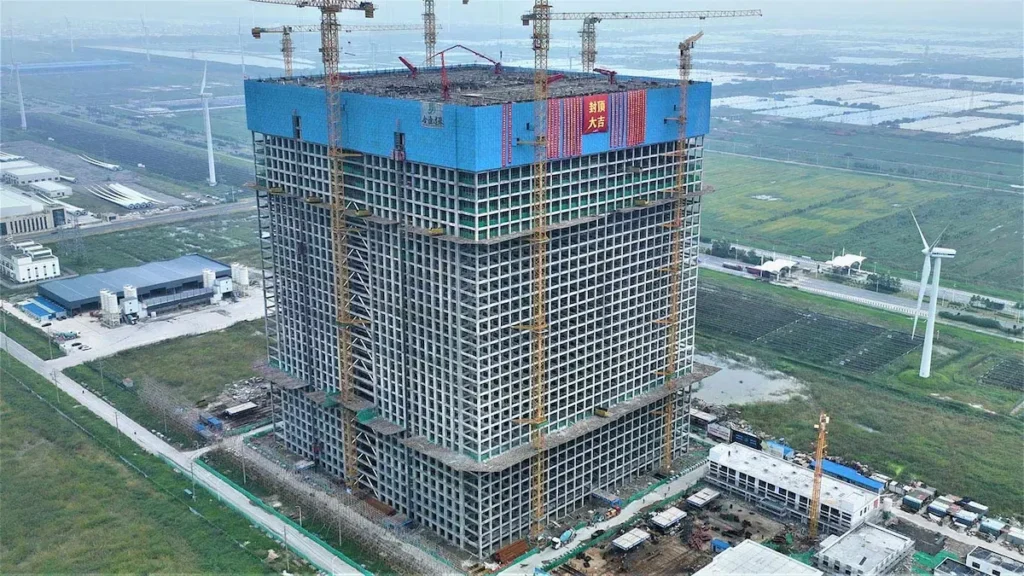
Electricity from wind and solar is cheap, but not always available. A system is now coming online in China that is intended to solve the problem using an astonishingly simple principle. It lifts heavy concrete blocks and recovers electricity as they are lowered. The world’s first commercial gravity energy storage device delivers 100 megawatt hours, lasts for 35 years and is completely lithium-free.
The company Energy Vault is implementing the world’s first commercial gravity-based energy storage system on an industrial scale in Rudong, China. The underlying insights come from an official project overview. Together with the local companies Atlas Renewables and CNTY, the system was built in the immediate vicinity of a large wind farm and the national power grid.
The core products used include the EVX technological platform and the VaultOST product. The system has a peak output of 25 megawatts and offers a total storage capacity of 100 megawatt hours. The system, which is currently being commissioned, should be able to deliver electricity continuously over a period of four hours. The storage period is theoretically unlimited.
How gravity energy storage stabilizes the grid in China
The predicted efficiency in the charging and discharging cycle, the so-called round-trip efficiency, is over 80 percent. This puts the system in a technologically superior position to alternative long-term storage methods such as thermodynamic, mechanical or purely chemical liquid battery systems. The system is also characterized by the fact that no self-discharge takes place.
The primary goal of this setup is to effectively balance the Chinese power grid for the State Grid Corporation of China (SGCC) by timing renewable energy. It thus directly supports the Chinese “Zero Carbon Parks” initiative and the national “30-60” plan to achieve complete climate neutrality.
Sustainability and the independence of supply chains
A key technological advantage is its extreme longevity, as concrete that is lifted to heights shows little degradation over time. This means that no subsequent system expansions or performance corrections are required over the planned operational lifespan of 35 years. The design also allows a strong focus on local supply chains and the regional procurement of labor and materials.
According to the company, the establishment of these regional procurement channels significantly reduces the financial risk and the vulnerability to volatile price changes on the global raw material markets. This first installation therefore serves as a technological benchmark for future global collaborations in the area of decarbonization.
Also interesting: