

Lithium-air batteries promise electric cars with a range of over 1,600 kilometers – at least in theory. In the laboratory, prototypes already exceed the energy density of today’s batteries four times. The Chinese battery manufacturer CATL has now officially included the technology in its long-term strategy for 2030.
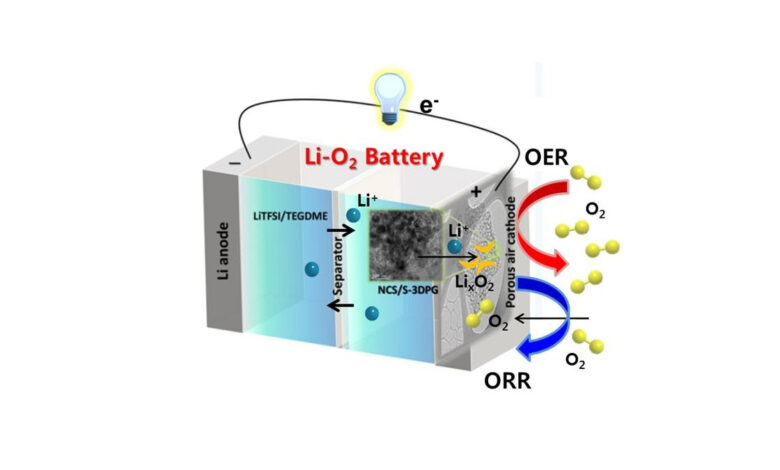
Conventional lithium-ion batteries are based on heavy metal compounds such as nickel, cobalt and manganese. So-called lithium-air batteries instead use lithium metal as an anode and oxygen from the air as a reactant at the cathode.
This special principle is intended to significantly reduce the weight and complexity of the entire battery. The theoretical energy density of these systems is around 12,000 watt hours per kilogram.
Lithium-air batteries create four times the energy density of current batteries
In laboratory tests, current prototypes have already achieved an energy density of more than 1,200 watt hours per kilogram. This means that these systems exceed the energy density of conventional commercial batteries four times.
However, practical implementation has so far mostly failed due to sensitivity to moisture and carbon dioxide in the air. In addition, inadequate catalyst stability and a short service life limited its functionality in everyday life for a long time.
A US research team demonstrated improved stability over more than 700 cycles in an air-like environment as early as 2024. In the following year, 2025, Argonne National Laboratory and the Illinois Institute of Technology developed a prototype with 1,000 charging cycles at room temperature.
This was achieved through a four-electron chemistry step that enabled the stable formation and decomposition of lithium oxide. The researchers also replaced flammable liquid electrolytes with a solid composite matrix, further increasing the safety of the cells during cycling.
From 2030: This is how CATL is planning the path to lithium-air batteries
Despite these successes in the laboratory, it will still take a long time for the technology to be widely marketed. The Chinese battery manufacturer CATL is initially relying on sophisticated technologies and sodium-ion batteries in its current corporate strategy. As a medium-term goal, the company is focusing on the development of solid-state batteries.
Research into the theoretical limits of lithium-air technology, however, is only planned for the period from 2030 onwards. Wu Kai, chief scientist at CATL and a member of the Chinese Academy of Engineering, made the announcement at the “Powering the Nation Forum 2026”.
The development could mean progress in the future for everyday use. If production on an industrial scale succeeds, electric vehicles could in future travel over 1,600 kilometers on a single charge. Conventional motor vehicles with combustion engines would be pushed out of the market in the long term by this level of performance, assuming the batteries are reasonably affordable.
Also interesting: