


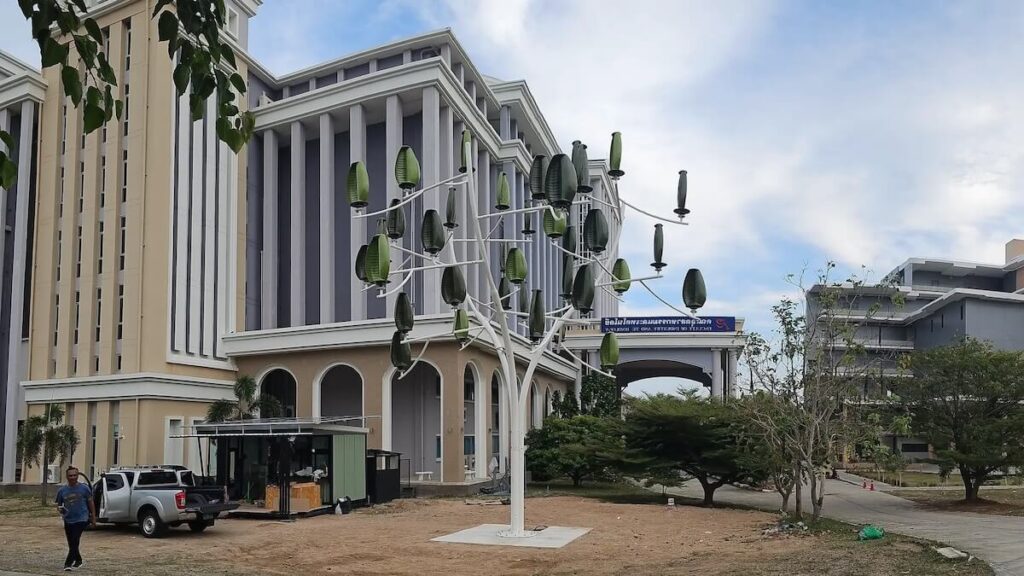
A wind tree with 36 leaf-shaped microturbines is intended to provide electricity even in low winds – around the clock, regardless of the sun. The first private facility in Germany has recently been built in Lower Saxony. But with a price of 70,000 euros, the question arises: Can the wind tree really compete with a photovoltaic system?
Photovoltaic systems now dominate the landscape in many residential areas in Germany. Solar panels that convert sunlight into electricity and provide green electricity for private households can be found on more and more house roofs.
When it comes to wind power, things are rather different. While large wind turbines dominate the landscape, smaller solutions for private use have so far played little role.
This is exactly where concepts such as the “wind tree” come in, which are intended to make wind energy usable in the energy supply in your own household. But whether the “wind tree” can actually compete as an alternative to photovoltaics in the private sector depends largely on factors such as location, wind conditions and economic viability.
Wind tree vs. solar system: What are the advantages?
The advantages of wind turbines over solar energy are clear. This is because they can generate electricity even when there is no sunlight, for example at night or when the sky is cloudy.
Especially in regions with constant air currents, they can deliver more consistent yields throughout the day. This is exactly where the “wind tree” from the French company New World Wind comes in.
With its blade-shaped microturbines, it can generate electricity at very low wind speeds of around 2.5 meters per second. This means that electricity is continuously generated even when the wind is weak, enabling more consistent energy production, while classic wind turbines would still be idle in this area.
The small turbines, the so-called “Aeroleafs”, each deliver up to 300 watts. A tree with 36 leaf turbines could achieve a total output of up to 10.8 kilowatts.
Compared to a classic balcony power plant, the theoretically possible peak performance of the “wind tree” is significantly higher. However, this is a maximum value under ideal conditions; the actual performance of course depends heavily on the actual wind conditions at the location.
Only two locations in Germany – and a private pioneer
The Windbaum in the Ruhrpark shopping center in Bochum has been the first system of its kind in Germany since November 2015. A year later, another facility was added in Stuttgart.
“We have already installed over 200 wind trees all over the world,” explains managing director Luc Eric Krief to the HNA. The first wind tree was only recently created on private property in Lower Saxony.
Due to its height of 9.8 meters, no building permit was required. However, a concrete foundation had to be poured to stabilize the steel tree, which weighs around 3.5 tons.
In total, the investment for the “wind tree”, including the foundation and electrical installations, amounted to around 70,000 euros. It is questionable whether the high price can be put into perspective in the long term by more constant electricity production with weak winds. Therefore, photovoltaics for private use are currently likely to be the economically more attractive solution in most cases.
Also interesting: