


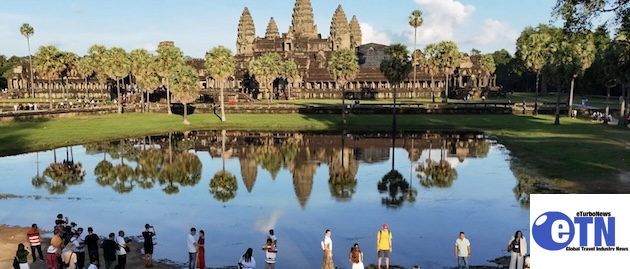
Cambodia’s tourism industry is facing renewed pressure after international visitor arrivals plunged 45 percent in early 2026. Despite the slowdown, the kingdom continues to attract travelers with Angkor Wat, tropical islands, eco-tourism, affordable luxury and expanding infrastructure, while competing intensely with regional tourism giants Thailand and Vietnam.
For decades, Cambodia has sold itself to the world through a single image: the soaring stone towers of Angkor Wat rising through jungle mist at sunrise. But the Southeast Asian nation is far more than a temple destination. It is a country of tropical islands, riverfront cities, culinary traditions, eco-tourism adventures and some of Asia’s most affordable long-haul travel experiences.
Now, however, Cambodia’s tourism industry faces one of its most difficult periods since the pandemic recovery.
According to a recent report by Khmer Times, international tourist arrivals plunged by nearly 45 percent in the first quarter of 2026, with just over 1 million foreign visitors entering the country. The decline follows an already weaker 2025, when Cambodia welcomed approximately 5.57 million visitors, down from 6.7 million in 2024.
The downturn has raised urgent questions for Cambodia’s tourism-dependent economy: Why are visitors staying away? Can the country compete with Thailand and Vietnam? And what still makes Cambodia one of Asia’s most compelling destinations?
The Enduring Appeal of Cambodia


Despite the recent slump, Cambodia retains several powerful tourism advantages.
1. World Class Heritage
The country’s tourism industry revolves around Angkor Archaeological Park, one of the world’s greatest religious and archaeological sites. Built between the 9th and 15th centuries during the Khmer Empire, the vast complex attracts millions of travelers annually and remains Cambodia’s international symbol.
Beyond Angkor Wat itself, travelers explore the haunting stone faces of Bayon Temple, the jungle-covered ruins of Ta Prohm and ancient reservoirs stretching across the Siem Reap countryside.
UNESCO describes the Angkor complex as one of Southeast Asia’s most important archaeological treasures.


The Official Site for Tourism of Cambodia
Agency offering information about Cambodia Tourism, Visa, Culture, Attractions, Travel Guides, Trip Planner, Hotels, Flights, Cars, Tours, Bus and Boat Tickets, News and Gallery.
2. Affordable Travel
Cambodia remains significantly cheaper than neighboring Thailand and increasingly less expensive than Vietnam in many tourism categories.
Typical daily travel budgets include:
- Backpacker: US$25-50 per day
- Mid-range traveler: US$70-150
- Luxury traveler: US$250+ with five-star resorts and private tours
A quality street-food meal in Phnom Penh can cost under US$3, while boutique hotels in Siem Reap often start around US$40–60 nightly.
3. Various tourism experiences
Cambodia is gradually diversifying beyond temple tourism.
Travelers increasingly seek:
- Eco-tourism in the Cardamom Mountains
- Island escapes on Koh Rong and Koh Rong Samloem
- Culinary tourism focused on Khmer cuisine
- Mekong River cruises
- Community-based village tourism
- Wellness and spiritual retreats
The country is also investing heavily in aviation infrastructure, including the massive new Techo International Airport near Phnom Penh, designed to dramatically increase future passenger capacity.
Phnom Penh: Cambodia’s Reinvented Capital

Once viewed mainly as a transit point, Phnom Penh has evolved into a destination in its own right.
The Cambodian capital blends French colonial architecture, Buddhist temples, rooftop bars, luxury hotels, and sobering historical museums tied to the Khmer Rouge era.
The city’s tourism growth has been supported by:
- Expanding air connections
- Rising luxury hotel investment
- Digital nomad arrivals
- Strong regional business travel
Visitors often combine Phnom Penh with Siem Reap and coastal destinations for one- or two-week itineraries.
Cambodia’s Beach Strategy


Cambodia’s coastline remains one of Asia’s lesser-known assets.
The islands off the southern coast offer white-sand beaches, diving, snorkeling and jungle eco-resorts. While destinations like Thailand’s Phuket and Indonesia’s Bali dominate international marketing, Cambodia’s coastal areas still appeal to travelers seeking quieter experiences.
However, rapid Chinese investment and casino-driven development in Sihanoukville have dramatically transformed parts of the coast, generating both economic opportunity and criticism of overdevelopment.
Why tourism is falling
The sudden 2026 decline shocked many tourism operators because Cambodia had previously appeared to be recovering strongly from the pandemic.
Several factors are contributing to the downturn.
Regional competition
Cambodia faces fierce competition from neighboring tourism giants.
Thailand continues to dominate regional tourism with stronger global branding, larger aviation networks and broader resort infrastructure. Vietnam has rapidly expanded international air routes and digital tourism promotion.
Cambodia, by contrast, remains heavily dependent on regional ASEAN visitors and short-haul markets.
Declining Regional Visitors
Industry reports indicate sharp declines from neighboring countries, particularly Thailand and Laos. Land-border tourism has weakened significantly.
Security and Political Perception
Although most tourists visit Cambodia without serious problems, some governments advise travelers to exercise caution because of petty crime and regional border tensions.
International headlines have also highlighted controversies over relocations in the Angkor region and concerns about tourism management.
Dependence on Angkor Wat
Cambodia still relies heavily on one iconic destination.
Tourism analysts argue the country must diversify faster into coastal, eco-tourism, wellness and high-value travel sectors if it wants longer visitor stays and higher spending.
The Chinese Tourism Factor
China remains critical to Cambodia’s tourism ambitions.
Before the pandemic, Chinese travelers were among Cambodia’s fastest-growing visitor groups. The government continues targeting Chinese airlines, tour operators, and investors.
Several recent reports note that while overall arrivals weakened, Chinese visitation showed signs of improvement during parts of 2025.
Massive Chinese-funded infrastructure projects — airports, highways, and casino developments — have reshaped parts of Cambodia’s tourism landscape, especially around Sihanoukville.
Sustainability Challenges
As Cambodia pushes for tourism growth, sustainability concerns are intensifying.
Environmentalists warned that unmanaged tourism can damage fragile ecosystems, coastal areas, and archaeological sites. Academic research increasingly links rapid tourism expansion with biodiversity pressures in developing destinations.
At Angkor, authorities continue to balance preservation with mass-tourism demand. Debates about relocation policies around the UNESCO site have attracted global attention.