


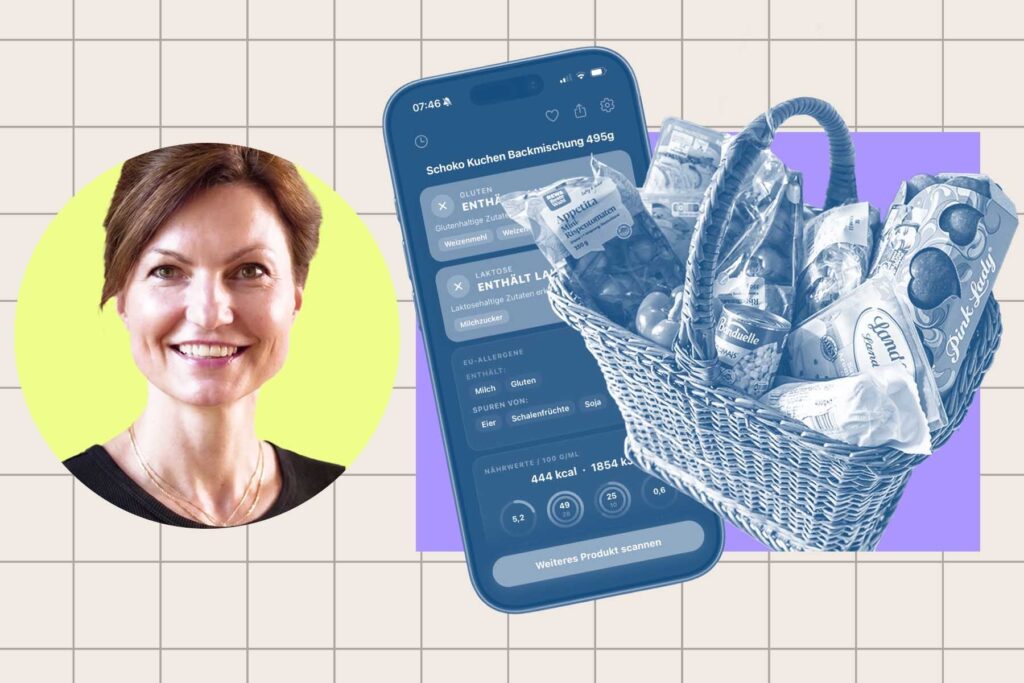
A gluten diagnosis gave Swantje Dettmers an idea. She programmed her own app with Claude – today it’s a startup.


Swantje Dettmers has celiac disease. Even the smallest amounts of gluten can trigger inflammation and damage the lining of the small intestine. “I even had to replace my cutting boards because there could still be traces in the wood,” she tells Gründerszene.
From now on, Dettmers reads the ingredient lists of all the foods she needs in the supermarket. “Often they have tiny prints or yellow writing on a white background,” she says. “Every purchase suddenly took three to four times as long.”
The mother of the family takes photos and enlarges the texts with her smartphone. But she realizes: “That can’t be the solution.” When doctors discovered that her children also had gluten intolerance, she came up with a plan. “That’s when I realized that there had to be a helper to help with the shopping.”
Dettmers is building an app that uses a barcode scan to detect whether a food contains incompatible substances. It is intended to show how dangerous a product is using traffic light logic: red for questionable, yellow for caution, and green for gluten-free. Four months later, the product and the startup are available: Ampelo. Around 5,000 users have already downloaded the app. Dettmers programmed it primarily with artificial intelligence (AI) – and in an interview with Gründerszene she tells us exactly how she used Claude Code for this.
Read too


The founder programs her app with Claude Code – and has every step explained to her
As a scientist, Dettmers conducted research at the Max Planck Institute for a long time, later taught at the Open University of Hagen and most recently advised a foundation. She initially built the gluten warning app for her family. “When it became clear that I wanted to publish the app, the project needed my full attention,” she says. She gives up the job for Ampelo.
Your scientific background helps with programming. “Structuring large amounts of data, building models and validating results was my everyday life. Thanks to AI, I now had the opportunity to translate this knowledge into my own app.”
She is also working on nutritional sciences. “I did a lot of research and got additional professional support. This meant I was able to continually expand and check my knowledge,” she says. “It was almost like additional study.”
On this basis, Dettmers will develop the concept for Ampelo from October 2025. “The idea came from a very personal story. That’s why I knew exactly what problem I wanted to solve and was able to respond with precision,” she says.
AI supports the database
First, Dettmers structures her idea using ChatGPT. “I simply tried out a lot of things and kept asking the AI,” she says. She also learns with YouTube tutorials. With this knowledge, she questions the AI answers. “This is extremely important because AI also makes mistakes or hallucinates.”
She explains her vision to the model, continually asks questions and has code generated. In January, the AI model Claude Code is experiencing a lot of hype. For Dettmers, the agentic program is “clearly the best solution”. Using the programming chatbot, she writes the code for Ampelo in the terminal on her computer.
“It was ultimately a classic learning by doing. At the same time, I constantly received feedback from the AI about what worked and what didn’t. I could see immediately whether a command was successful or whether I had broken something.”
She is also building a database with more than 350,000 products from the German food trade. It is continually expanding. The basis is sometimes open source registers that list ingredients for food. Ampelo can also assign barcodes using the database.
However, it was difficult to train the AI system to correctly recognize words and classify them in the traffic light system. “The setup was complex because some ingredients are spelled differently, contain hyphens or even typos. Ampelo tries to recognize all of these variants and classify them correctly,” says Dettmers.
This includes products containing gluten, such as wheat flour. “Of course the app has to react to this. At the same time, there are terms like buckwheat flour. Although the word ‘wheat’ is included there, buckwheat is gluten-free.”
More than 1000 people use Ampelo
Dettmers also analyzes the market. About one percent of Germans have celiac disease, the number of unreported cases is higher. Up to 20 percent are lactose intolerant and an unknown number of Germans cannot tolerate fructose. That’s why she’s expanding the app. It should also recognize other intolerances.
First, 30 people test the app. More than 1,000 people have now downloaded Ampelo from the Google Play Store alone. The platform does not replace medical advice, but it is intended to help you find your way around the supermarket.
“Without AI, I wouldn’t have been able to build the app as quickly as an individual, but without my knowledge of data and programming, AI alone wouldn’t have been able to do it either,” she says.
Read too

Three tips for coding with AI
In the interview, Dettmers shares her most important tips for building an AI-supported app:
- Solves a very specific everyday problem. Right from the start I had a clear idea of what would help me personally. This concrete vision helped me enormously in developing it.
- Always question the AI’s answers critically. The prompt “Explain it to me like a ten-year-old child” also helped me a lot. This allowed me to classify and understand new knowledge step by step.
- Be brave. If you really believe in an idea and are convinced that it solves a real problem, you should have the courage to implement it.
Dettmers has not yet made any money with the free app. Instead of investors, Dettmers builds her startup with equity. She is planning premium functions in the app and collaborations with health insurance companies, the grocery store and nutrition coaches. “It was initially important to me to build trust in the product. This plays a central role, especially in the healthcare sector.”