


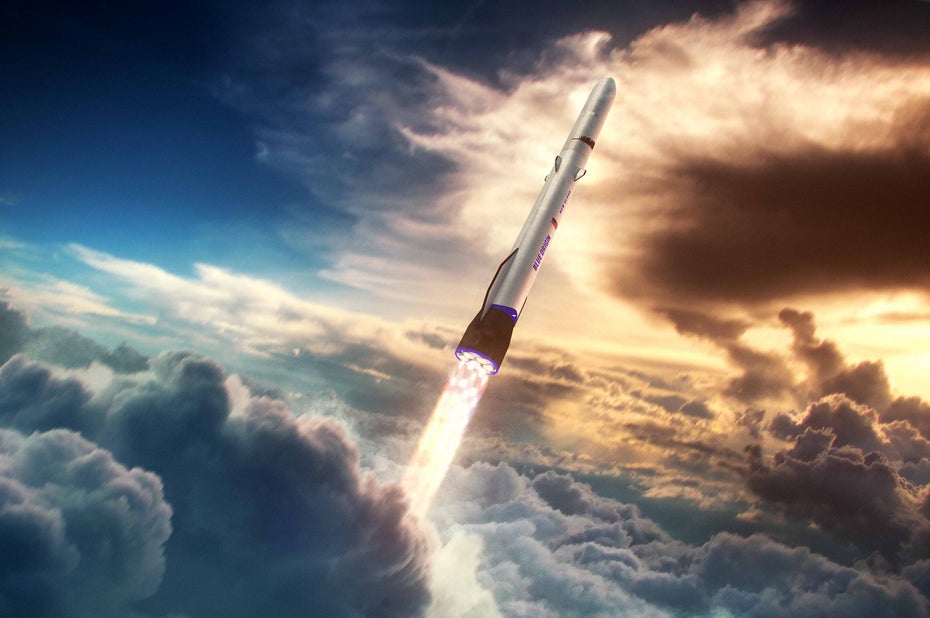
The US space company Blue Origin celebrated a premiere for its New Glenn heavy launch system on Sunday. For the first time, the company managed to relaunch an already flown orbital-class first stage and land it safely on a floating platform in the Atlantic.
The 98 meter high booster named “Never Tell Me The Odds” (after Han Solo in Star Wars) landed precisely on the landing ship after its flight. The team led by Amazon founder Jeff Bezos demonstrated that the New Glenn is fundamentally capable of reducing the costs of access to space through reuse.
However, the joy of the successful landing was short-lived as the mission failed to achieve its actual purpose. As Ars Technica reports, the upper stage malfunctioned after the stages were separated.
Satellite trapped in too low orbit
The two BE-3U upper stage engines installed, a version of the engine already known from the smaller New Shepard that was optimized for use in a vacuum, would have had to carry the BlueBird 7 communications satellite from the US company AST SpaceMobile to a target altitude of 460 kilometers. In fact, after being released, the load, which weighed around six tons, remained in an orbit of just 154 kilometers that was significantly too low.
In this region, the Earth’s atmosphere is still so dense that the satellite is massively slowed down by air resistance. According to a statement from AST SpaceMobile, the onboard fuel is not enough to correct the deficit, which is why the device will enter uncontrollably and burn up within a short period of time.
Consequences for NASA’s Artemis program
This incident is serious because the New Glenn is a central building block for the ambitious lunar plans of the US space agency NASA. Blue Origin is contractually obliged to provide a variant of its lunar lander for the Artemis program, for which an absolutely reliable launch vehicle is the basic requirement.
If the investigation into the cause of the error in the upper stage takes longer, planned test flights for the Blue Moon Lander could be delayed. NASA is closely monitoring the progress of its private partners. Competitor SpaceX was also confronted with similar problems with the upper stage of its Starship system.
Pressure in the competition of satellite networks
For AST SpaceMobile, the loss represents a major setback in direct competition with the Starlink network. The company is planning a constellation that will transmit mobile communications directly to conventional smartphones without the need for special antennas.
Although the satellite operator says the financial damage is covered by insurance, valuable time is lost in the race against the competition. While Amazon is also pushing the development of its own network with its Project Kuiper, Blue Origin now has to prove that the latest error is not a systemic problem.
Editorial recommendations
${content}
${custom_ad-badge}
${custom_tr-badge}
${section}
${title}

The company from Kent, Washington, is now faced with the challenge of correcting this partial failure as quickly as possible. Reliable reusability is of little use if reliability cannot be guaranteed when the payload is released.

Top article
${content}
${custom_ad-badge}
${custom_tr-badge}
${section}
${title}