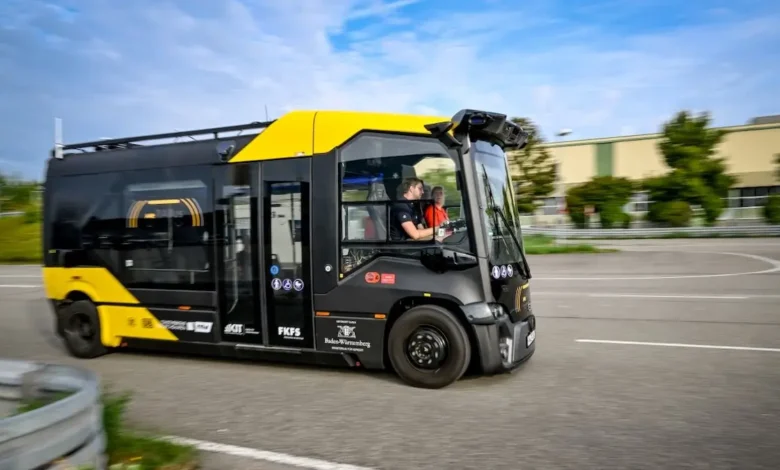
Autonomous minibuses can improve public transport and replace many car journeys. This is the result of a study by the Karlsruhe Institute of Technology (KIT), which evaluated more than 1,600 test drives with passengers.
Autonomous minibuses can improve public transport and replace traditional passenger car journeys. This is shown by a study by the Karlsruhe Institute of Technology (KIT) after more than 1,600 test drives with passengers in Mannheim and Friedrichshafen. The researchers analyzed the reliability of the technology in everyday life and the reactions of the population.
Your results form the basis for the future use of automated offers. Residents of rural areas particularly benefit from the technology, as conventional buses rarely run there. Professor Martin Kagerbauer explains that automated services improve mobility in rural areas. Reliable operation of the vehicles remains a prerequisite for this. In addition, passengers would have to understand exactly what capabilities the respective system has.
Autonomous minibuses: safety and trust as the basis
The surveys show that people are very open to autonomous vehicle technology. However, Christian Klinkhardt from the Institute for Transport (IFV) emphasizes that the passengers’ feeling of safety during the journey is decisive. This involves both the technical security of the systems and protection against aggressive behavior from other fellow travelers.
An easily visible interior and a direct connection to the control center are intended to increase passenger confidence. In addition, understandable information during the journey helps passengers feel safe and informed. Only if operators meet these conditions will people accept the offer of autonomous shuttles.
The analysis of the test drives shows that autonomous shuttles make daily trips to the train station, shopping or school easier. Christian Klinkhardt explains that these flexible offers create new mobility options for the population, especially in peripheral areas. For the system to work, the shuttles must be reliably available on demand.
Integration and technical requirements
If operators technically integrate the shuttles into existing ticketing and information systems, passengers use them without reservations. The experts are calling for seamless integration into these digital structures in order to simplify access for everyone. The system must be as easily accessible as already established systems.
Manufacturers, software providers and municipal transport companies should clearly distribute their roles among themselves. You would have to clarify who runs the business and who takes responsibility. The specific liability issue regarding software availability represents a central challenge for driverless operations.
Only when responsibilities are clear can a reliable service be created for passengers. Everyone involved must know their roles exactly in order to be able to react to technical failures. This organizational clarification forms the basis for the use of the shuttles in public spaces.
Outlook for driverless systems
The findings from the “RABus” project flow directly into the current “KIRA” and “ALIKE” projects. These projects are already testing autonomous minibuses in Hamburg, Darmstadt and the Offenbach district. This allows professionals to gain experience under different geographical conditions.
The researchers are now aiming for a regularly registered vehicle model that can operate without a safety attendant. Only this driverless operation makes it possible to implement larger model regions, as federal policy is currently planning. The goal is an autonomous system that does not require a safety attendant in the vehicle.
In the medium term, these autonomous shuttles could ensure mobility where there is currently a lack of staff. The technology also offers great potential in areas where buses currently only run very irregularly. The shuttles close gaps in the local transport network and improve connections to remote places.
The study by the Karlsruhe Institute of Technology (KIT) thus forms the starting point for autonomous line operations in Germany. The testing brings closer the widespread use of driverless shuttles. The final report shows the path for future mobility projects.
Also interesting: