


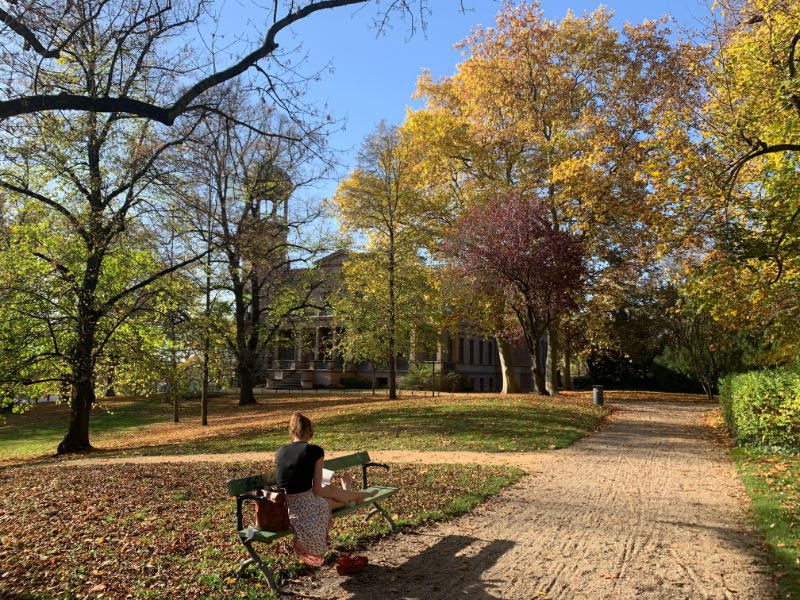
Schloss Biesdorf, a fabulous Italianate-style villa with beautiful parkland, is my latest Berlin discovery. Rather like Sleeping Beauty’s fairytale castle, it has been restored to life again after years of relative neglect. It’s only a 20-minute S-Bahn ride from the city center – a journey that whisks you from the bustle of Alexanderplatz through gritty urban industrial sprawl, past the Tierpark Zoo and into the socialist borough of Marzahn-Hellersdorf, the pride of so many East Berliners. On Biesdorf S-Bahn Station, there are signs to the nearby Schlosspark, the park surrounding the Schloss itself (English translation is generally ‘castle’ or ‘palace’) which now serves as a public art gallery and event space. Last week, in the warm autumn sunshine, Berlin was a riot of colors. Being a city of so many trees, their leaves now gently dropping, the pavements were edged in carpets of copper and gold and the parks and forests could not have looked so splendid. Biesdorf Schlosspark, a delight in any season, was simply stunning.


Originally commissioned by Baron von Rüxleben and created in 1867/68, the Schloss Biesdorf estate was purchased by electrical engineer, inventor and industrialist Werner von Siemens in 1887. He had the building renovated and extended and when his son Wilhelm von Siemens took over the property, Royal Garden Director Albert Brodersen was engaged to redesign the park. Using the existing visual axes, he created sequences of different park areas and laid out a landscape of varied terrain. The focal point of the vistas remained the castle with its Italianate charm. For many years it remained the home of the von Siemens family and after the death of Wilhelm in 1919, it was divided into apartments.

In 1927, the city of Berlin bought the estate and opened it to the public. A police station was installed on the ground floor of the castle and after Hitler came to power in 1933, the local Nazi Party Association and the Office of Public Welfare moved in and built an air raid shelter connected to the cellar. The castle was gutted by fire during the night of 20th April 1945; whether it was arson or a bomb attack is not known. When the war ended, the building was made safe and the large hall was used by the Red Army as a memorial hall for its fallen soldiers. The office rooms were extended and in further structural changes, room heights on the ground floor were reduced by inserting a false ceiling. In the early 1960s, the castle served as a village club and in the mid-1970s, it was converted into a cultural center with a branch of the Marzahn Borough Library located in the building. In 1979, Biesdorf Castle was added to Berlin’s list of heritage sites.


It wasn’t until after German Reunification in 1990 that the city of Berlin began to take an interest in the Biesdorf estate again and a foundation was set up to ensure that the castle and its parkland would eventually regain their historical appearance. In 2000, the ‘Immediate Program to Save Biesdorf’ started to raise funds for the reconstruction work, estimated at 8.5 million Euros. Between 2002 and 2007, the palace façade was renovated and reconstructed. Once further funding was secured, the project was finally completed in 2016 and opened as the ‘Centre for Art and Public Space Schloss Biesdorf’ by the Mayor of Berlin. Since February 2018, the estate has once again been managed by the Department of Culture of the Borough of Marzahn-Hellersdorf. The municipal gallery is a fabulous space with its high ceilings and polished wooden floors and there are changing exhibitions of contemporary art and cultural heritage, often with a focus on urban space. An important partner is the Beeskow Art Archive with its holdings of around 23,000 objects (mainly paintings, prints, drawings and watercolors) from the GDR.


When I visited the castle last week, the current exhibition (running until 10th February 2023) features works by the GDR artist, Jürgen Wittdorf (1932 – 2018). He was known to many as an illustrator of books and his paintings, drawings and woodcuts are characterized by the Socialist Realism of his time. The GDR authorities disapproved of his depictions of young people which they considered to be too westernized. Many of them also reflect his existence as a gay man. I took several photographs of Wittdorf’s pictures, all reflecting the light streaming in from the large gallery windows. Philip Oltermann, The Guardian newspaper’s Berlin bureau chief, has written an excellent article about the Wittdorf exhibition; you can find it by following this link.


Many other events take place in the castle, including film shows, concerts, poetry readings and workshops. There is a charming Schlosscafé with good coffee and home-made cakes, and in summer tables are set out on the terrace in the colonnade overlooking the gardens. The park hosts events too; open-air concerts and a flower festival in spring when the ancient crocus meadows are in blossom. Entrance to Biesdorf Castle and its exhibitions is free. I had the impression that the socialist and inclusive philosophy of the borough of Marzahn-Hellersorf shines through this whole community project. For further information on the castle and its opening times, follow this link.
