


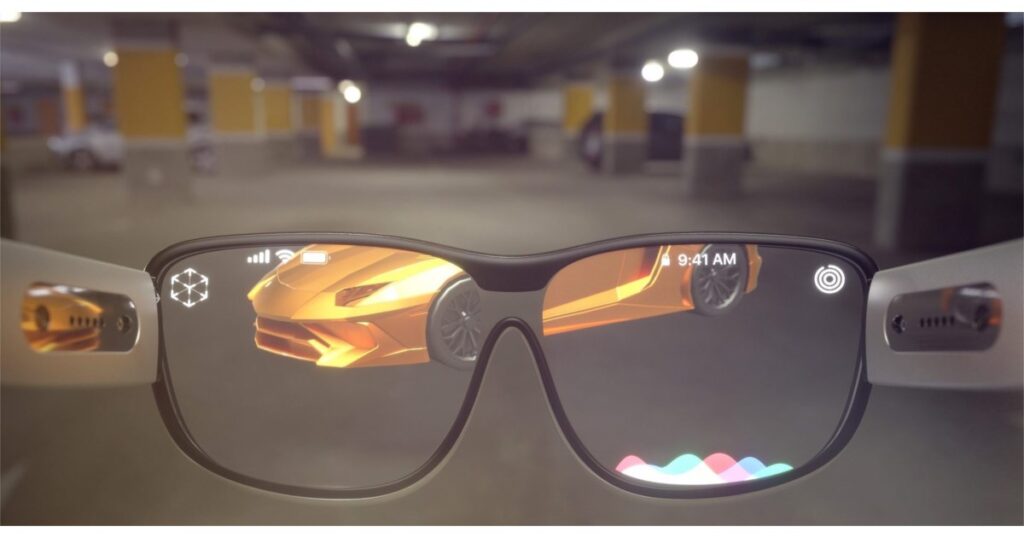


When introducing visionOS, Apple placed particular emphasis on the fact that no additional hardware had to be used to control it: Vision Pro users bring their thumb and index finger together to click. Scrolling, page turning and zooming were also controlled via gestures. Further interactions were added later. This should also be possible with “Apple Glasses”. For this purpose, the AR glasses use a wide-angle camera that records the user’s hand movements. A second, high-resolution camera is used to record photos and videos.
No display
The first generation of Apple’s AR glasses will have no visual feedback at all: the device does not integrate a screen. The model will also do without advanced sensors such as LIDAR or a second high-resolution camera for recording “immersive video”. This also eliminates the challenge of implementing the pointer control of visionOS: With Apple’s spatial computing headset, the user’s pupil movement is recorded in order to determine the current selection.
Duration decides
The reason for the limited selection of sensors lies in an important factor of user comfort: Apple Glasses should be light on the one hand and, on the other hand, last as long as possible on a single battery charge. Apparently Apple has taken to heart a frequently expressed criticism from users of the Vision Pro, whose energy storage device was connected via a cable and only lasted two to three hours of regular use.
Competition never sleeps
AR glasses are already available from a wide variety of manufacturers; most rely on voice input. Speakers in the ear hooks provide feedback to the user. Meta is quite advanced with frames from brands like Oakley and Ray-Ban. In the United States there is already a model with a display function (on the right). To implement gesture control, Meta does not use cameras, but rather a wristband (supplied).