


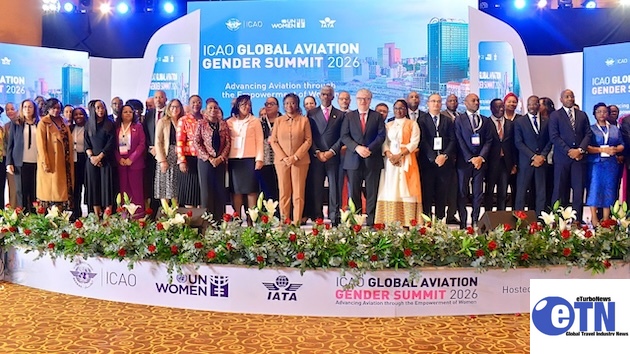
Angola is strengthening its international profile by hosting the ICAO Global Aviation Gender Summit 2026, just months after serving as ITB Berlin’s Official Host Country. The summit highlighted the urgent need to increase women’s participation across aviation, where they remain significantly underrepresented in technical and leadership roles despite growing global demand for skilled professionals.
Just months after emerging as the official partner country of the world’s largest travel trade show, ITB Berlin 2026, Angola is continuing its rise as a host of major international events. This week, Luanda welcomed more than 950 delegates from governments, airlines, manufacturers, regulators, international organizations and academia for the ICAO Global Aviation Gender Summit 2026, reinforcing the country’s growing profile as a destination for global diplomacy and industry gatherings.
The three-day summit, organized by the International Civil Aviation Organization (ICAO), concluded with a clear message: increasing women’s participation across aviation is no longer simply a matter of equality, but a strategic necessity for an industry facing growing demand, technological transformation and a worldwide talent shortage.
“The future of aviation depends on whether we succeed in unlocking the full potential of the people who will shape it. Women are not simply part of aviation’s future. They are essential to it,” ICAO Secretary General Juan Carlos Salazar said during the closing session.
Hosted by the Government of Angola with support from UN Women and the International Air Transport Association (IATA), the summit focused on practical measures to improve recruitment, retention and leadership opportunities for women throughout the aviation ecosystem. Delegates also called for better gender-disaggregated data, expanded mentorship programs, stronger leadership development and improved access to technical training.
ICAO’s latest figures illustrate why the issue remains significant. Globally, women represent only around 4% of airline pilots, 3% of aircraft maintenance engineers and technicians, and 20.6% of air traffic controllers. ICAO is responding through initiatives including a Global Network of Gender Focal Points covering 105 member states, a forthcoming Women’s Participation Toolkit and a landmark study spanning more than 140 countries.
The summit also highlighted Angola’s increasing role on the international stage. Before becoming ITB Berlin’s Official Host Country in March, Angola remained relatively unknown to many international travelers despite its vast Atlantic coastline, wildlife reserves and growing tourism ambitions. Since then, the country has accelerated its international engagement by hosting a succession of high-profile events, with the ICAO summit adding another important milestone.


Global Aviation Gender Summit 2026: Advancing Aviation Through the Empowerment of Women
An Invitation from His Excellency the Minister of Transport of Angola, Ricardo Viegas D’Abreu Aviation is a cornerstone of global connectivity and innovation. The need for a highly skilled, diverse workforce to meet the sector’s growing demands has never been greater. Yet, women continue to be significantly underrepresented across technical, operational, and leadership roles, limiting the industry’s ability to draw on the full range of skills, talent, and perspectives needed for the future. Global action is required to confront these gaps, strengthen collaboration, and mobilize the sector toward lasting change.Building off the momentum of the 2018 and 2023 Global Aviation Gender Summits, the ICAO Global Aviation Gender Summit 2026 in Luanda, Angola July 21-23 will bring together States, industry, and partners to advance dialogue on strengthening women’s empowerment across the aviation sector. The event will offer an opportunity to reflect on progress collaboration made and identify areas where continued is needed to transition from declarations and commitments to measurable, accountable, and sustainable action.Participants will explore emerging trends shaping the future of aviation and discuss how the right policies, workforce strategies, and leadership pathways can support greater participation of women in our sector. The Summit will spotlight the growing importance of data and shared knowledge in understanding and closing gaps worldwide. ICAO and its partners will introduce emerging tools and insights designed to support policies and practices across the sector to advance women’s empowerment. Discussions will focus on strengthening skills, training, and career opportunities that prepare women and girls to thrive in the aviation ecosystem of tomorrow. The event will serve as a platform for showcasing initiatives that elevate women’s representation and leadership across regulatory, operational, and technical domains.The Summit will inspire stronger partnerships and collective action to accelerate women’s empowerment across global aviation.
Is women’s empowerment really an issue in aviation?
The evidence suggests yesalthough the challenge varies considerably by occupation, region and employer.
Unlike industries where gender gaps have narrowed substantially, aviation continues to face persistent underrepresentation of women in highly technical and operational roles. The reasons extend beyond recruitment and include the high cost of pilot training, limited visibility of female role models, work-life balance challenges, historical stereotypes and relatively slow career progression into leadership positions.
Geography makes a difference
The gender gap is not uniform worldwide.
- North America and Western Europe generally have larger talent pools but still relatively low proportions of female airline pilots, typically between 5% and 7% depending on the country and airline.
- India is widely recognized as an outlier, with one of the world’s highest shares of female commercial airline pilots—around 12–15% according to various industry studies—supported by strong family acceptance of professional careers for women, expanding aviation demand and airline recruitment practices.
- Africa presents a mixed picture. Some countries have launched targeted initiatives to increase female participation, but shortages of training infrastructure and financing continue to limit entry into technical professions.
- Middle Eastern carriers have increasingly promoted women into visible cockpit and executive positions, although representation remains uneven across the region.
Companies also differ
Several aviation companies have made measurable progress through targeted diversity programs.
Examples include:
- Air India has long been recognized for employing one of the world’s highest proportions of female pilots and has operated several all-women flight crews.
- easyJet launched an “Amy Johnson Initiative” to double the proportion of new female pilots entering its cadet program.
- Qantas committed to achieving gender parity in many recruitment streams by expanding scholarships and targeted pilot training opportunities.
- Numerous airlines participating in IATA’s 25by2025 initiative pledged measurable improvements in female representation in leadership and technical roles.
These examples show that while aviation remains male-dominated globally, company policies can significantly influence recruitment and career progression.
A workforce challenge as much as a diversity challenge
One of the strongest themes emerging from the Luanda was that increasing women’s participation is increasingly viewed through an economic summit rather than purely social lens.
Global aviation expects sustained long-term growth while simultaneously facing shortages of pilots, engineers, technicians and air traffic controllers. Industry leaders argued that failing to attract more women effectively excludes half of the available talent pool at a time when skilled workers are becoming increasingly difficult to recruit.
As Angola continues positioning itself as a regional aviation and tourism hub, hosting the ICAO Global Aviation Gender Summit not only elevated an important global conversation but also reinforced the country’s growing reputation as a venue capable of convening major international events. (