


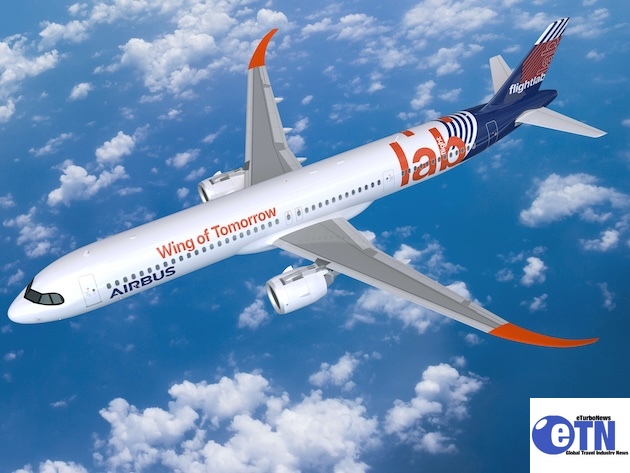
FARNBOROUGH, United Kingdom- Airbus is taking its Wing of Tomorrow research program out of the laboratory and into the air, launching a three-year campaign that will test full-scale wing extensions on an A321neo.
The extensions, each several meters long, will reproduce the aerodynamic shape of a folding wing in its fully extended flight position. Airbus said the aircraft will carry extensive instrumentation to measure structural behavior, aerodynamic performance and changes in handling under real flight conditions.
The program represents an important step towards Airbus’s next generation of single-aisle aircraft, for which the European manufacturer is examining longer, lighter and more slender wings as one of several ways to reduce fuel burn.
The extensions will be assembled at Airbus’s Wing Technology Development Center in Filton, England, with flight testing conducted from Toulouse, France. Airbus has already constructed three 17-meter ground demonstrators incorporating more than 100 manufacturing and assembly technologies. Since 2014, the wider Wing of Tomorrow program has received £227 million in funding through the UK Aerospace Technology Institute program.
“Importantly, the wing is one of the biggest levers we have to improve flight efficiency,” said Sue Partridge, head of the Wing of Tomorrow program. She said the campaign would allow Airbus to “safely challenge traditional design limits and explore the benefits of longer wings.”


eXtra Performance Wing demonstrator takes off
After looking at how wings work and how Airbus makes them, the third episode of our Wing Series zeroes in on an Airbus technology demonstrator that’s alre
Why longer wings can save fuel
A long, slender wing produces lift more efficiently than a shorter wing of comparable area. Increasing the wingspan can reduce lift-induced drag—the aerodynamic penalty created as an aircraft generates lift—and therefore reduce the thrust and fuel required during flight.
The concept is particularly attractive for single-aisle aircraft, which operate the majority of the world’s commercial flights. Airbus forecasts that airlines will require 33,920 new single-aisle aircraft between 2026 and 2045, making even modest improvements in fuel consumption significant when multiplied across tens of thousands of aircraft and millions of flights.
Airbus has not disclosed a specific fuel-saving target for the Wing of Tomorrow extensions. Any eventual improvement would depend on the complete aircraft design, including structural weight, engines, flight-control systems and the missions flown.
Independent NASA and Boeing research illustrates the potential rather than proving the performance of Airbus’s design. Studies of NASA and Boeing’s high-aspect-ratio Transonic Truss-Braced Wing have projected fuel-burn-per-seat reductions of roughly 5% to 9%, depending on the design assumptions and mission. That aircraft uses a wing supported by structural braces and is not the same configuration Airbus plans to test, so those figures should not be applied directly to Wing of Tomorrow.
The engineering trade-off is that a longer wing experiences greater bending loads. It may therefore require more structural reinforcement, which adds weight and can erase part of the aerodynamic benefit. It can also exceed the wingspan limits of existing airport gates and taxiways.
A folding outer section offers a possible solution: the wing can extend to its full aerodynamic span in flight and fold after landing to fit existing airport infrastructure.
Is Airbus the first company to try this?
No. Folding wings have been used for decades on military aircraft operating from aircraft carriers, primarily to reduce storage space rather than fuel consumption.
In commercial aviation, Boeing has gone further than any other major manufacturer toward introducing the concept on a production passenger aircraft. Its 777X has 3.5-meter folding wingtips that give the aircraft a 72-meter span in flight while allowing it to use many of the same airport gates as earlier 777 models after the tips fold upward. Boeing describes the system as a commercial aviation first.
The Airbus program nevertheless differs in several respects. The 777X is a large twin-aisle aircraft, while Airbus is examining the technology for the much higher-volume single-aisle market. Airbus also intends to test multiple wing geometries on an existing A321neo rather than immediately validating a final production design.
Airbus itself has explored hinged wings before. Its small, remotely controlled AlbatrossONE demonstrator tested flapping, semi-aeroelastic wingtips that react to gusts. Airbus called it the first aircraft demonstrator to trial flapping wingtips in flight, although it was not a full-size passenger aircraft.
The company is also assembling an eXtra Performance Wing remotely piloted demonstrator. Unlike the fixed extensions planned for the A321neo test aircraft, that project investigates a wing capable of changing shape during flight. A maiden flight is planned before the end of 2026.
NASA and Boeing have pursued another solution through the Transonic Truss-Braced Wing, which uses external braces to support an exceptionally long and thin wing. The concept demonstrates that the industry-wide search for greater wingspan is not limited to folding tips or to Airbus.
Are folding wings safe?
A folding wing is not inherently unsafe, but it introduces hazards that do not exist on a conventional fixed wing. These include incomplete extension, improper locking, asymmetric operation, actuator or sensor failures, structural fatigue around the hinge, damage during ground handling and maintenance errors.
The Airbus A321neo test aircraft will not initially be flying with tips that fold during normal operation. The extensions will replicate the wing’s fully extended geometry, allowing Airbus to study the aerodynamics and handling before adding the complexity of a complete folding system.
This staged approach lets engineers gather real-world load and handling data while limiting the number of new variables introduced at once. Airbus is also using digital modeling and wind-tunnel testing to refine the extensions before flight.
Boeing’s 777X certification requirements show how regulators are likely to approach any eventual Airbus folding-wing system.
The US Federal Aviation Administration determined that an aircraft taking off with incorrectly positioned or unsecured wingtips could face a catastrophic event. Its special conditions require such a configuration to be prevented with an extremely high level of reliability, not result from a single failure and produce appropriate warnings for the crew.
The FAA also required safeguards against the tips unlocking in flight, structural evaluation of the hinges and mechanisms, protection for ground personnel and acceptable handling during folding, taxiing and crosswind operations.
Boeing’s planned operational system automatically folds the 777X tips after landing below a specified ground speed, while cockpit indications display whether they are folded, moving or extended. Procedures are also required if one or both tips fail to fold or extend.
An Airbus production aircraft incorporating folding wings would similarly need to pass extensive structural, flight-control, system-safety, lightning, fatigue, icing and airport-operations assessments before certification by the European Union Aviation Safety Agency and other regulators.
What could passengers experience?
Passengers should not expect to see an immediate difference during the A321neo test program, which is a technology campaign rather than an airline product launch.
Should high-span wings eventually enter commercial service, the principal passenger benefit would be indirect: lower fuel consumption could reduce airline operating costs and emissions per passenger. Greater aerodynamic efficiency might also help aircraft fly farther or carry more payload, depending on how airlines and manufacturers use the performance gain.
Claims of a smoother ride require more caution.
A longer fixed wing does not automatically eliminate turbulence. In some conditions, a more flexible wing can absorb and redistribute gust loads, but ride quality depends on the structure, flight-control software, aircraft weight, speed and type of atmospheric disturbance.
Airbus’s flapping AlbatrossONE concept was specifically designed to respond to gusts, alleviate wing loads and combat some effects of turbulence. The fixed Wing of Tomorrow extensions now planned for the A321neo are a different experiment, and Airbus has not promised that they will make the passenger cabin noticeably smoother.
Passengers seated over or behind a future folding section might also notice wing movement while the aircraft is taxiing. Any production system would need clear procedures to prevent unnecessary delays if a tip failed to move into the required position.
Airport compatibility could ultimately be an important passenger benefit. Folding tips may allow airlines to use more efficient aircraft without forcing airports to rebuild gates, widen taxiways or restrict operations. Conversely, system failures could occasionally require alternative taxi routes, maintenance intervention or a return to the gate, as anticipated in Boeing’s published operational planning for the 777X.
The efficiency question is bigger than the wing
Wing of Tomorrow is one part of a broader technology package Airbus is considering for its next single-aisle aircraft.
The manufacturer is also studying advanced propulsion, lighter and more recyclable materials, digital flight systems and hybrid-electric technologies. Airbus and CFM International plan to test the open-fan RISE engine architecture on an A380 demonstrator later this decade, with the propulsion concept targeting a 20% reduction in fuel consumption and carbon dioxide emissions compared with today’s most efficient single-aisle engines.
Airbus therefore does not need the wing to deliver the entire efficiency improvement. The eventual aircraft could combine smaller gains from aerodynamics, propulsion, weight reduction and systems.
The commercial challenge will be achieving those gains without producing a wing that is too expensive, heavy or slow to manufacture. Airbus says its earlier ground demonstrators tested production methods intended to reduce wing-assembly work by more than 50%, indicating that industrial scalability is as central to the program as aerodynamic performance.
A significant test, but not yet a new aircraft
The announcement at Farnborough does not amount to the launch of a new Airbus model, nor does it confirm that a future single-aisle Airbus will have folding wings.