


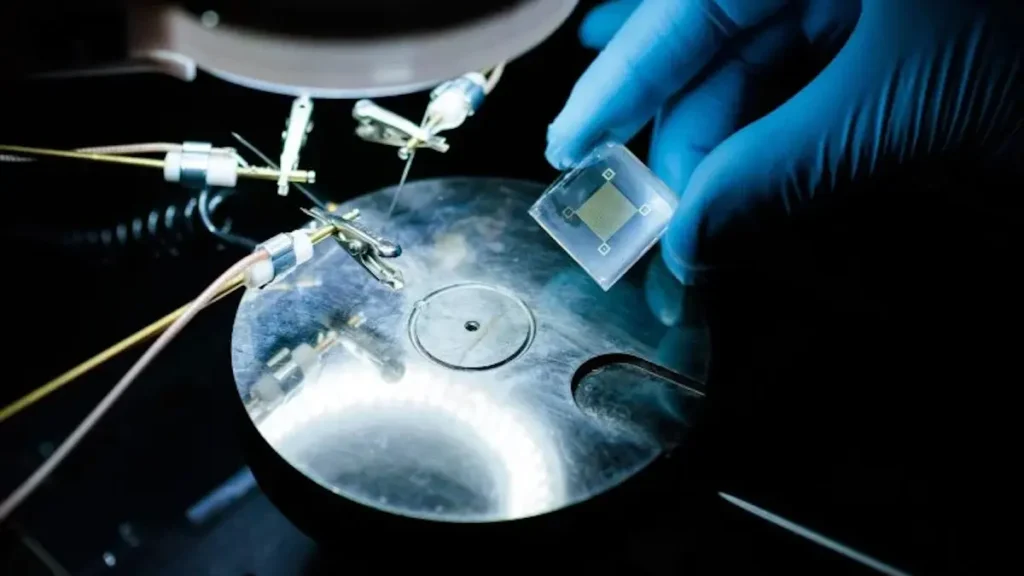
When it comes to ventricular fibrillation, every second counts. But traditional health trackers have to send data to external servers before they can sound an alarm. A new AI skin patch, however, processes vital data directly on the skin and detects life-threatening cardiac arrhythmias in milliseconds.
Conventional health trackers such as smartwatches often reach their functional limits in medical emergencies. The data collected usually has to be transmitted to servers via a wireless connection, which leads to delays in early warnings. However, in life-threatening conditions such as sudden ventricular fibrillation, every second counts, making time-consuming detours via remote servers impractical.
Researchers at the University of Chicago have now developed a new type of AI patch that can carry out the necessary calculations within a few milliseconds by processing data directly on the body.
The underlying research was published on May 20, 2026 in the journal Nature Electronics. The system therefore works completely autonomously and provides medical insights almost in real time.
New AI skin patch has up to 10,000 transistors in one square centimeter
The heart of the wearable technology is an extremely dense arrangement of organic electrochemical transistors. Up to 10,000 of these advanced components can be accommodated in one square centimeter, which corresponds to approximately 64,500 units per square inch.
The transistors process information about both electrical currents and the movement of ions in a gel-like electrolyte layer. A striking aspect of this structure is the striking similarity to human brain synapses.
Because the electrolyte layer can store information over time, each individual transistor has its own memory. A special polymer gel is used during production, which hardens into precise structures when exposed to ultraviolet light.
High precision with limitations
In initial tests, an integrated neural network showed relatively high diagnostic performance. The flexible system identified wavefront positions in ventricular fibrillation with 99.6 percent accuracy, even when the data structure was stretched to more than one and a half times its original length.
In addition, in another test, an accuracy rate of 83.5 percent was achieved when estimating the individual risk of heart attack. Despite sensitive polymers and physical hardware limitations, the system will be expanded into a fully integrated platform in the long term.
Sihong Wang, associate professor of molecular engineering at the University of Chicago and one of the lead authors of the new study, said:
The future we want to achieve is making wearable and implantable devices smarter. This gives people a personal, instantly available doctor integrated into their devices. We had to ask ourselves whether we could exploit or modify the properties of these polymers to make them compatible with photolithography – the main patterning process in the microelectronics industry.
Also interesting: