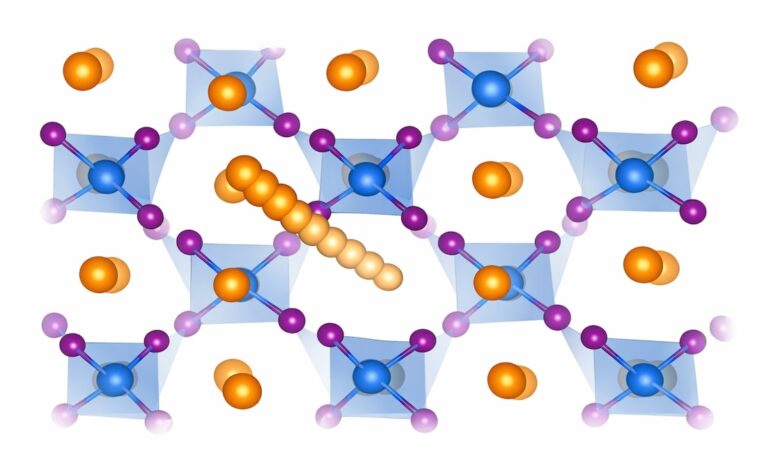
The search for high-performance materials for solid-state batteries is considered a major challenge. However, AI is now speeding things up by using Raman signals to identify suitable candidates.
Solid-state batteries promise high energy densities and safety, but the search for suitable materials has so far slowed down development. Identifying suitable electrolytes in the vast chemical space is like looking for a needle in a haystack, as lengthy laboratory tests cost valuable time.
A new AI pipeline now acts as a digital filter to screen out unsuitable materials before researchers even enter the laboratory. The decisive breakthrough comes from Raman spectroscopy, which scatters light on atoms and thus makes their movements visible.
To overcome the daunting computational barriers of traditional density functional perturbation theory (DFPT), the team uses efficient AI surrogate models. These models calculate the optical properties of solids in an extremely short time and achieve almost the precision of complex standard calculations.
AI material search for solid-state batteries
To validate it, the scientists tested their artificial intelligence with silver iodide (AgI). This material is considered a prototype for superion conductors, but due to its atomic disorder it is difficult to tame computationally. The AI still depicted the chaotic atomic movements without errors, thereby proving its practical suitability for highly complex systems.
Only after this success did the researchers transfer the process to modern sodium ion conductors. The simulations link atomistic models directly with experimentally measurable Raman signals. This created a reliable tool that can precisely predict the behavior of new energy sources.
The data efficiency of the model is impressive in practical application. To predict polarizability (the key parameter for light scattering), the AI only needed 140 training examples. Despite this small amount, the system achieved an accuracy of over 80 percent compared to the physical ground truth.
This efficiency saves valuable computing power and makes screening huge databases economically possible. The model learns how electrical polarizability changes during ion migration in the solid state. Researchers can now specifically search for substances that enable rapid energy transport.
The digital shortcut to the solid-state battery
The comparison between the doped substance NaSbWxS4 and the super conductor Na3P.S4 makes the technological difference clear. In the doped variant, ions only jump from one place to the next along rigid paths about every five picoseconds. Since this hopping hardly disturbs the crystal symmetry, the Raman signal remains weak in this region.
The gamma phase of Na behaves completely differently3P.S4in which ions literally flow through the lattice. During this liquid-like dance, even the sulfur atoms of the host structure begin to vibrate. This total breaking of symmetry creates an intense central peak in the spectrum that the AI immediately recognizes as a marker of peak performance.
The AI pipeline acts as a highly efficient filter for the materials science of the future. It clarifies in advance whether a new substance has the potential for extremely short loading times or only shows slow jump processes. This means that valuable resources only flow into the synthesis of the most promising battery candidates.
By merging quantum chemistry and machine learning, the research is now scaling the search for ionic conductors worldwide. Solid-state batteries are taking a decisive step closer to industrial mass production. In the future, the energy transition will no longer only take place in the laboratory, but first in intelligent simulation.
Also interesting: