


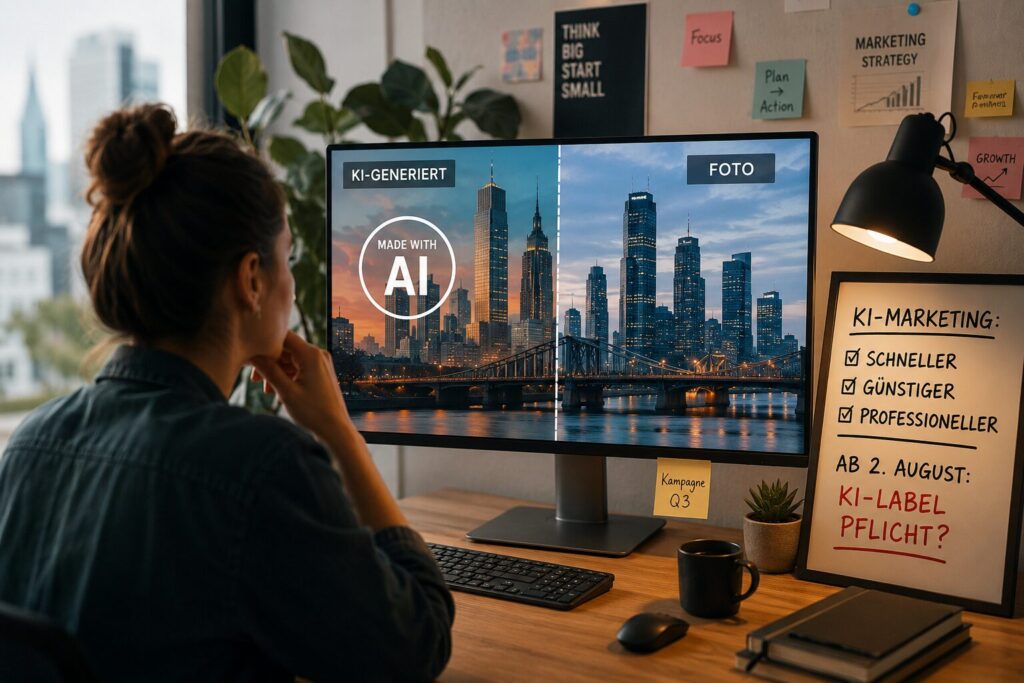
On August 2nd, Article 50 of the new AI Act will come into full force. As a small startup, you can currently produce content of exactly the same quality as a multi-billion dollar corporation. Thanks to AI, marketing your business is now 1,000 times cheaper than it used to be. But only until August 2nd.
After this date, EU legislation will require photorealistic AI-generated media to bear a visible ‘AI-generated’ label. For example in the form of a ‘Made with AI’ badge.
We are currently experiencing a cost revolution in marketing. High-quality images, texts, advertising videos, product visualizations and entire campaigns can now be created in minutes. Things that used to cost thousands or tens of thousands of euros are suddenly accessible to small businesses, self-employed people and startups. For the first time, a small business can produce advertising that no longer automatically looks cheap. For the first time, a startup with a limited budget can appear visually on a par with large corporations.
And it is precisely at this point that the EU intervenes and puts an end to the euphoria.
Imagine you want a new hero image of your office building for your website. Do you need to book a photographer? Waiting for the perfect weather? Want to catch the perfect time of day? No. Today you can solve this with AI. Perfect light, perfect angle, perfect mood. A result that looks like an expensive photo shoot. Responsible agencies are now refraining from asking customers to pay for images that were created in seconds using AI. But now imagine that there should be a visible ‘AI generated’ label on this image. Would you still use it? Probably not. And not because the picture is bad or inferior in any way. But because the label itself sends a signal: cheap.
A small example shows how absurd this rule is: If you want to sell your used car and spend three hours in Photoshop to improve the photo, you don’t need a hint. But if you do the same thing in two seconds using AI, the label is suddenly mandatory.
The legislature punishes the tool, not the intention.
A commercial in which a dirty T-shirt comes out of the washing machine magically white again in two seconds using tried and tested cutting tricks? Totally fine. However, when you implement the same concept with AI, you suddenly need a label to declare, “This isn’t real.”
Of course, there are real problems with AI. Fraud. Fake shops. Political manipulation. Nobody disputes this. But the crucial question is: Does a visible ‘AI generated’ label solve these problems? Will a criminal who builds a fake website with non-existent products obediently put an AI label on his images? Of course not.
Those who want to cheat will ignore the rules. Those who want to work legally pay the price.
This is annoying for large companies, but manageable. They continue to book studios and retouchers. They have budgets, legal departments and compliance processes. For small businesses it’s different. For them, AI is not a toy, but a lever. It makes start-ups cheaper and competition fairer. And it is precisely this leverage that is now being restricted.
The result is predictable.
This makes Europe the last market in which the ancient art of ‘Photoshopping’ is still passed down from father to son like a family craft. While the rest of the world reduces marketing costs, increases speed and tests campaigns in real time, content creation in the EU will remain more expensive than necessary. Startups will start slower. Small businesses will rather forgo better images than put an AI label on their website. Any regulation that increases fixed costs only helps those companies that can easily bear them. It doesn’t protect the little ones, it protects the established ones.
The tragedy is that the better solution is obvious.
The decisive factor should not be the tool, but rather the responsibility for the content. Just like with text. The proposed regulation stipulates that an AI-generated text that has been reviewed, edited and approved by a human is not considered uncontrolled machine utterance and does not require a badge or endorsement. Why shouldn’t the same principle apply to images?
If a company examines, consciously selects and takes responsibility for an AI-generated image, then it is responsible for the statement. Just like a photo. Just like any other form of commercial communication.
Europe is constantly talking about innovation, digitalization and competitiveness. But as soon as a technology actually helps small companies to keep up with the big companies faster and cheaper, a set of rules comes along that reduces exactly this advantage.
Not on purpose.
That’s why it makes sense to address the topic.
Long Story Short: If you want to launch a startup, build a website, or professionally position your brand, do it before August 2nd. Take advantage of the phase in which AI marketing still brings the full cost advantage.
About the author
Barnabas Szantho is a marketing expert and has worked as a marketing manager for some of the largest corporations, up to the C-level. He teaches at Pforzheim University, is a regular guest lecturer in the MBA program at Mannheim Business School, publishes articles in specialist media and works as a consultant. In 2026 he founded the marketing startup ModernPanda.de to help startups implement significantly cheaper and at the same time professional marketing through AI.
Startup jobs: Looking for a new challenge? In ours Job exchange You will find job advertisements from startups and companies.