


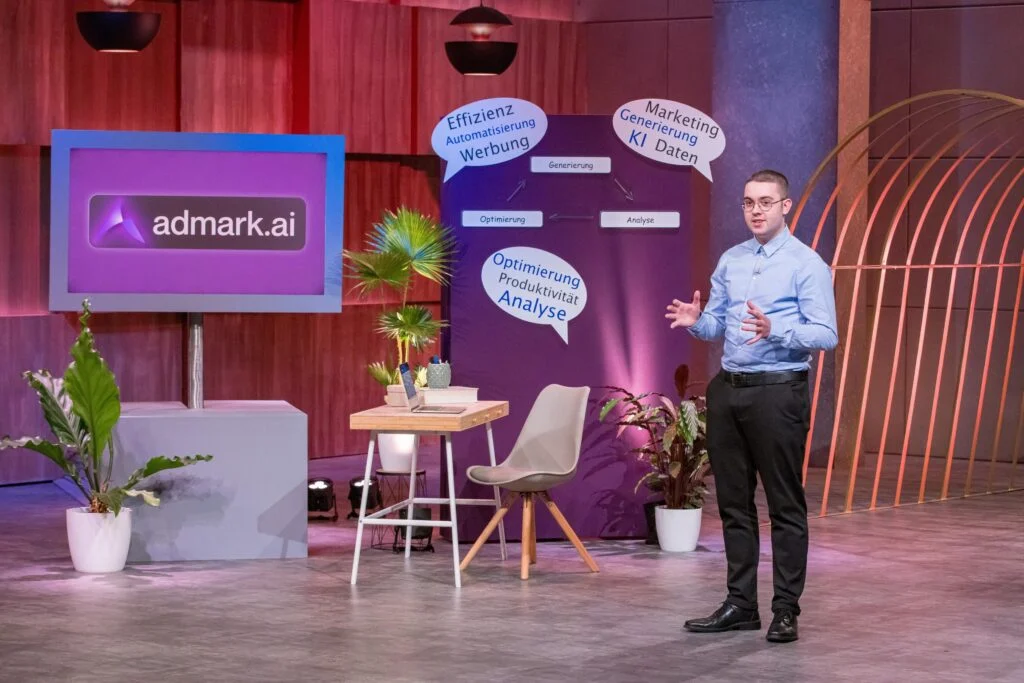
The still young founder of admark.ai Christopher Luis Zoellner is being celebrated on some social media platforms after he appeared to stand up to Frank Thelen in the first episode of the new season of “The Lions’ Den”. Many viewers also seemed to find the investor’s interruptions rude.
But perhaps he had good reasons? And how polite should or must founders and investors actually be in such conversations?
Of course, the discussion about good or bad behavior is an idle one. After all, it depends on various factors and is often in the eye of the beholder.
The topic of “giving excuses” in particular seems to be worth discussing in the German startup world (and probably beyond), because every founder has certainly been interrupted at some point during investor meetings.
Contrary to what many polished pitch events would have us believe, investors have a reputation for jumping back and forth through the pitch and not letting the presenters finish any point. And they even like to interrupt answers to their explicit questions.
That’s exactly what the viewers of the popular startup show were able to observe when Christopher Luis Zoellner from admark.ai tried to answer the lions’ questions after his pitch.
The young founder came forward with the bold claim that his platform admark.ai was “AI made in the nursery” and wanted to give companies a tool that analyzes their social media posts and creates optimized versions of them.
For this he would like to collect 200,000 euros and give up 20% of the company shares, so he is calling for a post-money valuation of one million euros.
But he proudly claims that his software is the first software that allows posts to be generated, analyzed and optimized. At this point you can hear a kind of indignant noise from Leo Frank Thelen, and he then says soon afterwards that the topic is not new and that the large AI models such as ChatGPT are mostly used for this purpose. He then also accuses the founder of having “bent the logs” with this claim, but he defends himself vehemently.
He insists on not being an OpenAI wrapper, but rather combining a generative AI (like the aforementioned ChatGPT from OpenAI) with a self-developed predictive AI.
But that’s not clear enough for the technology-savvy lion. He wants to know exactly where he uses the large models and where he has made his own development work in the field of AI in order to make such a claim.
The founder replies that the algorithm receives the data and is fed with its own analyses, that it analyzes texts, but also images and videos and can, for example, recognize faces and estimate the age of people in photos. So he actually just lists functions.
Here Frank Thelen soon interrupts him and strongly doubts that he is doing this with his own AI, as claimed.
Understandable, because the larger models have already offered such functions for a long time.
But the founder sticks by it and emphasizes again that the approach of his software is completely unique.
But the investor seems to be slowly becoming impatient and interrupts him again to ask him to explain exactly which language, which data and which training centers are used in his childhood AI.
The goal behind it should be clear to technology-savvy viewers by now at the latest: the founder should explain his tech stack and its rough architecture so that it becomes clear where AI is used and whether or where his own AI development has actually taken place. But so far it seemed (always, of course, as long as you can trust the editing) as if he only answered with functions and features and Frank Thelen didn’t get a real answer to his question despite repeated inquiries.
So he now gives him another 90 seconds to catch up.
But as soon as the founder starts his answer with “For our UI…” the lion interrupts him again and emphasizes that this is about his claim to have built his own, proprietary AI model, which his UI couldn’t really have anything to do with.
Here the founder now asks to be able to finish saying what he has received respect for from both Ralf Dümmel and Frank Thelen – and later from parts of the Internet community.
But the hard-fought answer is unfortunately disappointing again, because the founder once again only talks about what his algorithm can do. For Frank Thelen, there is again “0 technology” in it and, above all, nothing that answers the question he has now asked several times.
He also indicates why he had repeatedly interrupted him before: because one often noticed at the beginning of the sentence that he had taken a “wrong turn,” meaning that a meaningful answer to the question posed was not at all to be expected.
And that’s exactly the crux of the matter: certain questions need to be answered by investors if you want to make progress in the process. Because certain facts simply have to be crystal clear before an investment can take place. This includes legal matters, business model and company figures as well as the tech stack and the question of how much in-house development is really involved in the whole thing.
Especially in the current boom times, many investors who lack expertise in this area have had a rude awakening, because not everywhere where founders write about AI actually has AI in it – or none of their own.
And if they have the feeling that founders are talking around it or highlighting the features of their product for the umpteenth time instead of naming the components of the technical setup, they can become impatient.
A simple example from another area, which can also often be seen with the lions: When founders answer the question about sales figures not with a number, but with “not that much, because…” or “that is less relevant for us right now, because…”, they very quickly attract the displeasure of investors. Because for this the number is essential.
And despite all the justified criticism of not letting someone finish, isn’t it also rude not to actually answer a question several times, but instead to try to distract from the issue? Isn’t it at least rude to try to sell something as something it isn’t?
Of course, this can also happen unintentionally, but if a founder repeatedly fails to understand a legitimate question from an investor, the investor will at least question his competence. And having to listen to unhelpful answers multiple times is simply a waste of the lives of both parties.
You also have to ask yourself whether you would prefer to be interrupted in such a case.
In the end, the founder in this case had a deal with Carsten Maschmeyer, but he canceled it after a technical check because the share of proprietary IP was not sufficiently recognizable for him either.
Sometimes constantly interrupting investors are just rude and annoying. Sometimes they can also be an indicator that your questions have not been answered satisfactorily and that you should perhaps reflect on them again.
Startup jobs: Looking for a new challenge? In ours Job exchange You will find job advertisements from startups and companies.