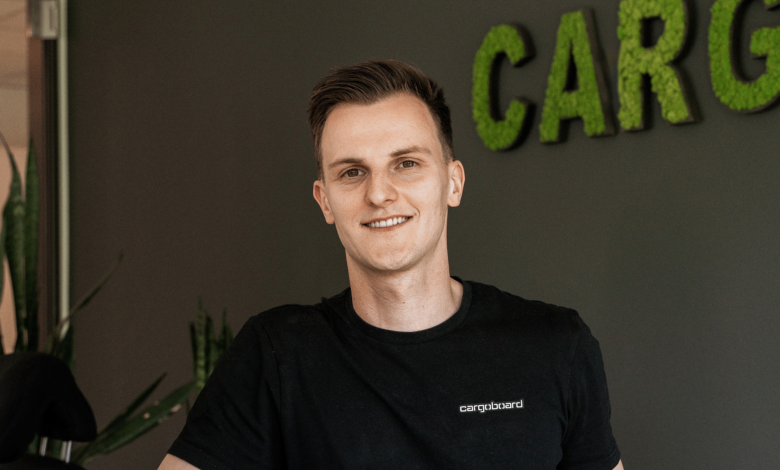
Lukas Petrasch founded the company when he was in his early 20s. He believes that you shouldn’t complain so much about bureaucracy, but rather get into action.

Lukas Petrasch is the founder and CEO of Cargoboard. The digital logistics company emerged from a student workshop at the University of Paderborn. In just eight years, the team says it had 100 employees and 100,000 customers.
When I founded Cargoboard in my early 20s, I didn’t have decades of professional experience or a huge network. But I had one conviction: freight transport must be easier to organize digitally. Today Cargoboard employs around 100 people.
Over the past few years, I have had countless conversations about starting a business – with entrepreneurs, investors, students and people who are playing with an idea themselves. There is one statement I hear again and again: “Germany is simply not a country for founders.” Is that true? No. I am absolutely convinced of that. Germany is certainly not perfect. Many things could be so much simpler, especially when it comes to bureaucracy, regulations and processes. But I am firmly convinced that we are making it too easy for ourselves when we see this as the main reason why so few people start businesses.
Read too

From my point of view, the actual reason is completely different. We have become accustomed to first explaining to young people why starting a business is difficult.
We talk more about risks than opportunities
The well-intentioned advice that every founder knows is certainly well-intentioned:
- “Finish your studies first.”
- “First gain a few years of professional experience.”
- “Find a secure job first.”
Although there may be care behind it, I wonder why we almost reflexively look for reasons why a start-up project must fail. Germany has gotten used to first looking for ten reasons why something doesn’t work, instead of one reason why it could work. Sometimes I have the feeling that we make young people more afraid of starting a business than excited about it.
We are actually experiencing the complete opposite: never before have so many startups been founded in Germany. So why does the image persist that Germany is not a start-up country? Maybe because we keep telling the same stories.
In my early 20s I had less to lose than ever since
Many people believe that you have to gain as much experience as possible before you can start a business. I see it differently. For me, starting a business is THE ultimate experience you can have as a young person. In my early 20s, I didn’t have a family, a home loan, or any other major financial obligations. Of course there is always a risk, but objectively I probably never had as little to lose again as I did back then.
Read too

The perfect time? I don’t believe in that anyway. Because the longer you wait, the greater the obligations become.
Of course, not everyone has to start a business at just 20. At the same time, I don’t think we should constantly tell young people that they aren’t ready yet.
My experience is that many experienced entrepreneurs are surprisingly open to sharing their knowledge and experiences with young, curious people. Age is less important than your own attitude. Those who listen with genuine interest, ask questions and want to learn often receive an incredible amount of support.
What is rarely well received, on the other hand, is the attitude of knowing everything better – just because, as a digital native, you have supposed advantages over the “older generation” or are actively involved in new technologies. In my opinion, the combination of fresh ideas and the experience of established entrepreneurs is the greatest lever.
Bureaucracy is not the real problem
Of course there is bureaucracy, which is a hurdle for many founders. However, she does not differentiate between younger and older entrepreneurs.
It costs time, it’s annoying and unfortunately it’s unlikely to get any less in the future. But I don’t believe that bureaucracy determines whether a company will be successful. For me, the question of how a company deals with complexity internally is much more important. It was clear to me early on: I couldn’t fight bureaucracy by constantly being annoyed by it. Instead, I have to create processes that still work.
Five principles helped us:
1. Think everything digitally: Bureaucracy becomes a problem especially when companies still work with paper and manual processes. Everything that can be digitized should be digitized. This saves time, avoids errors and takes much of the horror out of bureaucracy.
2. Transparency instead of islands of knowledge: Bureaucracy becomes dangerous when knowledge is only in the heads of individual people. You need complete transparency because it ensures that tasks are not left behind and that the company remains able to act even in the event of failures.
3. Build a strong team early on: Many founders believe that they have to do everything themselves and initially handle the bureaucracy on their own. The opposite is true. Those who bring the right people into the company early on and hand over responsibility grow significantly faster.
4. Allow other opinions: Bureaucratic processes often arise when no one questions the existing processes. Those who allow different opinions and encourage their employees to make things easier often find the best solutions.
5. Set up processes to be scalable: Most companies don’t become slow because of bureaucracy, but because they create their own process for each special case. Exceptions must be regularly questioned and, if they occur more frequently, integrated into the standard. This is the only way a company can remain efficient even as it grows.
Germany needs more founders and less skepticism
A world without bureaucracy? It might sound tempting at first, but I don’t want a world like that. Guardrails are useful in many places. Likewise, I don’t want a world in which everyone should start a business. Instead, I would like to see a different debate. A debate in which we don’t first tell young people why starting a business is so difficult. But why it can be worth it.
Because in the end I am absolutely convinced of one thing: it is not Germany that is stopping young people from starting a business. Much more often it is the fear of even taking the first step.