
Scientists have developed a flexible, 3D-printed diving suit designed to equip insects for disaster response. The development enables remote control of cyborg cockroaches, which can move for hours underwater and in oxygen-depleted environments. The new approach could permanently change biological rescue robotics in inaccessible rubble fields.
Scientists from Nanyang Technological University (NTU) and Waseda University have developed a diving suit for cockroaches to remotely control them underwater. The researchers published their results in the renowned journal Nature Communications. The primary goal of the research, which has now been ongoing for over a decade, is to support rescue workers in serious natural disasters.
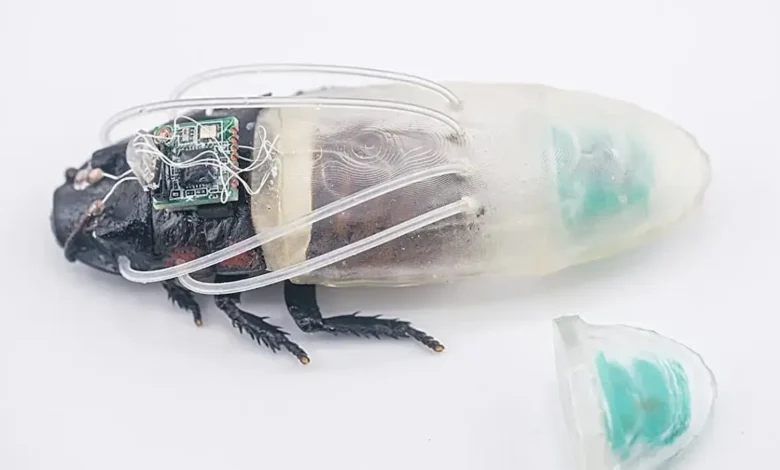
Background: Insects naturally breathe through tiny openings on the side of their bodies, so-called spiracles, which is why they would quickly drown under water without any aids. The newly developed system solves this biological problem through three mechanical components: an ultralight oxygen tank, a flexible sleeve and four silicone oxygen supply tubes.
Inside the tank, manganese dioxide acts as a highly effective catalyst. This slowly decomposes injected, diluted hydrogen peroxide and thus continuously releases vital oxygen.
Why Cyborg cockroaches with diving suits are the better rescue robots
The researchers deliberately chose the Madagascar hissing cockroach as the ideal test animal for the project. Their body size, biological robustness and lack of wings make them the ideal basis for building delicate electronics. Because they use their own muscles, they use far less energy than purely artificial mini-robots. Such robots carry heavy onboard batteries for their own motors.
According to the information, none of the animals suffered any damage during the experiments and all breathing tubes could be removed afterwards without any pain. Professor Hirotaka Sato from NTU Singapore explained the mechanism of living robots:
Our new insect diving suit works like the oxygen tank used by human divers. It generates oxygen and delivers it directly to the insect’s breathing openings, allowing the cyborg cockroach to survive and move in underwater or oxygen-deficient environments.
Areas of application and future challenges
The technology transforms a primarily land-based insect into a versatile amphibious system that can easily operate on both dry and wet terrain. Earlier, less advanced versions of these biological helpers were put into practical use as part of the large-scale “Operation Lionheart” following a severe 7.7 magnitude earthquake in Myanmar on March 28, 2026.
In the future, the new diving extension will be used to systematically and safely inspect flooded pipes, drains, tunnels and difficult-to-access public infrastructure.
The development appears important because flooded debris and narrow crevices block the path of conventional robots after heavy rains. The key engineering challenge was therefore to make the system small, light and flexible enough for the insect to carry.
In order to prevent dangerous leakage of chemical liquids from the tank, the sensitive tank opening in the laboratory currently has to be precisely sealed with special UV adhesive. The university’s innovation and entrepreneurial society (NTUitive) has already successfully applied for a patent for the technology. In the upcoming test series, the team will focus on the final integration of environmental sensors and navigation systems.
Also interesting: