

ILA Berlin 2026 concluded its professional days with a record number of strategic agreements, industry partnerships, and technology announcements. From sustainable aviation and electric aircraft development to European defense cooperation and space exploration initiatives, the exhibition demonstrated the aerospace sector’s growing role in security, innovation, and economic competitiveness.
Strategic partnerships, major industry agreements, and international cooperation dominate professional days at Europe’s leading aerospace exhibition
BERLIN — ILA Berlin 2026 is setting new records and exceeding expectations, underscoring the growing importance of aerospace as a driver of competitiveness, security, and technological sovereignty. As the professional days of the exhibition conclude on Friday, the event prepares to welcome the general public over the weekend.
With 750 exhibitors from 37 countries, ILA Berlin 2026 has become a focal point for international collaboration, commercial agreements, and technological innovation across the aviation, space, and defense sectors.
“This ILA is breaking records and exceeding all expectations,” said Marie-Christine von Hahn, Chief Executive Officer of the German Aerospace Industries Association (BDLI). “Our members report a level of business discussions and negotiations not seen in years—broader, more concrete, and more binding. Contracts, memoranda of understanding, and product launches demonstrate that aerospace is increasingly recognized as a key industry for competitiveness, security, and technological sovereignty. The professional days have shown that this record-breaking ILA is also an ILA of new beginnings.”
ILA Berlin 26 | Homepage | ILA Berlin
Aviation: Driving Sustainable Aircraft Technologies
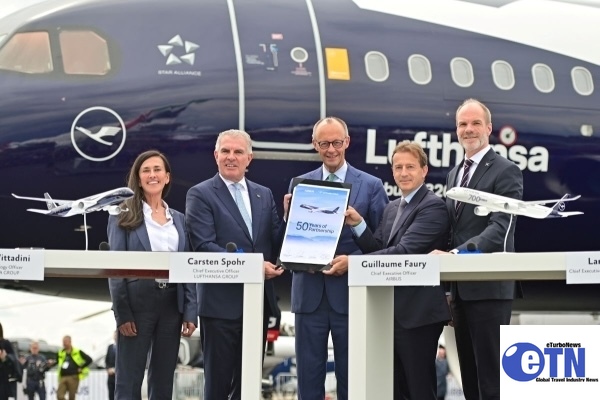
One of the exhibition’s most prominent announcements came on opening day when Lufthansa Group and Airbus signed a strategic agreement marking the 50th anniversary of their partnership. The agreement, signed in the presence of German Chancellor Friedrich Merz, includes a component services contract covering Lufthansa’s entire Airbus A220 fleet. Both companies also reaffirmed their commitment to advancing sustainable aviation technologies.
Another milestone was achieved through a strategic cooperation agreement between the Clean Aviation Joint Undertaking and the German states of Brandenburg and Saxony. The Memorandum of Cooperation aims to strengthen collaboration on the development of sustainable aircraft technologies, bringing together regional innovation ecosystems and the European Union’s aviation research and innovation program.
German aircraft developer VÆRIDION also reported significant progress for its all-electric regional aircraft, the Microliner. The company secured commitments for more than 100 aircraft in passenger and cargo configurations across Europe. Additionally, VÆRIDION announced its first commercial collaboration with General Atomics for an airborne battery system and successfully completed its Preliminary Design Review, a critical technical milestone on the path toward a first planned flight within approximately 100 weeks.
Defense: Strengthening European Security Capabilities
Against the backdrop of evolving geopolitical challenges, defense and security were major themes throughout the exhibition.
German Defense Minister Boris Pistorius and Montenegrin Defense Minister Dragan Krapović signed an agreement enabling future government-to-government sales of defense equipment between the two countries.
Airbus Defense and Space announced several strategic partnerships during the event. In the presence of Minister Pistorius, Airbus and Ukrainian defense technology company SkyFall signed a Memorandum of Understanding to strengthen Ukraine’s air defense capabilities against drone and missile attacks while reinforcing the country’s role as a leading European hub for defense innovation.
Airbus Defense and Space and Diehl Defense also agreed to deepen cooperation in Integrated Air and Missile Defense (IAMD), combining their complementary technological expertise to develop advanced air defense solutions.
Further expanding its defense partnerships, Airbus signed an MoU with European defense technology company Alta Ares, specializing in counter-drone systems and artificial intelligence, to jointly develop and integrate European counter-UAS capabilities.
Airbus Helicopters and Quantum Systems announced plans to evaluate the integration of Quantum’s counter-drone interception technologies into Airbus military helicopters, beginning with the H145M multi-role platform.
Meanwhile, Rheinmetall, ERC System, and the state of North Rhine-Westphalia launched a strategic partnership to establish the foundations for manufacturing the Victor U250 heavy-lift drone in Germany.
The State of Berlin and Israel Aerospace Industries (IAI) signed a declaration of intent to establish an innovation center focused on aerospace, defense, security, and dual-use technologies. The initiative aims to support startups and accelerate technology transfer in these critical sectors.
Artificial intelligence also featured prominently at ILA. HENSOLDT and Munich-based SE3 Labs agreed on a strategic collaboration focused on spatial and agentic AI applications for defense and autonomous systems. Diehl Defense signed a cooperation agreement with Spire Global to explore satellite-based intelligence, surveillance, and early-warning capabilities against ballistic and hypersonic missile threats.
Space: Expanding Europe’s Reach Beyond Earth
Space exploration and technology development remained a central pillar of ILA Berlin 2026.
The German Aerospace Center (DLR) and ArianeGroup extended their long-standing framework agreement to continue joint research and development activities in launch systems and propulsion technologies. The partnership supports Europe’s strategic goal of maintaining independent access to space.
DLR also entered into a collaboration with US-based Starlab Space, securing ten standardized experiment modules, known as Middeck Lockers, aboard the company’s planned commercial space station.
In another agreement, DLR and Canada’s Conair Group signed a Memorandum of Understanding focused on aerial wildfire suppression technologies and operations.
At the European level, the European Space Agency (ESA) and the European Commission signed a joint declaration on In-Space Operations and Services (ISOS), highlighting their shared ambition to establish European leadership in orbital servicing and space infrastructure maintenance.
A major contract was also awarded to Thales Alenia Space, the joint venture between Thales and Leonardo, for the development of two next-generation Sentinel-1 Earth observation satellites under ESA’s Sentinel-1 NG program. The satellites will provide critical data for environmental monitoring, climate research, disaster response, and a wide range of public and commercial applications.
A Turning Point for Aerospace
The professional days of ILA Berlin 2026 have highlighted the accelerating transformation of the aerospace sector. Sustainability, defense readiness, sovereign technologicalty, and international cooperation emerged as the dominant themes across aviation, space, and defense.
The unprecedented number of agreements, partnerships, and technology announcements demonstrates that aerospace is increasingly viewed not only as a strategic industry but also as a cornerstone of economic growth, security policy, and innovation leadership.
As the exhibition opens to the public, ILA Berlin 2026 is already being remembered as one of the most significant editions in its history—a record-breaking event that signals a new era of momentum for the global aerospace industry.