Mexico emerged as North America’s fastest-growing tourism economy in 2025, outperforming the United States and Canada in visitor spending, arrivals, and tourism GDP growth, according to WTTC research. Analysts point to geopolitical shifts, affordability, and Trump-era travel policies as key factors reshaping North America’s tourism competitiveness ahead of FIFA World Cup 2026.
Madrid-Mexico has emerged as North America’s strongest Travel & Tourism performer in 2025, overtaking both the United States and Canada across nearly every major tourism growth metric, according to newly released data from the World Travel & Tourism Council (WTTC).
The findings, unveiled today in Madrid as part of WTTC’s 2026 Economic Impact Research (EIR), reveal a striking divergence within North America’s tourism economy amid mounting geopolitical tension, shifting traveler sentiment, and renewed political uncertainty surrounding the second administration of President Donald Trump.
According to WTTC, Mexico’s Travel & Tourism GDP grew by 1.8% in 2025, compared to 0.9% growth in the United States and 1.2% in Canada. More significantly, Mexico posted a 3.5% increase in international visitor spending and a 6.1% increase in international arrivals, while both the US and Canada suffered declines in inbound international tourism.
The United States recorded a 4.6% drop in international visitor spending and a 5.5% decline in arrivals — a dramatic reversal for what remains the world’s largest Travel & Tourism economy.
Trump Administration Policies and the “Welcome Factor”
Industry analysts increasingly point to the political climate and perceptions of border policy as major factors influencing global travel decisions.
Since returning to office in January 2025, President Trump has reintroduced a series of hardline immigration measures, intensified visa scrutiny, and expanded rhetoric centered on border security and economic nationalism. While the administration argues such policies strengthen domestic security and prioritize American workers, tourism economists warn they may be discouraging international leisure and business travelers alike.
Several global tourism associations have quietly expressed concern about what they describe as a deteriorating “welcome factor” for the United States.
Travelers from Latin America, Europe, and parts of Asia increasingly report apprehension about entry procedures, visa uncertainty, and increased political polarization in the US market. Combined with a strong dollar, higher costs, and reduced air connectivity on some international routes, the result has been a measurable slowdown in inbound demand.
Mexico, by contrast, has benefited from a perception of openness, affordability, and relative ease of access and has demonstrated resilience and leadership despite the country’s own domestic safety concerns in connection with drug cartels.
“Mexico has become the value proposition of North American tourism,” said one European aviation analyst following the WTTC release. “Travelers are seeking cultural richness, lower costs, fewer bureaucratic barriers, and increasingly they are finding that in Mexico rather than the United States.”
WTTC CEO Gloria Guevara: Mexico’s Competitiveness Is Growing
Gloria Guevara, President & CEO of WTTC, emphasized that Mexico’s strong performance reflects years of investment and growing international competitiveness. Guevara had been the secretary of tourism for Mexico from March 10, 2010, to November 30, 2012.
“North America’s Travel & Tourism sector continues to demonstrate resilience and strong long-term potential, supported by robust domestic demand and sustained investment across the region. Mexico’s performance in 2025 clearly shows the strength of its tourism sector and its growing competitiveness on the global stage,” Guevara said.
She added that the 2026 FIFA World Cup could become a transformational moment for the entire region.
“The FIFA World Cup presents a once-in-a-generation opportunity for North America to accelerate tourism growth, strengthen connectivity, and showcase the region to millions of travelers worldwide. This international event is a chance to capitalize on the long-term benefits it provides.”
Her comments come as Mexico increasingly positions tourism not only as an economic engine, but also as a pillar of international soft power and regional influence.
Geopolitics Favor North America — But Mexico Captures the Momentum
WTTC’s report emphasizes that North America overall remains relatively isolated from some of the global geopolitical disruptions affecting tourism elsewhere, particularly instability linked to the Middle East.
Ongoing conflict and security concerns along major Eurasian transit corridors have weakened several long-haul travel markets, while volatile fuel prices and operational risks for airlines continue to pressure international aviation networks.
North America benefits from:
- Strong domestic travel demand
- Stable aviation infrastructure
- Geographical distance from active conflict zones
- Large regional consumer markets
- Integrated cross-border tourism economies
Yet Mexico appears to be capturing the greatest share of that advantage.
The country has aggressively expanded air connectivity, invested in tourism infrastructure, and diversified its destination portfolio beyond traditional beach markets. Destinations such as Mexico City, Oaxaca, Mérida, Los Cabos, and the Riviera Maya continue attracting both leisure travelers and digital nomads.
Mexico also benefits from a comparatively favorable exchange rate and lower operational costs for airlines and hospitality operators.
FIFA World Cup 2026 Could Reshape Regional Tourism
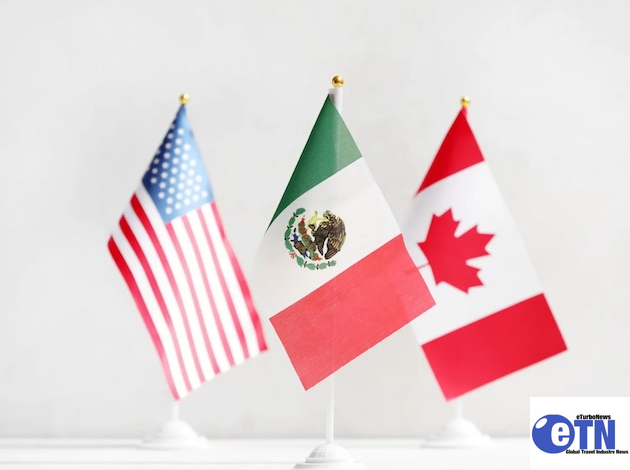
WTTC forecasts that the 2026 FIFA World Cup — jointly hosted by the United States, Mexico, and Canada — will become one of the most economically significant tourism events in modern North American history.
Canada is projected to see Travel & Tourism GDP growth of 6.4% in 2026, followed by Mexico at 2.4% and the United States at 2.1%.
The tournament presents not only a short-term visitor boom but a strategic geopolitical opportunity.
Governments across the continent are using the event to accelerate airport modernization, digital border systems, hospitality investment, and transportation connectivity. The World Cup is also expected to deepen cross-border tourism cooperation among the three USMCA partners despite increasing political friction on trade and migration issues.
World Travel & Tourism Council
The World Travel & Tourism Council (WTTC) represents the Travel & Tourism sector globally.
However, the United States faces a unique challenge: balancing enhanced security measures with the need to efficiently process millions of international visitors.
Tourism executives privately worry that overly restrictive entry procedures or politically charged immigration messaging during the World Cup could undermine America’s ability to maximize the economic benefits of hosting.
Tourism Becomes a Soft Power Battleground
The WTTC findings underscore a broader global reality: tourism is no longer merely an economic sector — it is increasingly an instrument of geopolitical influence and national branding.
Countries perceived as open, safe, affordable, and culturally welcoming are gaining a competitive advantage in a post-pandemic world where travelers are more selective and politically aware.
Mexico’s rise reflects more than strong marketing or favorable pricing. It signals a strategic repositioning of the country as a global tourism power at a moment when international perceptions of the United States remain deeply polarized.
For the Trump administration, the challenge may not be whether America remains a dominant tourism economy — it almost certainly will — but whether it can retain its attractiveness as a destination in an era where global mobility, openness, and traveler sentiment increasingly shape economic competitiveness.
A $12 Trillion Global Industry
WTTC forecasts global Travel & Tourism will contribute nearly $12 trillion to the world economy in 2026, representing 9.9% of global GDP and supporting 376 million jobs worldwide.
Over the next decade, the sector is expected to grow 1.5 times faster than the broader global economy.
In that race for growth, Mexico appears to have seized the momentum in North America — at least for now.