Global tourism is faltering again as geopolitical instability rises, while military spending hits a record $2.9 trillion. New data from SIPRI highlights a widening imbalance between investment in conflict and peace—raising urgent questions about the long-term future of the Travel & Tourism industry in an increasingly militarized world.
Bangkok – According to a report by Travel Impact Newswire, the world of tourism barely recovered from the devastation of Covid-19, and the global Travel & Tourism sector is once again facing a downturn—this time amid a surge in geopolitical instability. Millions of jobs are at risk. Yet while tourism struggles to regain its footing, another global industry is thriving: the business of war.
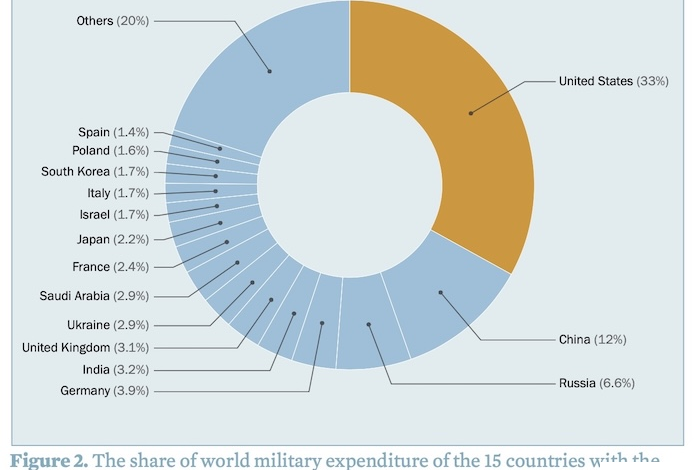
New data released on April 26 by the Stockholm International Peace Research Institute (SIPRI) reveals that global military expenditure reached a record $2.887 trillion in 2025, marking a 2.9% real-term increase over 2024. The world’s top three donors—the United States, China, and Russia—accounted for a combined $1.48 trillion, or 51% of the global total.
The outlook for military spending remains robust. SIPRI researcher Xiao Liang attributed the increase to “another year of wars, uncertainty and geopolitical upheaval with large-scale armament drives,” adding that growth is likely to continue through 2026 and beyond.

Home
Stockholm International Peace Research Institute (SIPRI): the independent resource on global security
For Travel & Tourism, however, the trajectory is heading in the opposite direction.
The Fragile “Bounceback” Narrative
Industry advocates often argue that tourism is resilient—that it rebounds quickly once crises subside. But recent history suggests otherwise. The post-pandemic recovery, widely celebrated as a “bounceback,” proved short-lived in many regions.
Now, with conflicts simmering across multiple regions, optimism is once again being tested. The assumption that peace will return swiftly—and with it, a tourism boom—may be increasingly unrealistic in a world where instability is becoming entrenched.
A Cycle That Sustains Itself
A closer reading of the SIPRI data raises deeper questions about the structural forces shaping global priorities.
Military expansion is not a temporary response—it is part of a self-reinforcing cycle. Armed conflicts drive demand for weapons systems, which are then refined, upgraded and marketed. The need to justify these investments creates incentives for continued tension, ensuring that the cycle of conflict—and spending—persists.
This has profound implications for industries like tourism, which depend on stability, openness and trust.
Competing Priorities: War vs Development
The imbalance in global spending priorities is strong.
While governments cite funding shortages as a key reason for failing to meet the United Nations Sustainable Development Goals (SDGs) by 2030, there appears to be no shortage of resources for defense budgets.
This raises uncomfortable questions:
Why is funding scarce for poverty reduction, climate action, and public health—but abundant for military expansion? And what role can the tourism sector—often described as an “industry of peace”—play in reshaping this debate?
The Hidden Costs of Militarization
Beyond the headline figures, the true cost of military expansion is far broader and less visible.
- Environmental impact: The extraction of critical minerals, manufacturing of weapons systems, and operation of military hardware carry significant ecological consequences—yet these remain largely unquantified.
- Economic trade-offs: Rising defense budgets divert resources from education, healthcare, and infrastructure.
- Humanly great: Wars leave lasting scars—bereaved families, displaced populations, and long-term care burdens that ripple through societies.
- Governance risks: Arms deals are often shrouded in secrecy, raising concerns about corruption and accountability.
Even more concerning for tourism, evolving warfare technologies—particularly drones—are introducing new risks. Attacks on airports and hotels in conflict zones demonstrate how easily civilian infrastructure can become targets, undermining traveler confidence worldwide.
Regional Trends: A World Rearming
United States
The United States remained the world’s largest military donor at $954 billion in 2025—33% of the global total—despite a 7.5% decline linked to reduced aid to Ukraine. However, this dip may be temporary. SIPRI warns that approved spending for 2026 already exceeds $1 trillion, with projections reaching $1.5 trillion by 2027.
Europe
Europe recorded the sharpest spending in spending, rising 14% to $864 billion—the fastest growth since the Cold War. Germany alone increased its defense budget by 24% to $114 billion, surpassing 2% of GDP for the first time since 1990.
The ongoing war in Ukraine continues to drive spending. Russia allocated $190 billion (7.5% of GDP), while Ukraine’s military burden surged to an extraordinary 40% of GDP.
Middle East
Military expenditure in the Middle East remained relatively stable at $218 billion. Israel’s spending declined slightly following a ceasefire in Gaza, but remained nearly double its 2022 level. Türkiye increased spending amid ongoing operations in multiple regions, while Iran’s real-term spending declined due to inflation—although analysts believe official figures understate actual expenditure.
Asia and Oceania
Spending in Asia and Oceania rose 8.1% to $681 billion, led by China, which increased its budget to $336 billion—its 31st consecutive annual increase.
Implications for Travel & Tourism
For the tourism sector, the implications are deeply concerning:
- Rising geopolitical tensions determine travel and investment.
- Nationalist rhetoric and xenophobia undermine cross-border mobility.
- Security risks increase costs and operational complexity.
- Budget priorities shift away from tourism development toward defense.
Ironically, segments of the industry—such as business travel linked to defense contracts—may benefit from increased military spending. But these gains are marginal compared to the broader instability that undermines global tourism flows.
A Question of Balance
Notably, SIPRI’s figures do not include spending on non-military security systems—such as surveillance technologies, cybersecurity tools, and policing equipment—nor transactions involving non-state actors. The true scale of global security-related expenditure is therefore significantly higher.
This raises a fundamental question for policymakers and industry leaders alike:
Can the global economy sustain such an imbalance between investment in conflict and investment in peace?
For Travel & Tourism, the answer may determine not just the pace of recovery—but the future viability of the sector itself.
About the author

Imtiaz Muqbil
Imtiaz Muqbil,
Executive Editor
Travel Impact Newswire
Bangkok-based journalist covering the travel and tourism industry since 1981. Currently editor and publisher of Travel Impact Newswire, arguably the only travel publication providing alternative perspectives and challenging conventional wisdom. I have visited every country in the Asia Pacific except North Korea and Afghanistan. Travel and Tourism is an intrinsic part of the history of this great continent but the people of Asia are a long way away from realizing the importance and value of their rich cultural and natural heritage.
As one of the longest-serving travel trade journalists in Asia, I have seen the industry go through many crises, from natural disasters to geopolitical upheavals and economic collapse. My goal is to get the industry to learn from history and its past mistakes. Really sickening to see the so-called “visionaries, futurists and thought-leaders” stick to the same old myopic solutions which do nothing to address the root causes of crises.
Imtiaz Muqbil
Executive Editor
Travel Impact Newswire