
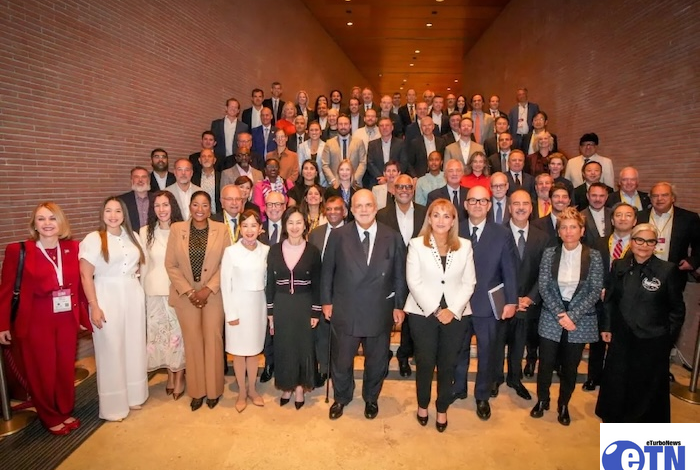
In a candid and unusually pointed statement, Gloria Guevara, President and CEO of the World Travel & Tourism Council (WTTC), confirmed that while the United States remains the world’s largest Travel & Tourism market, its leadership position is no longer guaranteed.
Her remarks come at a pivotal moment for the global tourism industry—one marked by record-breaking growth, shifting traveler preferences, and rising geopolitical uncertainties.
A Global Leader Facing New Pressures
“The United States remains the largest Travel & Tourism market in the world and has an amazing foundation,” Guevara stated. “To avoid losing its leadership position, the US must invest in promoting its attractiveness… change perception and position the US as a welcoming destination.”
This message, delivered with diplomatic precision, represents a notable shift in tone. Historically, many US-based travel associations have avoided public criticism or strategic warnings of this magnitude. WTTC’s intervention highlights its growing role as a global advocate for the industry—especially given that many of its member companies are headquartered in the United States.
WTTC’s members are the Chairmen or Chief Executives of leading global Travel & Tourism companies, from all geographies and industries, including hotels, airlines, airports, tour operators, cruise, car rental, travel agents, rail, as well as the emerging sharing economy, enabling them to speak with one voice to governments and international bodies.
Over 200 companies are now represented on the Council, accounting for two-thirds of a trillion US dollars in turnover, equivalent to 30% of the entire sector.
Record Global Growth—But Not in North America
Earlier this week, WTTC, in partnership with Chase Travel and with research sponsorship from JPMorgan Chase, released a landmark report declaring 2025 the best year ever for global tourism.
All data referenced in this report reflect 2025 performancea critical detail given that the global environment has already begun to shift significantly.
The numbers for 2025 are striking:
- Global Travel & Tourism GDP grew 4.1%
- 80 million more people traveled internationally compared to 2024
Yet, beneath the headline growth lies a strong regional imbalance.
North America emerged as the slowest-growing region globallywith just 1.0% growthwhile the United States lagged even further at 0.9%.
More concerning:
- International visitor numbers to the US fell by 5.5%
- International visitor spending declined 4.6%totaling $176 billion

In a year when global travel surged, millions of travelers simply chose other destinations.
A Data Snapshot Before Rapid Change
While 2025 marked a historic high point globally, industry leaders caution that these figures may already represent a peak before a period of disruption.
Since the close of 2025, a series of compounding factors have emerged that could significantly alter the trajectory of US Travel & Tourism:
- Increased enforcement actions by US Immigration and Customs Enforcement (ICE), including reports involving international travelers
- A noticeable shift in US reputation overseaswith growing concerns about welcome, accessibility, and policy unpredictability
- Ongoing and evolving conflicts in the Middle East are affecting global stability and aviation patterns
- Volatility in energy markets and fuel prices directly impacts travel costs
- A widening sense of global frustration towards the United States in certain markets is influencing travel sentiment and destination choice
Taken together, these developments suggest that the next WTTC report—covering 2026 and to be released roughly a year from now—could reflect far more dramatic changes than those observed in the 2025 data.
The Scale of US Tourism Remains Unmatched
Despite these emerging risks, the US Travel & Tourism sector continues to dominate in sheer scale:
- $2.63 trillion contribution to global GDP
- 20.4 million jobs supported in 2025
- 242,000 new jobs added
- Domestic visitor spending reached $1.54 trillionexceeding pre-pandemic levels by 14.3%
These figures underscore the resilience of the US market—particularly its strong domestic base. However, reliance on domestic travel alone may not be sufficient to maintain global leadership in a rapidly evolving global landscape.
A Defining Opportunity: Global Football Events
Looking ahead, the United States is preparing to co-host major international football events in 2026, including the FIFA World Cup 2026.
WTTC estimates the tournament could attract approximately 1.24 million international visitorsoffering a rare opportunity to:
- Reintroduce the US to global travelers
- Showcase various destinations and experiences
- Convert visitors into long-term ambassadors
This moment, Guevara suggests, could either reinforce US leadership—or expose vulnerabilities if underlying challenges are not addressed.
Asia-Pacific Surges Ahead
While the US recalibrates, the Asia-Pacific region is accelerating.
China, now the world’s second-largest tourism market, reported:
- $1.75 trillion GDP contribution (+9.9%)
- 84.6 million jobs supported
- International visitor spending up 10.5%
- Domestic spending up 10.7%
Across the region:
- Malaysia grew 11.2%
- The Philippines 10.8%
- China 9.9%
- India 7.3%
- Indonesia 7.2%
Overall, Asia-Pacific tourism GDP reached $3.29 trilliongrowing 8.2%—double the global average.
This rapid expansion signals a structural shift in global tourism power.
Industry Leaders Call for Action
Jason Wynn, CEO of Chase Travel, emphasizes both the resilience of the US sector and the urgency of seizing the current moment:
“As WTTC’s latest research shows, the US Travel & Tourism sector continues to demonstrate remarkable resilience, supporting millions of jobs and driving trillions of dollars in economic growth even amid global headwinds. With the US set to host a series of global events through 2028, we have an extraordinary opportunity to welcome new visitors and bring travelers from around the world closer together, fostering meaningful connections across countries and communities.”
He added that Chase Travel remains committed to strengthening the industry by leveraging its global marketplace to support travelers, advisors, and partners, while helping to drive sustained growth across the sector.
Policy, Perception, and Global Confidence
Beyond economics, perception is emerging as a decisive factor.
Guevara’s call to “position the US as a welcoming destination” reflects growing concerns within the industry. Reports involving US Immigration and Customs Enforcement enforcement actions at airports have raised alarms just months before the US is expected to welcome millions of international visitors.
At the same time, geopolitical developments are influencing travel sentiment.
Today’s announcements by Donald Trump regarding a ceasefire between Israel and Lebanon, alongside renewed diplomatic engagement with Iran, have helped ease fears of broader regional conflict. Stability in the Middle East—and the uninterrupted flow of oil—remains critical for global travel demand and pricing.
WTTC Steps Into a Leadership Void
WTTC’s statement may also reflect a broader vacuum in domestic advocacy.
For months, many US tourism organizations have remained largely silent on policy challenges and declining international demand. By contrast, WTTC is now taking a more assertive stance—signaling to both governments and industry stakeholders that coordinated action is urgently needed.
Guevara, currently in Washington, DC, described her visit as “going excellently,” suggesting active engagement with policymakers behind the scenes.
The Road Ahead
The United States stands at a defining moment in its tourism trajectory.
To maintain its leadership, WTTC outlines several priorities:
- Rebuild international demand
- Enhance global marketing efforts
- Improve traveler perception and experience
- Encourage higher visitor spending through various offerings
- Leverage major global events as catalysts for growth
Failure to act could see the US gradually lose ground to faster-growing, more aggressively promoted destinations.
A Turning Point for Global Tourism
As global travel enters a new era of competition and uncertainty, the stakes have never been higher.
WTTC’s message is clear: the United States still holds the strongest position in global tourism—but that position is increasingly fragile.
With 2025 now serving as a benchmark rather than a guarantee, the real test will come in the next set of data. One year from now, when WTTC releases its next report, the world will see just how much impact today’s geopolitical tensions, policy decisions, and global sentiment have had on the future of US Travel & Tourism.