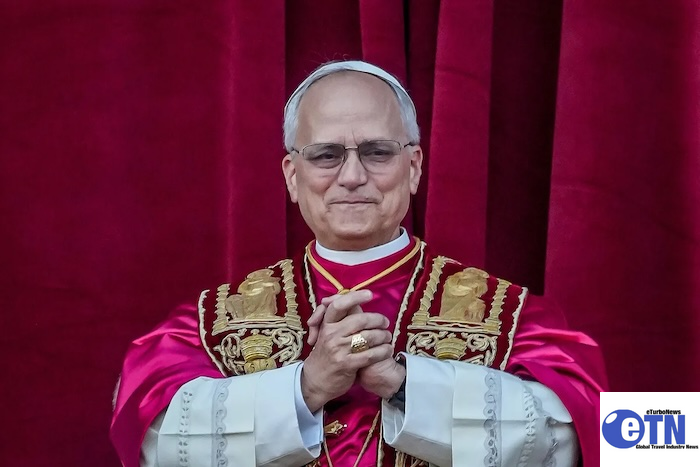
On his first visit to Africa, Pope Leo XIV is advancing a message of peace, dialogue, and human dignity — sharply contrasting with US President Donald Trump — while offering Algeria, Cameroon, Angola, and Equatorial Guinea an unexpected opportunity to reposition themselves on the global tourism map.
Pope Leo XIV arrived in Algeria.
Trump calls Pope Leo ‘weak’ and ‘terrible.’
This was the first in the 250-year history of the United States of America that a US president said the pope is ‘not doing a very good job’ in unprecedented criticism of the leader of the Catholic church. This may be the biggest compliment the pope has received so far from a head of state, but it will outrage many Americans. His welcome to the African continent will be more civilized and sincere.
A Peace Mission Across a Changing Continent
Pope Leo XIV began his first apostolic journey to Africa on April 13, embarking on a ten-day tour of Algeria, Cameroon, Angola and Equatorial Guinea. The visit is one of the most geopolitically and symbolically significant papal trips in recent years, with a strong focus on peace, migration, interreligious dialogue, youth, environment and social justice.
Across the four nations, the pope is expected to hold large public masses, meet political and religious leaders, and engage directly with communities affected by conflict, poverty and migration pressures. His itinerary includes stops at historic Christian sites in Algeria, peace gatherings in Cameroon, youth-centered engagements in Angola, and humanitarian visits in Equatorial Guinea — including a psychiatric hospital and the notorious Bata prison.
The visit comes at a time when Africa is both rising in global importance and facing complex challenges. The Catholic Church itself is growing rapidly across the continent, now accounting for more than one-fifth of the global Catholic population.
The Holy See
Visiting the official website of the Holy See one can browse: the Magisterium of the Supreme Pontiffs; the fundamental texts of Catholicism in various languages (the Sacred Bible, the Catechism of the Catholic Church, the documents of the Second Vatican Council and the Code of Canon Law); the documents of Dicasteries, Bodies and Institutions of the Roman Curia.
A Clear Contrast With Trump on Peace and Power
The Africa tour has also become a platform for a widening ideological divide between the Vatican and Washington.
In recent statements, Pope Leo XIV has forcefully condemned war, militarization and what he describes as violations of international law. He has called on world leaders to prioritize dialogue and mediation over rearmament, warning against what he views as a dangerous global drift toward conflict.
That stance places him in direct contrast with US President Donald Trump, who has defended more aggressive geopolitical strategies and stricter migration policies. The pope has also criticized positions linked to ongoing conflicts and humanitarian crises, prompting public attacks from Trump in recent days.
Rather than retreat, Leo has doubled down on his message — insisting the Church must continue advocating for peace even when it faces political backlash. His framing goes beyond individual conflicts, extending to critiques of “neocolonial tendencies,” inequality and systemic injustice.
By bringing that message to Africa, the Pope is elevating the continent as a central arena in the global conversation on peace, justice and human dignity.
Country by Country: Messages and Realities
Each stop on the tour reflects a tailored message tied to local realities:
- Algeria: Focus on interfaith dialogue and migration, including engagement with Muslim leaders and visits to early Christian heritage linked to Saint Augustine. The country remains a key transit route for African migrants heading towards Europe.
In Algeria today, Pope Leo XIV met with authorities, civil society, and diplomatic corps in Algiers on the first day of his three-day Apostolic Journey to Algeria.
After meeting with President Abdelmadjid Tebboune at the presidential palace, the Pope addressed around 1,400 civil authorities at the Djamaa el Djazair Conference Center.
He thanked the President for the invitation to visit Algeria in the first year of his Petrine Ministry, recalling that he has visited Annaba—ancient Hippo—in 2001 and 2013, “as a spiritual son of St. Augustine.”
Pope Leo said he comes as a “pilgrim of peace” and noted that “we are brothers and sisters, for we have the same Father in heaven.”
He praised the Algerian people for their culture of encounter and reconciliation, as well as for their spirit of solidarity, hospitality, and community.
The Pope pointed to the great generosity shown by the Algerian people in their practice of almsgiving, which stems from a sense of justice regarding wealth.
“This view of justice is both simple and radical for it recognizes the image of God in others,” he said. “Indeed, a religion without mercy and a society without solidarity are a scandal in God’s eyes.”
Pope Leo XIV invited the civil leaders of Algeria to embrace dialogue and solidarity, so as to bring greater justice to our world.
“By respecting the dignity of everyone and allowing yourselves to be moved by the pain of others, instead of multiplying misunderstandings and conflicts, you can surely become protagonists of a new chapter in history,” he said.
The Pope recalls the words of his predecessors—Pope Benedict XVI and Pope Francis—on the importance of directing the process of globalization through “a model of social, political, and economic participation,” so that all people and nations may benefit from growth in the global economy.
“I therefore urge those of you who hold positions of authority in this country not to fear this outlook but to promote a vibrant, dynamic and free civil society, in which young people in particular are recognized as capable of helping to broaden the horizon of hope for all,” he said.
Pope Leo said a nation’s true strength lies in its ability to foster cooperation among citizens without authorities dominating but rather serving all people and promoting their development.
He pledged the efforts of the Catholic Church to contribute to the common good of Algeria and strengthen the country’s identity as a bridge between nations of all hemispheres.
The Pope pointed to Algeria’s location bordered by the Mediterranean Sea and the Sahara desert, saying these geographical aspects represent a spiritual crossroads filled with “immense treasures of humanity.”
“For the sea and the desert have been places of mutual enrichment among peoples and cultures for millennia,” he said. “Woe to us if we turn them into graveyards where hope also dies!”
Deserts and seas contain majestic beauty, he added, saying their boundless expanse can help people reflect on transcendence.
“Let us free these tremendous reservoirs of history and of the future from evil!” he said. “Let us multiply oases of peace; let us denounce and remove the causes of despair; and let us oppose those who profit from the misfortune of others!”
Pope Leo urged Algeria’s civil leaders to unite spiritual energy, intelligence, and resources to make the land and the sea places of life, encounter, and wonder.
Algerian society, noted the Pope, has seen fundamentalism and secularization manifest themselves, leading to tension between religious sensibility and modern life.
“Religious symbols and words can become, on the one hand, blasphemous languages of violence and oppression, or on the other, empty signs in the immense marketplace of consumption that does not satisfy us,” he said.
In conclusion, Pope Leo XIV encouraged the civil authorities of Algeria not to let “absurd polarizations” dishearten them but to confront them with intelligence.
Polarization, he said, is “a sign that we are living in an extraordinary time of great renewal, in which those who keep their hearts free, and their consciences alert, can draw from the great spiritual and religious traditions new ways of seeing the world and an unshakable purpose in life.”
- Cameroon: Emphasis on reconciliation and peace, particularly in the conflict-affected English-speaking regions. Separatist groups have already declared a temporary ceasefire during the papal visit — a symbolic but notable gesture.
- Angola: Attention to youth, economic inequality, corruption, and the legacy of colonialism, with a strong focus on human development and tourism. Angola was the main sponsor of the recently concluded ITB Berlin
- Equatorial Guinea: Focus on culture, education, and human rights, including high-profile visits to vulnerable populations in hospitals and prisons.
Together, these stops underscore the Vatican’s broader message: peace is inseparable from justice, governance, inclusion, and dignity.
A Global Media Moment for Africa
Beyond its religious and political significance, the papal tour is delivering something rare for the host nations — sustained, positive global visibility.
International media coverage of the visit is placing Algeria, Cameroon, Angola and Equatorial Guinea in front of global audiences not typically exposed to their cultural depth, heritage and tourism potential. At a time when Africa is leading global tourism recovery growth, this kind of attention is particularly valuable.
The visit reframes the narrative. Instead of focusing solely on conflict or crisis, it highlights history, faith, resilience and diversity — elements that are central to destination branding but often underrepresented in global media.
Tourism Opportunity — and Its Limits
The opportunity for tourism is real, but it is not automatic.
Countries like Cameroon and Angola are actively working to grow their tourism sectors, while Algeria is cautiously opening up its cultural and heritage tourism offer. Equatorial Guinea, however, remains constrained by accessibility challenges, strict visa regimes and international perceptions around governance and safety.
This means the immediate impact of the papal visit is likely to be brand visibility rather than a surge in arrivals.
To convert attention into tourism growth, destinations will need to act strategically — and carefully.
How Destinations Can Turn the Visit Into Tourism Growth
Tourism boards and operators across the four countries have a narrow window to leverage the moment effectively. The most credible strategies include:
1. Build Faith and Heritage Tourism Routes
Algeria in particular can capitalize on its early Christian history, including sites linked to Saint Augustine. Developing pilgrimage-style itineraries tied to papal stops and Catholic heritage could attract niche but high-value travelers.
2. Launch Story-Driven Campaigns
Rather than traditional advertising, destinations should align with the pope’s themes — peace, youth, culture and coexistence — using authentic storytelling that reflects real communities and experiences.
3. Create Multi-Country Itineraries
Tour operators can package the four categories into curated, small-scale travel experiences targeting diaspora travelers, religious groups and cultural explorers.
4. Strengthen Religious and Event Tourism
The visit creates momentum for future conferences, pilgrimages and interfaith gatherings, particularly in countries with growing Catholic populations.
5. Improve Practical Travel Access
Perhaps most importantly, governments must simplify visas, improve traveler information and invest in infrastructure. Visibility without accessibility rarely translates into bookings.
A Long-Term Branding Opportunity
The biggest tourism gain from Pope Leo XIV’s visit may not be immediate visitor numbers, but something more durable: narrative repositioning.
By associating these destinations with global conversations about peace, dignity and human connection, the visit helps shift perception. It opens the door for Africa — and these four countries in particular — to be seen not just through the lens of challenges, but through their cultural richness, historical depth and human stories.
The Bottom Line
Pope Leo XIV’s Africa tour is more than a religious journey. It is a diplomatic intervention, a moral statement and a global media event.
It highlights a stark divide with Donald Trump on the meaning of peace — dialogue versus force, reconciliation versus confrontation.
And for Africa, it offers something equally significant: a chance to be seen differently.
Whether that moment translates into lasting tourism growth will depend not on the visit itself — but on what comes next.