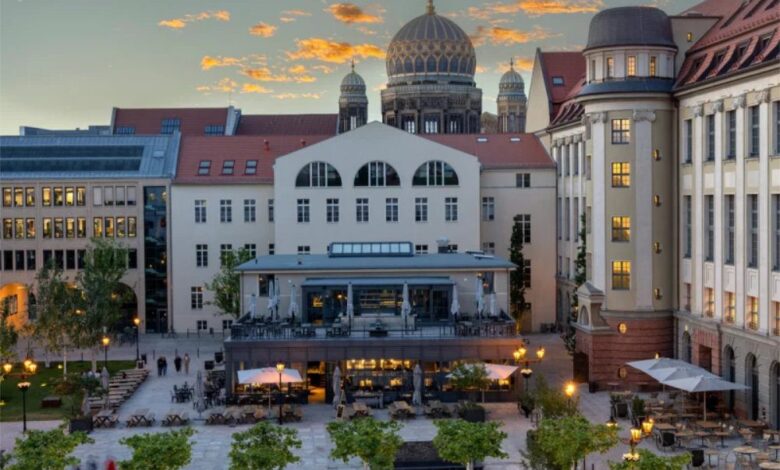
Last week, on a bitter winter morning, I set out across Berlin’s icy streets towards what is being billed as the German capital’s new ‘urban heart’, the Forum Museumsinsel, one of the city’s most intriguing recent redevelopments. It was hardly the ideal season for hiking outdoors but bundled against the cold and with the entire area virtually to myself, I had ample space to take in the compelling ensemble of buildings. Better still, two of them offered warm havens of hospitality. The Forum Museumsinsel is just a stone’s throw from Oranienburgerstraße S-Bahn station, opposite the New Berlin Synagogue (now the Center Judaicum) with its fabulous golden dome. I entered the Forum through the Torhaus (Gatehouse) and stopped to watch the large screen projected on to the walls which explains the history and layout of the buildings.

The word ‘forum’ is a good example of how language travels across centuries and cultures, picking up new shades of meaning along the way. For me, it immediately calls to mind Ancient Rome — a civic space made up of several buildings where people gathered for commerce, trade, and worship. In German usage, the word still loosely carries this meaning, and Berlin has created many such forums, most notably the Humboldt Forum on the site of the former city palace. Its most recent incarnation, the Forum Museum Island, occupies a prominent position on the banks of the Spree, directly opposite the UNESCO World Heritage-listed Museum Island complex and is best described as both a public square and a mixed-use urban quarter.
Over the past two centuries, this site played a significant role in Berlin’s communication, scientific, and civic life. In the mid-19th Century, the northern part of the area was developed into a pioneering postal and communications hub, housing the city’s main telegraph office alongside a vast network of telephone operators. At its peak, the complex processed up to 20,000 telegrams a day and was connected to Europe’s oldest pneumatic tube system, which by the late 1930s extended over more than 250 kilometers. This rich history of communication stands in contrast to the Forum’s current role as a cultural and social gathering place, although both eras share a common purpose: connecting people.
One of the defining features of the Forum Museumsinsel is its architectural diversity, spanning four centuries. It showcases eight listed buildings, each representing a distinct period in European architectural history. The oldest, constructed between 1789 and 1791 in the Classical style, originally served as the Logenhaus — one of Germany’s most historically significant Masonic lodge buildings. Over the course of the late nineteenth and early twentieth centuries, several further landmark buildings were added, including the Gropius Ensemble, designed in the Neo-Renaissance style by Martin Gropius and Heino Schmieden (1879–1882), as well as the Monbijou House and the Ida Simon House (later the Simon Palais), built in Neobaroque and Neoclassical styles respectively. The ensemble also incorporates early examples of Bauhaus architecture and Art-Déco-Expressionist design from the 1920s and 1930s. This layering of architectural styles reflects Berlin’s evolving cultural, political, and social conditions, from Prussian Enlightenment ideals to modernist experimentation.

Photo: Tagesspiegel
The Forum Museumsinsel lies within the Spandauer Vorstadt, a historic quarter in Berlin’s central Mitte district which also includes the Hackesche Höfe and takes its name from the former Spandauer Gate, once part of the city’s 17th-century fortifications. The restoration of this particular site took more than a decade, involving extensive work on every historic building. Many of them had remained empty or underused for twenty years before the project began. The main aim was to preserve historical authenticity while adapting the buildings for 21st-century use. Architects involved included internationally renowned firms such as Sir David Chipperfield Architects alongside local partners like Patzschke & Partner.

At the Forum’s heart is a public square, a meeting place for locals, tourists, and office workers. For visitors, the main draw is the ‘Dieselhaus’ restaurant, which serves traditional German fare. It had yet to open on the morning I was there, although in summer tables spilled out around the fountains. I shall certainly return then—not only for the warmer weather, but to see the colossal diesel engine that once supplied emergency and backup power to the Reichspost (Imperial Postal Service), and from which the restaurant takes its name.
The surrounding buildings accommodate office spaces occupied by prominent companies such as Google and Delivery Hero. The Bauhaus building is home to König Galerie, a contemporary art space working with international artists and presenting exhibitions ranging from sculpture and installation to photography and beyond. Rather in keeping with the modernist feel of the building, there was a group of trendy-looking office workers standing outside the main entrance in the cold, smoking and vaping.
Just behind the square stands the impressive Telegraphenamt hotel, with views across to the Museum Island. I explored its vast open-plan reception area, complete with a sleek, industrial-style bar and restaurant, but missed the chance to visit the Rohrpostbar (Pneumatic Tube Bar) in the basement, where remnants of the original pneumatic delivery system are on display. Next time.

From the hotel, I walked the few meters down Monbijoustraße to the River Spree and paused on the bridge opposite the Bode Museum, taking in the scene. To my left, the TV tower rose into the gray sky; in the distance stood the tower of the Berlin City Hall. It was too cold to linger, so I turned right and set off gingerly along the embankment towards the Simon-Palais on Tucholskystraße.

Built between 1909 and 1911, the building was founded by Ida Simon, sister of the Berlin philanthropist James Simon and originally served as a clinic for destitute women and girls. Today it has been converted into luxury apartments, although on the ground floor is ‘Petit Bijou’ —quite literally a little jewel of a café. I loved its atmosphere and in particular the warm sheepskins scattered across the chairs and the light jazz background music. Judging from the locals enjoying a coffee or light lunch, this a definitely an insider tip.

Walking back up Tucholsky Strasse, I passed the ‘Fernsprachamt’ (Telephone Exchange) built from 1926 to 1927, an impressive example of expressionist Art Deco architecture now meticulously renovated as an office building. After the Second World War, the telephone exchange was expanded to include the GDR Institute for Postal and Telecommunications Services housed in the eye-catching yellow brick building on the other side of Oranienburger Straße. This was originally the ‘Kaiserliches Postfuhramt’ (Imperial Postal Office) and is under a historic preservation order. For a while, it served as a temporary exhibition space but is now in private hands with no public access.
My final stop was back at the gatehouse. On one side is ‘OKA Onigiri’, a highly acclaimed Japanese café serving home-made miso soup and a wonderful selection of expertly crafted onigiri, my favorite comfort food. The word ‘oka’ means ‘gentle mountain’ and it fits. This calm oasis where simplicity is the key was the perfect place to feed the body, mind and soul. Here I reflected on some words that I wrote in my Berlin guidebook, ‘Berlin Unwrapped’: “Berlin is a unique showcase for visitors… The sense of space has been preserved, enhancing the effect of architecture. Buildings are set apart, individually or in set-piece ensembles like pictures at an exhibition.” How true these words are for the Forum Museumsinsel, but whether it manages to have an authentic urban heartbeat remains to be seen.

For further information and pictures
lake