

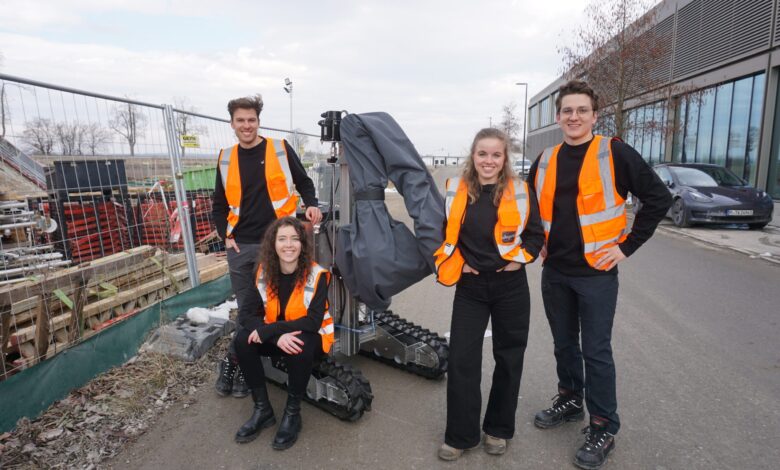
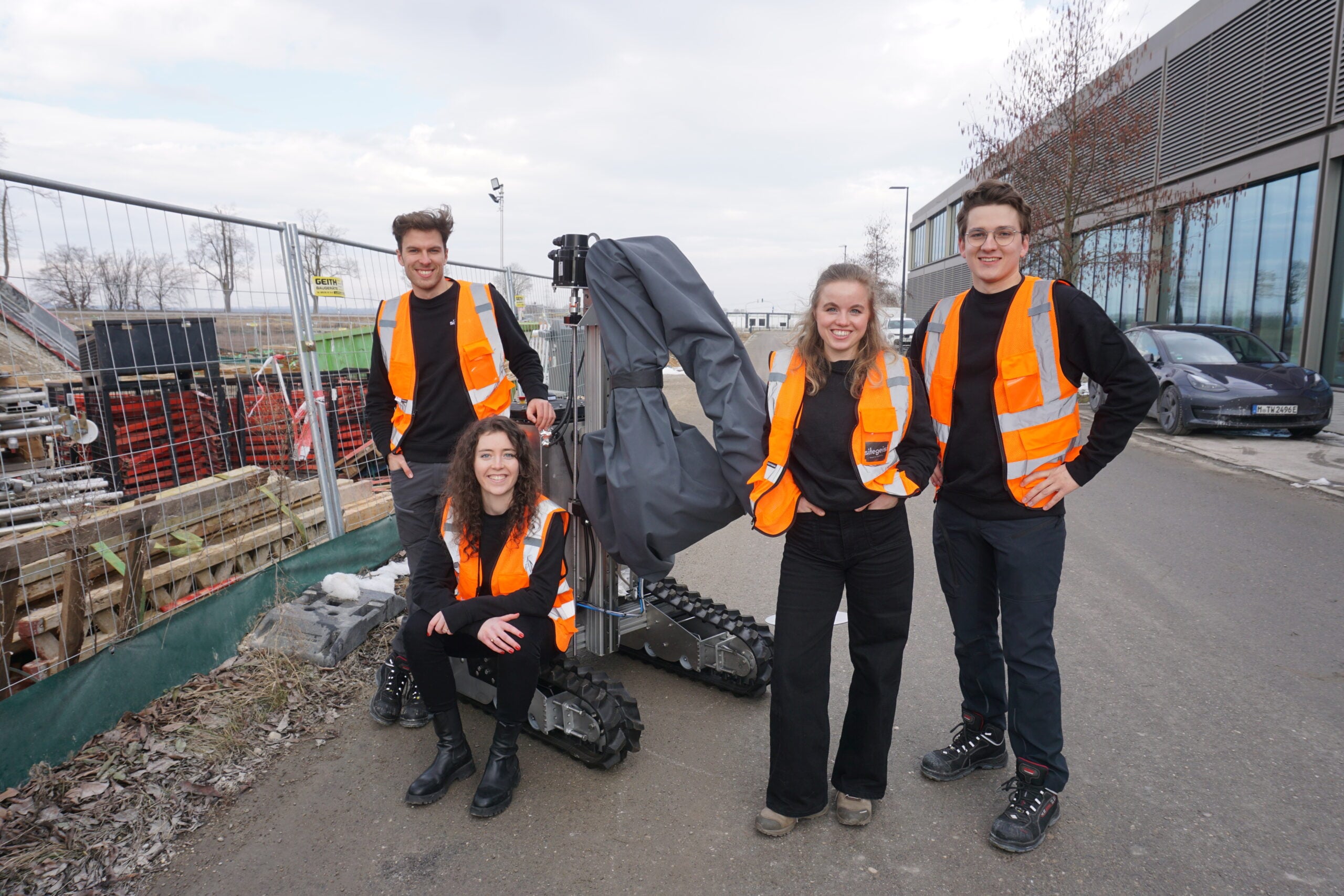
Anyone who doesn’t work in construction rarely has a good position on construction sites. Investors, engineers, women – they’re all not that welcome. The site spirit, however, feels differently. They like it in construction. All. Because: He does the worst of the dirty work for them.
He doesn’t complain or grumble and – best of all for the boss: he doesn’t need a break either. Because the Sitegeist is a robot that can carry out concrete demolition work. He removes dilapidated concrete with a high-pressure water jet, for example from bridges that need to be renovated, in parking garages or tunnels.
Because it requires an enormous amount of pressure, 3000 bar, this work is extremely strenuous. At the same time, you have to work very precisely and not remove too much concrete or in the wrong places. This work requires a lot of experience and there are complex safety regulations. In short: Concrete removal is not only extremely unpopular in construction, but there is often simply a lack of skilled workers to do it.
Impulse from practice
Concrete renovation is one of the biggest pain points in the construction industry, explains Lena-Marie Pätzmann, co-founder and CEO of Sitegeist. And that’s exactly why a construction company approached the chair for “Robotics, Artificial Intelligence and Real-Time Systems” at the Technical University of Munich a few years ago. And the question is: Can’t you do something about it? For example, couldn’t you build a robot to do this pig job?
A professor in the department, the engineer Matthias Althoff, found this an exciting question and wrote it out as a research project for a bachelor’s thesis. And Julian Hoffmann set about doing that. It turned out that such a robot is not only technically possible, but also makes economic sense. In this case, man hours are more expensive than robot hours. And so the thing with the concrete demolition robot was not just a successful university project, but a rock-solid startup idea.
Read too

In the summer of 2025, Julian Hoffmann and his fellow students Claus Carste and Nicola Kolb implemented the idea and founded Sitegeist – together with Lena-Marie Pätzmann. The team was looking for her: “At a hackathon at Google, Claus and Julian came up to me directly and asked me if I could help them prepare the applications for the Exist research transfer,” says Pätzmann. “The two of them really fascinated me with their directness.” As CEO, the St. Gallen graduate primarily takes on the business management part of the founder’s tasks.
Of course, and above all, this includes fundraising – and that has already worked. Just six months after being founded, Sitegeist has just completed four million euros in pre-seed financing, led by the VCs b2venture and OpenOcean and with the participation of the UnternehmerTUM Funding for Innovators fund as well as renowned business angels such as Verena Pausder (also a St. Gallen alumna) and Lea-Sophie Cramer.
Robots made in Munich
The fact that Sitegeist is based in Munich is not particularly surprising. Munich is Germany’s number one robotics hotspot. The list of well-known robot startups based here is long: For example, there is the robot unicorn Agile Robotics. Or Robco, a startup that makes modular robotics hardware and software (aka “Physical AI”) for autonomous industrial automation and just raised 85 million a few weeks ago. Or in the defense sector: Arx Robotics – they are also building a type of robot in the Munich area. Filics makes robots for warehouse logistics, Kewazo Baurobotic.
Read too

The list of – still – unknown and very young robotics startups from the Bavarian capital is even longer: in UnternehmerTUM’s Robotics Venture Lab, founders are currently working on robots for people in mental distress (Navel Robotics) or ones for home care (Devanthro).
MIMRI does it
Those who work on their robot startups here say that it is clear that so much is happening in the area of robotics on the Isar, at TUM. And at MIRMI, the Munich Institute of Robotics and Machine Intelligence, an integrative research institute and part of the Technical University of Munich.
Scientists who are leaders in their fields have been researching and working there for decades: Prof. Dr.-Ing. Sami Haddadin, for example, Executive Director of MIRMI and Chair of Robotics and Systems Intelligence. He is considered one of the most prominent robotics researchers in the world, particularly in human-robot collaboration and the development of robotic fine motor skills.
Or Matthias Althoff, Professor of Cyber Physical Systems, who not only accepted the indirect commission from the construction industry with the impulse to develop a concrete demolition robot, but who also co-founded the startup RobCo in the past – and whom the Sitegeist team describes as its “founding father”.
An example of Physical AI
Of course, Munich didn’t become the robot capital overnight, explains Max Pohl, Founders Associate at Sitegeist. Robots have been built for over fifty years – they just keep getting “smarter”. Even robots with sensors are not new, but since more and more data is available in companies, could Robots are provided with more and more information. And so they become artificially intelligent.
“Physical AI” is considered THE megatrend of 2026. It was also often talked about at the World Economic Forum in Davos: artificial intelligence will leave the screens and move into bodies and machines. It combines perception, for example via camera, lidar, sensors or microphone, with autonomous decisions, using machine or deep learning, and subsequent actions.
Read too

The Sitegeist robots are an example of such embodied AI. Or more precisely: you are on the way there, the startup is still in its early stages. The construction site robot has to overcome a major challenge: no two construction sites are the same. In contrast to a robot arm installed on the production line, which is in a clearly structured environment and a repetitive process, it has to find its way around in different environments. Sitegeist must “see” and derive actions from what it sees.
In addition, it needs the ability to overcome uneven terrain, it must be able to withstand the high water pressure, but at the same time it must not be too heavy (not to forget: it must be able to drive over concrete that needs to be renovated, i.e. broken bridges and ceilings.)
Five Sitegeist models have now been created in their Garching workshop. Each one is better than the last, says Pätzmann. Because: The team always tests its prototypes on real construction sites on behalf of private construction companies.
“We are now entering the phase where we are making the robot robust,” explains Pätzmann. The next milestone after that is CE certification. “To do this, however, it must reach a level of robustness where we can be sure that it can be used productively for several weeks at a time.” The challenge is not just that the robot can withstand the harsh construction site environment. Above all, it is crucial that it delivers high-quality and reproducible results even under conditions in which even a human can hardly recognize anything. “Serial production is only the goal after the next round of financing or the one after that.”