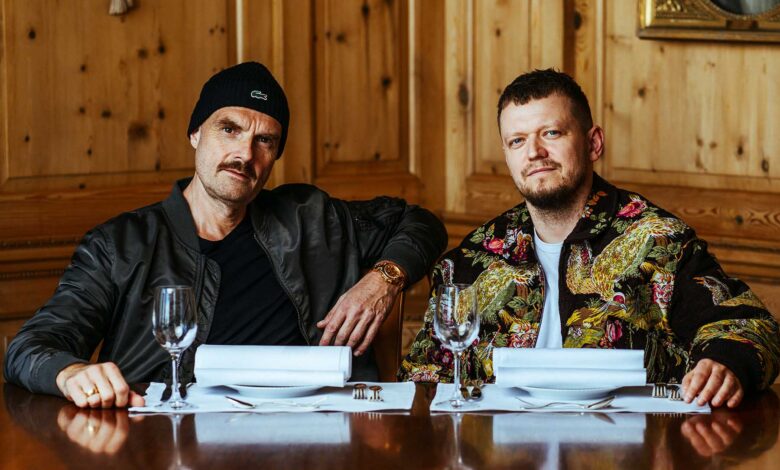
“Do you have 30 minutes?” – Founders and investors often get this kind of news on Linkedin. Our podcast “Royal GS” is about what’s annoying about networking and what works.

“You don’t need to network if you have something awesome to show,” the latest one starts with this steep thesis from Nikita Fahrenholz Podcast episode by Royal GS. And it is deliberately provocative. Because what many people understand as networking, i.e. indiscriminate connecting, cold messages, artificial closeness, is more of a vanity thing, they say Fahrenholz (Founder of Delivery Hero & Fahrengold) and Martin Eyerer (Ex-CEO Factory Berlin, entrepreneur, techno DJ).
Listen to the episode here: Spotify and Apple Podcast
Audio player not available
In order to display embedded audio content, your consent, which can be revoked at any time (via the switch or via “Revocation tracking and cookies” at the bottom of the page), is required for the processing of personal data. Data can be transferred to third countries such as the USA (Art. 49 Para. 1 lit. a GDPR). By switching to “on” you agree. You can find further information in our data protection declaration.
But behind the polemic there is a serious question: Do you really need a network if you are “just good”?
The honest answer from the two hosts: Yes. But only if you understand what networking really means – and what it doesn’t.
Successful entrepreneurs invest 6.5 hours per week
A study that Eyerer subsequently cites comes to the conclusion: Successful entrepreneurs network on average 6.5 hours per week. This corresponds to almost a whole working day.
But: The study also shows that the benefits do not increase infinitely with the time spent. At some point saturation is reached.
Anyone who just takes will be thrown out
One of the central learnings of the episode: A good network is not a transaction space. “I give you something so that I can get something back from you” – that’s not how it works, according to Eyerer. Anyone who thinks like that will quickly be sorted out. The most important currency is trust.
That means specifically:
- Don’t just let us know when you need something
- Respect each other’s time
- Do not exploit resources
- Also give it ten times before taking it once
An example from Eyerer’s practice: According to Eyerer, anyone who constantly asks for favors, for example for guest lists, intros or recommendations, is not only burning their own reputation, but also that of others. Good networkers always consider the perspective of their counterparts, he says.
Or to put it another way: Anyone who calls every week will eventually no longer be called back.
The biggest networking mistake: “Do you have 30 minutes?”
And random messages on Linkedin are not the best way to network. Almost every founder and investor knows them: the Linkedin messages without salutation, without context, without advance payment. Fahrenholz receives about two messages a week along the lines of “Do you have 30 minutes for me and my buddy? We have an idea.”
The problem is not the request, but rather the message behind it. According to Fahrenholz, anyone who asks like that signals that they don’t respect other people’s time. Networking doesn’t start with a request, but with an offer. Fahrenholz and Eyerer agree on this.
Read too

Fahrenholz also gives a positive counterexample: When Fahrenholz was in Milan, he asked in a Linkedin post whether anyone had time for a coffee. A young entrepreneur saw this and wrote him a short message. He offered Fahrenholz to approach him for the meeting. Fahrenholz later found out that the young entrepreneur had come all the way from Firenze. Today he is Head of Events at Fahrenholz. Not because he “networked.” But because he was invested.
Where real networks emerge (and where they don’t)
Another lesson the two entrepreneurs learned: Not every exclusive setting is automatically a good network. For example, private members clubs such as Soho House or China Club should be places where contacts can be made. But only if you use them actively, for example through events or targeted presentations.
But there are also other ways you can expand your network. Eyerer and Fahrenholz mention:
- In the gym
- In party work
- On foundation boards
- In voluntary roles
- In sports clubs
- in restaurants
The dark side: belonging as a business model
Eyerer and Fahrenholz also address a larger phenomenon: entrepreneurs who specifically stage exclusive settings such as yachts, villas or private jets in order to create the feeling of wanting to belong. The implicit message is clear: If you want that, you have to invest and spend money. That’s nothing for Fahrenholz, he says. According to Eyerer and Fahrenholz, such a network is simply not sustainable.
Read too

Linkedin: unloved but unavoidable
And the two also have an opinion about Linkedin itself: Eyerer doesn’t think much of “Open to network” badges. That tends to put him off. The two use Linkedin for networking to find relevant contacts, identify experts or prepare intros.
This is the central insight for both of them: networking in itself is not the problem, but opportunism is. However, if you understand that relationships are long-term investments, you build an asset that should make the difference in crucial moments.
Read too

All episodes at a glance
Audio player not available
In order to display embedded audio content, your consent, which can be revoked at any time (via the switch or via “Revocation tracking and cookies” at the bottom of the page), is required for the processing of personal data. Data can be transferred to third countries such as the USA (Art. 49 Para. 1 lit. a GDPR). By switching to “on” you agree. You can find further information in our data protection declaration.