There’s something quietly magical about transparent furniture. Glass and polycarbonate, with their shifting surfaces and delicate light play, bring a kind of poetry into a room.
In Vincent Van Duysen’s Optô collection for WonderGlass, molten glass becomes a canvas for light, full of circular cutouts and clear tubes that draw the eye and invite touch.
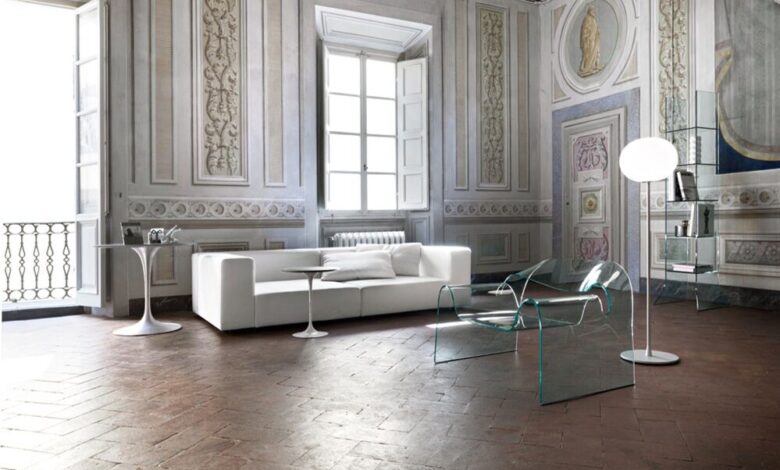
Cini Boeri’s Ghost chair for Fiam is unforgettable – an armchair made entirely of glass, soft in form and spirit, even as it almost disappears into its setting.
Mac Stopa’s Coral Beach table turns embossed glass into the echo of a shoreline, rippling, and fluid. Patricia Urquiola’s Shimmer pieces catch the light like oil on water, while Michael Anastassiades’ Kazimir shelving uses acid-etched glass to carve out space with a kind of quiet grace.
The Bow table by Massimo Castagna for Tonelli Design is more sculpture than furniture, its thick glass base catching light like frozen fabric.
Then there’s Jacopo Foggini for Edra: A’mare, a love letter to the sea, made of translucent polycarbonate rods, and Margherita, a swirling hand-formed chair that feels like it grew rather than was built.
Finally, Philippe Starck’s Louis Ghost and the Bouroullecs’ Papyrus for Kartell reimagine old-world elegance with plastic and light, giving us new classics that feel fresh and full of character.
Optô Collection: Glass with Soul

Optô by Vincent Van Duysen turns raw glass into something emotional. The name comes from ancient Greek and means “to see” – fitting, as the whole collection is about transparency and perception. Tables and screens are made from thick, molten glass panels with smooth circular holes and delicate glass tubes running through. The light moves across them like water. The result is calm but never cold: two tables, one curved screen, and a sense of openness that doesn’t cut the room in half.
Ghost Armchair: The Invisible Icon

Cini Boeri’s Ghost, created for Fiam in 1987, is a glass armchair that somehow feels soft. Generous and entirely see-through, it has an intimacy that draws you in. It slips into any space without trying, yet holds its own like few pieces can. It won the Compasso d’Oro for lifetime achievement in 2022 and now sits in major museums like MoMA – but more than anything, it shows how glass can be personal.
Coral Beach Table: Glass That Moves

Mac Stopa’s Coral Beach table captures a fleeting moment – that shimmer where sea meets shore. Made with high-temperature embossed glass, the surface ripples and shifts. It’s sculptural but light, strong but lyrical. Traditional craftsmanship meets 3D printing, and the result is a table that feels alive, not static. Metal legs keep it grounded without stealing attention.
Shimmer: Light That Dances

Shimmer, by Patricia Urquiola for Glas Italia, doesn’t just reflect light – it changes with it. Made from laminated, glued glass with a special iridescent finish, each piece shifts color depending on your angle and the time of day. Round, oval, rectangular – every version feels like it’s hovering just above the floor. Imperfections on the surface aren’t flaws, they’re part of the charm – like brushstrokes in a painting.
Kazimir: Quiet Geometry

Kazimir by Michael Anastassiades is less a bookshelf than a quiet architectural gesture. Made from acid-etched or extra-clear glass, its finish is soft and muted. The texture reduces glare, making the shape feel almost velvety. Invisible UV bonds keep everything clean and solid. It can be used against a wall or left free-standing – even upside down. Empty, it still fills a space with presence.
Bow: A Table That Holds Light

Bow by Massimo Castagna for Tonelli Design is glass doing something it shouldn’t: feeling heavy and light all at once. The top is clean and crisp in clear, smoked or bronze glass, but it’s the base that pulls you in – thick slabs of fused glass with deep textures that bend light like a prism. Steel elements and visible joints are part of the story. It’s bold, unapologetic, and made to be seen.
A’mare: Floating Furniture

A’mare by Jacopo Foggini is furniture that seems to float. Inspired by the sea and named with a clever play on words – “to love” and “at sea” – the line includes chairs, tables, loungers, and benches. Each piece is made from translucent polycarbonate rods, screwed together in a way that looks fragile but isn’t. There’s a softness to them, a glow, a sense of movement even when still.
Margherita: A Chair with a Heartbeat

Margherita, also by Jacopo Foggini, is made by hand, and you feel that in every curve. Built from swirling strands of transparent polycarbonate, it catches light like spun sugar. The high back curves around you, resting on a swivel base in brushed steel – gold, palladium, or ruthenium finish. Each chair is unique, a sculptural presence with just enough mystery to hold your gaze.
Ghost: A Classic Reborn

Starck’s Louis Ghost, designed for Kartell in 2002, is all about contrast: old shapes made new, delicate looks with tough performance. The clear polycarbonate gives it lightness, but it’s strong, stackable, weatherproof. Inspired by the Louis XV style, but stripped back to its essentials, it suits any setting – from grand to minimal – and always feels current.
Papyrus: The New Tradition

Papyrus, by Ronan and Erwan Bouroullec for Kartell, reworks the woven chair into something leaner and more poetic. Made from transparent or tinted polycarbonate, it has soft arms and a curved back with fine vertical lines running through. The texture hints at rattan, but keeps things clean and modern. Stackable, waterproof, and made to last, it brings a light touch to any setting.
Read more:
Last Updated on January 28, 2026 by Editorial Team