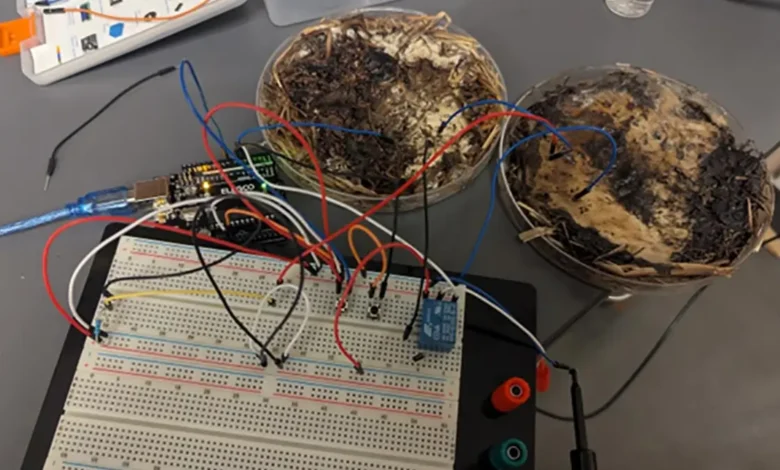
US researchers have developed a living computer system. The background is hardware components made from mushrooms that can process and store electrical information.
Scientists at Ohio State University have developed hardware components for computers from fungi. Their research shows that so-called mycelium networks can process and store electrical information. In doing so, the experts are charting a course for low-energy computer architectures.
Researchers John LaRocco and Qudsia Tahmina published their study in the journal PLOS ONE. They use mycelium networks as the basis for bioelectric components. These memristors process data by maintaining the state of past electrical signals. The result is a system that functions like a biological memory.
Living computers powered by mushrooms
The researchers cultivated common shiitake mushrooms and champignons. Once the mushrooms were ripe, they dehydrated the material. This step is intended to ensure the long-term stability of the organic components. The dried mycelium was then connected to electronic circuits and probes.
Because the electrical properties vary, the researchers created multiple junctions between the fungus and the probe. Because: DA’s mycelium specifically exposed different voltages and frequencies. The scientists observed how the material responded to the electrical stimulation. The system showed measurable memory effects that are similar to conventional semiconductor chips.
After a test phase of two months, the system demonstrated its technical properties. The memristor switches at a speed of up to 5,850 signals per second. The hardware achieved 90 percent accuracy. Although the performance decreased at higher frequencies, the researchers found a solution.
Hardware from mushrooms
They fixed the problem by connecting additional mushrooms to the circuit. This principle is based on the networking of a real brain. Qudsia Tahmina explains that this technology can be scaled due to its flexibility. In the future, larger systems could take on tasks in edge computing or space research.
One advantage lies in the environmental compatibility of the biological hardware. While conventional chips often require rare earths, mushrooms grow with comparatively little effort. At the same time, they cause less electronic waste because they are biodegradable.
LaRocco explains that all that is needed for initial experiments is a compost heap and simple home electronics. In the future, factories could produce this organic storage on a large scale. However, researchers still need to make the memristors significantly smaller in order to make them competitive with current technology. Research is just beginning, but nature offers the necessary resources.
Also interesting: