TechTicker Special: Cambridge introduces cool new streaming speaker L/R in three sizes and many colors | News

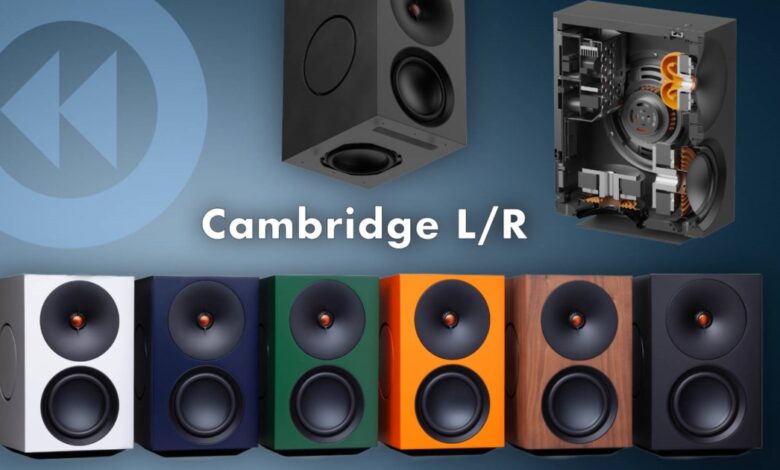
 Cambridge Audio, which recently only went under the “Cambridge” label and is one of the few well-known medium-sized British hi-fi brands that are still in private hands, is starting the new year with a surprise. The company is best known for its fairly priced and, above all, always outstanding audio components and headphones. For example, the Melomania P100 over-ear headphones delivered an outstandingly good result in the REWIND test for their list price of 279 euros. And the CXN100 streaming DAC preamplifier also impressed with its capabilities in the test.
 The fact that Cambridge is now coming onto the market with its first active loudspeaker is remarkable in several ways. On the one hand, it is quite courageous to enter a market today that is populated and dominated by many competitors with years of experience in this field. This is also a bold but also daring step in view of the success of small smart speakers à la HomePod and WiiM Sound.

Apart from that, such a step from a manufacturer that has made a name for itself with a particularly good price/sound ratio raises hope for a possibly superior loudspeaker concept at an affordable price. For this reason, it is definitely worth taking a closer look at the new offer.
Cambridge L/R – The name says it all
Let’s start with the name of the series: “L/R”. This unmistakably represents the principle of using two loudspeakers required for stereo playback. One left and one right – L/R. This also tells us that the new speakers in their currently announced form are probably not designed for surround applications and cannot be expanded to 5.1 or more. Stereo rules! Personally, I think it’s absolutely ok, as I said goodbye to the box and cable-intensive surround universe a good quarter of a century ago and am very happy with good old stereo. Experiments with “immersive” sound systems are always interesting and there are always advances in this area, but in addition to the effort involved in hardware and cabling (which also affects costs and space in the living room), it is above all the always proprietary sound formats that often prove to be a “dead end” in the long run.
The L/R series from Cambridge starts with three models. In addition to the sheer size and performance, there is above all a significant difference: The smallest model L/RS is primarily designed for desktop or similar applications. This speaker does not have an integrated streaming function, but is supplied with music from a Mac via USB or Bluetooth, for example. The medium and large models (M and Including HDMI eARC and MM phono stage.

Cambridge’s fourth-generation StreamMagic module supports direct streaming via Tidal Connect, Spotify Connect Lossless, Qobuz Connect, Amazon Music, Deezer, Roon Ready, UPnP and Internet radio, as well as use in multiple rooms via Google Cast or Apple AirPlay 2. The connection between the two speakers of a stereo set can be established either via USB-C or wirelessly according to the WiSA HT standard.
Another crucial difference between the Model S and the larger Models M and X is the driver configuration and the acoustic concept in general.
The special features of the L/RM and L/RX models
For the L/RM and L/RX, Cambridge promises nothing less than “the dynamics and sound quality of a floorstanding speaker”. To achieve this, the British use two bass-midrange drivers with 2.5-way circuitry, which are supported by passive radiators on the sides. The drivers were specially designed for the Cambridge Audio L/R series and match the color of the housing. The side radiators (diaphragms without their own drive, which are stimulated by the sound pressure changes in the closed interior of the housing and which essentially take on the function of a bass reflex opening), are larger than the active bass drivers, which is intended to ensure particularly clean and deep bass reproduction. In any case, flow noises such as those with bass reflexes cannot arise.

The crossover is completely digital. This also means that analog sources such as phono are always digitized first. Analogue purists will be less happy about this, but they aren’t necessarily the target group of the L/R series. Six power amplifiers per stereo set control the chassis. These add up to a total output of 150 watts RMS per channel, with the largest L/RX model even reaching 400 watts.

The new torus tweeters (torus stands for the ring-shaped shape of the sound dissipation behind the membrane, see pattern) were developed specifically for the Cambridge Audio L/R. Each model is equipped with a waveguide that is specially tailored to the geometry and is intended to ensure particularly harmonious propagation of sound waves in space and holographic imaging. The L/RX in particular can also be used in larger rooms, says Cambridge.

The special features of the L/RS
The small L/RS boxes are designed as a particularly affordable and uncomplicated solution for desktops, shelves or other locations with little space. They also have a closed housing, but do not have passive radiators, which means they can be easily integrated into shelves. The downfire bass found in the larger models also doesn’t seem to be available here, which would also explain the slightly different foot designs (see picture of the three models in Racing Green above). Thanks to Class D amplification optimized by the manufacturer with a total output of 100 W RMS, the stereo set should deliver a transparent, spatial and yet full-fledged sound. – In marketing words.

Wireless playback to the master box is possible via Bluetooth with aptX HD codec (assuming an aptX-compatible source – Apple doesn’t). Wired sources can be connected via analog input (is digitized), USB and optical Toslink. With its compact dimensions and the housing available in six different colors, the L/RS brings premium sound to every desk and into smaller living spaces – that’s the manufacturer’s promise. If there are higher bass and maximum level requirements, an external subwoofer can also be docked here. A remote control app via Bluetooth enables sound adjustments taking into account the placement and listening position thanks to customizable equalizer presets.
assessment
To leave the church in the village: There are no unprecedented and revolutionary technical concepts to be discovered here, which is why I don’t want to raise my expectations too high. Cambridge Audio also only cooks with water. Nevertheless, the name alone makes you curious about initial listening tests, because the British have proven themselves to be very competent more than once when it comes to sound coordination.
But of course such concepts are always about the practical aspects. It remains to be seen whether the streaming models M and X somehow offer more comfort than competitors such as the KEF LS/LSX. After all, the StreamMagic app proved to be above average in the test with the Cambridge streamers. The connection options and variety are similarly positive. But so do the practical limitations that come with it. Such as the fact that in a living room setup, in the worst case scenario, many cables have to be laid up to the master. Concepts with a central streaming hub outside the speakers often prove to be superior. However, experience shows that only a relatively small proportion of users connect more than one wired source. The question of how responsive and reliable the system will be also remains open. For example, when master and slave are connected to each other via radio.
By the way, the speakers aren’t available that quickly yet. This is basically just a technology preview. The market launch of the small L/RS is expected in March or April. The M and X models will probably not arrive until autumn. A test of the small and later the medium model is planned.
The prices are as follows:
- Cambridge Audio L/RS: 499 euros (all lacquers), 549 euros (real wood veneer walnut)
- Cambridge Audio L/RM: 1399 euros (all lacquers), 1499 euros (real wood veneer walnut)
- Cambridge Audio L/RX: 1999 euros (all lacquers), 2099 euros (real wood veneer walnut)