


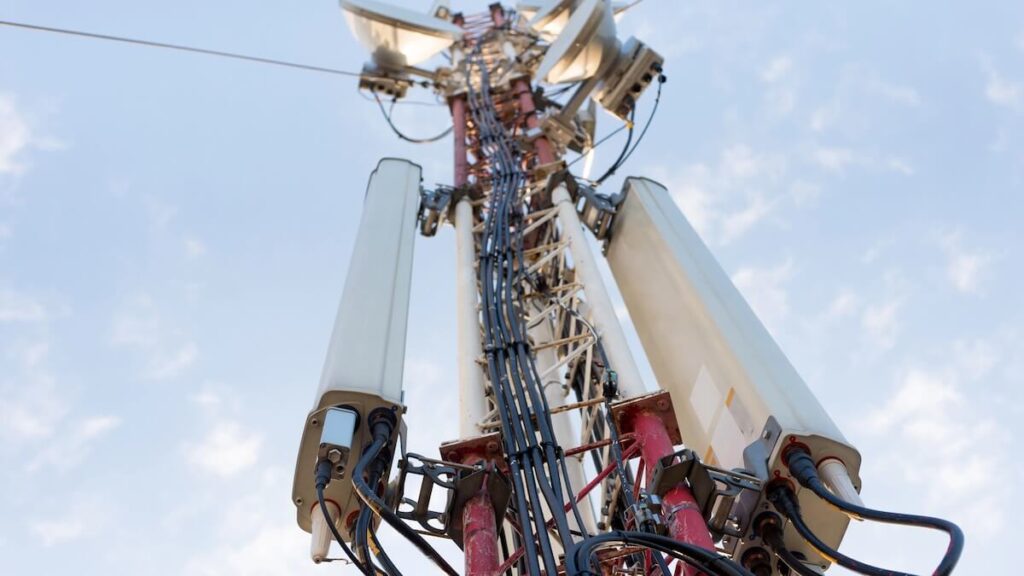
The EU and the federal government are pushing forward the development of 6G. From 2030, the new mobile communications standard should not only transmit data, but also be able to record the surroundings using radar. Data protection advocates are already warning against complete surveillance, in which even people without smartphones could be recorded. A 6G apocalypse and a dispute over scarce frequencies also appear inevitable. A commentary analysis.
What is 6G?
- The federal government and the EU are in 6G fever. The European Commission is working on establishing 6G as a new mobile communications standard and preparing Europe to be independent when it comes to the next digital infrastructure. The aim is to 6G to be deployed by 2030to enable significantly higher data rates, lower delays and greater networking of devices. The technology is expected to become particularly important for applications such as AI, autonomous vehicles, robotics and the connection of mobile communications with satellite networks. Unlike previous generations, 6G is not just about faster smartphone internet, but about a digital infrastructure for a networked industry and society.
- With the planned introduction of 6G, mobile communications is facing an epochal change. Data protection officer however, warn of significant risks. In the future, 6G will not only be able to transmit data, but also be able to record the environment using Integrated Sensing and Communication (ISAC). Researchers at the Barkhausen Institute in Dresden have been working on technical solutions for years to make the technology safe, trustworthy and data protection compliant. Meanwhile, critics argue that the upper 6 GHz band for Wi-Fi in combination with fiber optics could fundamentally bring greater immediate benefit.
- ISAC is considered one of the key technologies of 6G. Mobile networks are no longer just used for communication, but can also be used as a result simultaneously capture their surroundings. The technology can be used to detect vehicles, locate drones, monitor production facilities or support rescue operations without any additional technical effort. However, these opportunities also give rise to new risks. Because unlike before, future 6G networks can Capture people’s movements or information – even if they don’t use a device. The independent federal and state data protection supervisory authorities are therefore calling for data protection and the protection of fundamental rights to be taken into account during development.
The jack of all trades 6G
5G has barely arrived in everyday life politicians and industry are raving about it already from 6G. Many of the promised advantages of the new mobile communications standard, such as autonomous driving, a European satellite network or digitized cities and industries, are only beginning to be recognized.
The wet 6G dreams of politics and business are therefore primarily future fantasies, which unfortunately often come to fruition sell better than reality and everyday life. Admittedly, the potential of 6G is enormous because it is not just about transmitting data, but about networking different technologies with each other. But the risks are at least equal.
Or: What could go wrong with a new visionary mobile communications standard that plugs AI agents and radar signals directly into the network to analyze objects, signals and movements? I’ll keep it short: 6G is a jack of all trades!
Because it’s as if AI companies have already driven out the devil of errors in their agents and chatbots, which is currently the case one data protection nightmare after another out of a hat, politicians and the industry are talking about a mobile phone standard that is supposed to do everything – but probably not do anything right. Clearly, a timely look into the future and appropriate preparations are essential.
But the more tasks 6G is supposed to take on, the more complex the new mobile communications standard will become – and with it also its susceptibility to errors. There is great potential behind all the big visions. But many people haven’t really thought through 6G yet. Not even with the scarce radio frequencies that both mobile and WLAN providers rely on. Not to mention data protection.
Voices
- Dorothee Bär, Federal Minister for Research, Technology and Spacediscussed the federal government’s plans at the end of 2025: “Today’s research creates the basis for value creation and technological sovereignty of tomorrow. We want to be one of the technology leaders in 6G. The new mobile communications standard has the potential to redefine our technological ecosystem, with enormous leaps in performance, security and sustainability. It is now important to set the strategic course, because 6G is an important innovation driver for Germany.”
- Tobias Keber, State Commissioner for Data Protection and Freedom of Information Baden-Württemberg and chairman of the Data Protection Conference 2026, warns in a statement: “If potentially every mobile device receives a radar function and, in conjunction with the respective base station, can scan and perceive people and objects in the room, there will hardly be any rooms in which we can be unobserved. We should therefore regulate the use of this new technology, enable what is sensible and exclude what is dangerous.”
- Lisia Mix-Bieber, Head of Federal and European Policy at the Federal Association of Broadband Communications (BREKO)criticizes the plans: “The fact that the federal government wants to reserve the valuable frequencies in the upper 6 GHz band exclusively for mobile communications is based on a fatal misjudgment and is a bitter disappointment for Europe as a digital location. Instead of strengthening free Wi-Fi use and efficiently bringing the bandwidths possible thanks to fiber optics to all mobile devices, reserving the frequencies would be of no short-term benefit to the mobile phone companies and in the long term, if at all, would marginally improve network coverage in metropolitan areas.”
When is 6G coming?
6G is absolute music of the future! It will probably be at least five years before the mobile communications standard really becomes part of everyday life. Absurd: While politicians and industry are already looking forward to the future, existing problems such as fiber optic expansion or the digitalization of administration have not yet been solved. There are also still unfilled dead spots.
Many systems are still far from functioning autonomously. In other words: the basics of 6G are missing everywhere. It is all the more pleasing that, above all, independent ones Institutions are already keeping an eye on the issue of data protection have. What is also lost in the political debate: 6G cannot simply be implemented at the push of a button or update.
On the contrary: new antennas, radio masts, computing capacities and network infrastructure are needed Billions and a lot of time become. Of course, it makes sense to work on the next generation of mobile communications early on. But this must under no circumstances be at the expense of current construction sites.
For industry, 6G may be an investment in competitiveness and the future. For the average consumer, however, the added value remains manageable. It is still likely that the technology will prevail in the long term. More exciting than the question of whether 6G will come is the how and the question of what the technology will actually be used for.
After a 5G apocalypse that was conjured up in many places, but which never happened, sadly it also seems to be the case with 6G Conspiracy theories are already inevitable to be. Maybe something with mind control or artificial diseases to reduce the population? Let’s see how this article ages.
Also interesting: