


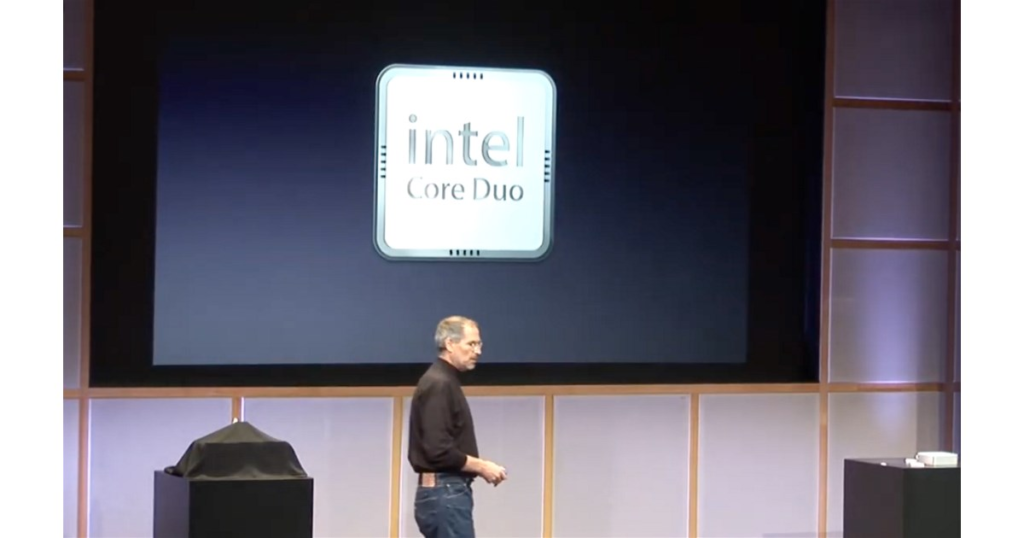


However, the demonstration didn’t end there, because Jobs also announced a Core Duo with two cores – the performance would take off into the stratosphere, according to the then Apple CEO. According to SPECint, compared to the G4 processor, the Mac mini achieves 4.8 to 5.5 times more performance without the need for any adjustments to the casing. All of these were sensational values that significantly enhanced the value of the Mac mini. The price of the basic model rose from $499 to $599; for the dual processor you had to spend at least $799.

No real graphics card, “just” chipset graphics
However, another decision caused considerable criticism. While the previous Mac mini boasted that, unlike other manufacturers of compact devices, they used a real graphics card, Apple only installed an integrated chipset graphics (GMA950) in the Mac mini with an Intel processor. Although the somewhat outdated ATI Radeon 9200 was extremely weak, it still had at least 32 MB of dedicated video memory available. The GMA, on the other hand, had to access the normal RAM (shared, but not unified memory like with M-Macs) at a lower bandwidth. Practical tests revealed an inconsistent picture: games often ran worse, system/program interfaces were much smoother thanks to “Core Image” hardware support. However, many people didn’t like the decision because the perceived value of the graphics unit decreased.
Introducing the “iPod Hi-Fi”
There was another product presentation at the small Apple event. In 2006, one would have believed that “iPod” as a brand would help every product be successful. However, in at least one example this was clearly not the case. The iPod Hi-Fi was a sound system with an integrated iPod dock – but there was no wireless connection or USB playback. At a price of $349, there were only a few buyers. The soundbox only remained on sale for a year and a half before Apple confirmed the discontinuation of the project in autumn 2007.

