


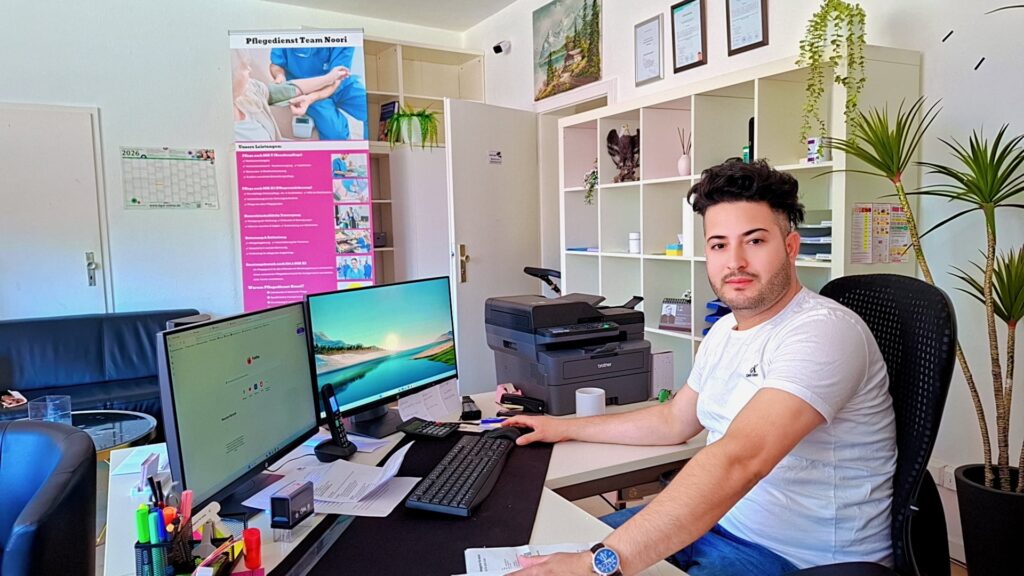
Fahim Noori fled Afghanistan in 2015. Today he employs 17 people – but he still can’t get a permanent residence permit.


In Celle, Fahim Noori runs a nursing service with 17 employees. He speaks perfect German, pays taxes and, according to his own statements, earns around 80,000 euros in profit a year. Nevertheless, to this day he has not received a permanent residence permit. How can that be?
For Noori, this has very concrete consequences: banks have a hard time with loans, as do leasing companies. The 34-year-old would like to further expand his nursing service. The demand is there. He would hire new employees immediately. But bureaucracy, of all things, is slowing him down.
Entrepreneur – and still no permanent right to stay
Noori would actually like to become a German citizen. But in Celle, naturalization procedures currently take around two years. A spokeswoman admitted this in response to our request. The immigration authorities are considered chronically understaffed.
That’s why Noori doesn’t even try naturalization. As an entrepreneur he doesn’t have that much time. That’s why he first applies for a settlement permit. But he’s been waiting for this for months.
At its core, it comes down to one question: Can Noori secure his livelihood in the long term? Based on his accounting, he can prove a profit of around 80,000 euros last year. But that’s apparently not enough for the authorities.


Particularly bitter: The office now also wants to see the documents for 2026. Because Noori invested a lot this year, the numbers are much worse, he tells us. Of all things, his investments in further growth could now be construed against him.
Founders in particular have it particularly difficult
As an entrepreneur, Noori cannot prove his income as easily as an employee can with payslips. His economic situation must be assessed more comprehensively and this is exactly what complicates the process.
After completing his training, Fahim Noori was once employed as a nursing assistant, he says. “There was a lot of demand for nursing services, so I wanted to set something up for myself.” Apparently with success. An article in the Cellesche Zeitung on Facebook provides evidence of Noori’s good reputation.


An older woman writes: “I met Fahim when I needed help. I know his story and it’s unbelievable how he fought through it. I’m proud to know him and I sincerely hope that the bureaucracy will get off his back and do what needs to be done very quickly.” Another commented: “For me, he is a prime example of successful integration and lived entrepreneurial spirit.”
From escape to independence
This entrepreneurial spirit is unique to Noori. But he is not without moments of doubt. The escape biography has left its mark. Noori came from Afghanistan in 2015. The current problems “seem like nothing” to him when he compares them to his previous ones: initially, his application for asylum was rejected. The result: Noori suffered from depression. He fought back with psychotherapy. He was allowed to complete his training and later received asylum.
“I see every problem as an opportunity,” he says. “It’s about the will, about sticking with it.” His current residence permit expires in mid-August. Germany is unlikely to deport him. Instead, he is likely to receive a temporary residence permit again. Again for three years.
Bureaucracy slows growth
But the time limit stands in the way of his entrepreneurship. He needs a loan from the bank so that the nursing service can continue to grow. There are inquiries from potential customers, Noori would like to hire even more people. But he also needs cars for the employees. And as a man with a temporary residence, it’s just as difficult for him to lease it.
Fahim Noori’s case is particularly difficult. But it is an example of how overwhelmed the German administration is. This has long been criticized in politics and the startup scene.
“Roll out the carpet” for talent
“Anyone who builds an existence here, employs people and pays taxes must not fail because of overburdened authorities,” says Green Party member of the Bundestag Katharina Beck to Gründerszene. The incumbent government has promised a lot: “a company can be founded within 24 hours, a one-stop shop for all administrative procedures, and particularly important for better start-up immigration: a digital work-and-stay agency for skilled workers. But so far nothing has happened.”
The head of the startup association, Christoph Stresing, says to Gründerszene: “Even though there have already been significant improvements in the legal framework with the Skilled Immigration Act 2020 and its further development in 2023, the administration in our country still finds it too difficult to apply it. More than 500 immigration authorities make uniform approval procedures difficult.”
Christian Miele, VC partner at Headline-Partner, adds to Gründerszene: “The carpet should definitely be rolled out for those people who also fulfill important tasks and do work where we ourselves do not have enough workers.”
Two-hour hotline for questions about fate
Unfortunately, this cannot be said in Celle. The local newspaper regularly reports on the paralysis of the Celle immigration office and calls for help from politicians. There are no improvements. It’s about the fate of families like Noori’s. And the office shuts down. The telephone hotline is only available on Mondays, from 2 p.m. to 4 p.m. Two hours in a whole week.